
Iraq’s parliament took five months to fill 11 cabinet seats. Prime Minister Ali al-Zaidi was sworn in on May 14 with only 14 of 23 ministries staffed, the minimum needed to form a government; defence and interior, the two ministries that control armed men, sat empty. On Thursday, October 15, with 261 of 329 members present, lawmakers approved the rest: a defence minister, an interior minister, nine other portfolios, three deputy prime ministers, and a brand-new ministry nobody had before, Reuters reported via Al-Monitor and Al Jazeera.
The delay is the mechanism, not a bug in it. Iraq allocates ministries by muhasasa, a post-2003 power-sharing formula that splits cabinet seats among parties roughly in proportion to parliamentary blocs, Shia, Sunni and Kurdish, rather than by portfolio competence. Each seat is a patronage node: a minister appoints directors-general, advisers and contracts within his ministry, so every party with a seat at the table has to agree before a nominee moves. The Arab Center in Washington has documented how this produced more than 5,000 senior civil-service “special grade” posts across Iraqi ministries, roughly 1,000 of them party proxies whose job is distributing state resources rather than running anything. Defence and interior are the hardest seats to fill precisely because they are worth the most: they command the budgets and the chains of command the parties actually fight over.
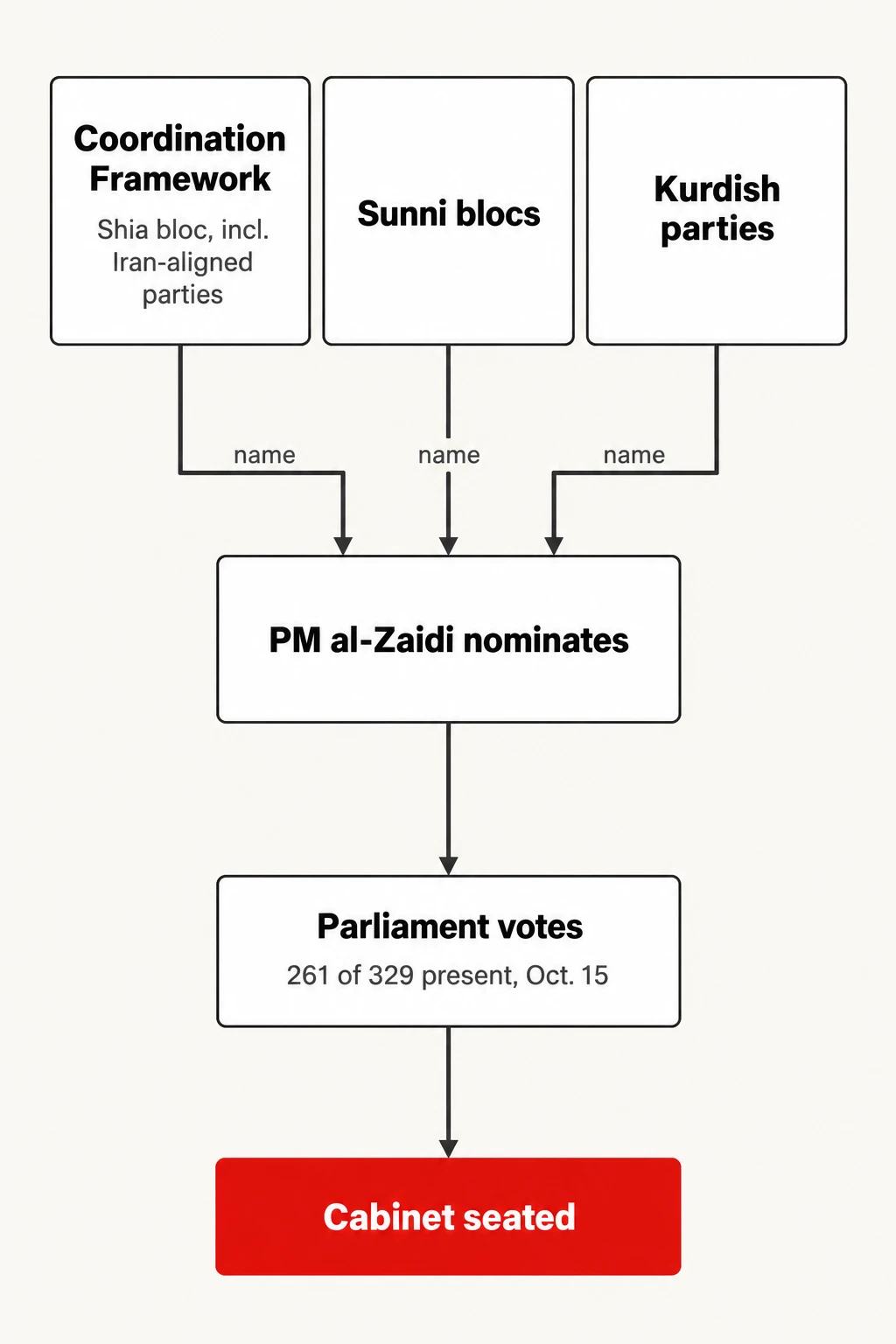
| From | To | How |
|---|---|---|
| Coordination Framework (Shia bloc, incl. Iran-aligned parties) | PM al-Zaidi nominates | name |
| Sunni blocs | PM al-Zaidi nominates | name |
| Kurdish parties | PM al-Zaidi nominates | name |
| PM al-Zaidi nominates | Parliament votes (261 of 329 present, Oct. 15) | |
| Parliament votes (261 of 329 present, Oct. 15) | Cabinet seated |
Nayef al-Shammari takes defence and Yasir al-Maliki takes interior, closing the two posts that had sat vacant since May. Parliament also seated three deputy prime ministers: Mohsen Ali Akbar al-Mandalawi, Mohammed Tamim al-Jabouri, and Laith al-Khazali, a senior figure in Asaib Ahl al-Haq. The US Treasury designated al-Khazali and his brother Qais as Specially Designated Global Terrorists under Executive Order 13224, effective January 3, 2020, according to the Federal Register notice; the State Department named Asaib Ahl al-Haq itself a foreign terrorist organisation the same month, citing attacks on US and coalition forces. The New Region reported that the appointment makes al-Khazali the highest-ranking US-sanctioned official now sitting inside Iraq’s executive. Nine other ministries were filled, covering planning, culture, higher education, housing, labour, youth and sport, and tourism, plus a minister of state.
Parliament also created a ministry that did not exist in May: Digital Economy, Governance, Science and Technology, headed by Mohammed Sahib al-Daraji, per Iraq Business News. Al-Zaidi told parliament the new deputy prime ministers would draw “no salary, financial allowances, or office appointments,” and signalled he would cut the number of government advisers. That is a specific promise against a specific record: Iraqi governments have used adviser posts as unpaid-in-name patronage, and al-Sudani’s caretaker administration was still terminating adviser contracts earlier this year amid disputes over who had been hired, on what legal basis, and at what cost. Whether a newly created ministry, however small its stated mandate, nets out to fewer paid positions than the advisers it is meant to replace is the kind of claim that shows up in next year’s civil-service headcount, not in Thursday’s floor speech.

The five-month gap matters more than it would have in a calmer year because Iraq has spent those five months absorbing the economic fallout of a war it is not fighting. On February 28, the United States and Israel launched a sustained air campaign against Iran, killing Supreme Leader Ali Khamenei and senior regime figures; Iran retaliated against Israel and US facilities across the Gulf and struck tankers in the Strait of Hormuz, the channel that normally carries about one-fifth of the world’s seaborne oil, the IMF said in its October outlook, reported by Al Jazeera. The IMF now projects Iraq’s 2026 GDP will contract by 16 percent, worse than Qatar’s projected 15.6 percent and just behind Kuwait’s 16.7 percent, the three steepest contractions in a region the IMF had expected to grow 1.9 percent before the war started.
Iraq’s own crude exports, 90 percent of state revenue by the finance ministry’s own accounting, fell from more than 3.6 million barrels a day before the war to about 2.34 million bpd in August, recovering only to roughly 2.6 million bpd from southern terminals by late September, Reuters reported. Baghdad’s central bank reserves fell from $106bn to about $80bn by August, Al Jazeera reported, and on October 7 the cabinet devalued the dinar by close to 15 percent, to 1,520 per dollar from 1,320, a move covered in detail here. Al-Zaidi, asked about the devaluation, put it plainly: “I was facing three challenging options to cover salaries.”
| Iraq crude exports (million bpd) | |
|---|---|
| Prewar | 3.6 |
| August 2026 | 2.34 |
| Late September 2026 | 2.6 |
Source: Reuters, via Oilprice.com. September figure is southern (Basra) exports only, not the national total
That is the arithmetic the new cabinet inherits, not one it created. A government that cannot agree on a defence minister for five months is also a government that could not, in that time, present a unified position to the parties still deciding how far to let Iran-aligned armed factions like Asaib Ahl al-Haq operate outside state command, a question this site covered when the US-led coalition formally ended its anti-ISIS mission in Iraq on September 30, removing roughly 2,500 foreign troops who had been one check on exactly those factions. Washington wants the militias dissolved, Tehran wants them kept as leverage, and Baghdad, by putting a Treasury-sanctioned Asaib Ahl al-Haq leader in the deputy prime minister’s chair, has signalled which of those two positions currently has more votes in parliament.
One ministry is still empty: migration and displacement, which parliament could not fill for lack of political agreement, per Al-Monitor. Al-Zaidi still has a 2027 budget to get through parliament, 217 trillion dinars ($166bn) in planned spending against a projected deficit of more than 40 trillion dinars ($30bn), built on an assumption of $58 oil and 4 million bpd of exports, a volume Iraq has not managed since before the war. Whether a full cabinet moves that budget faster than a partial one did the last five months is the number to watch next.