
The American-led coalition deployed to Iraq in 2014 to fight the Islamic State group ended its mission there on Wednesday, closing a 12-year campaign that Iraq’s leaders and President Trump celebrated even as armed pro-Iran factions refused to give up their weapons.
The Pentagon confirmed that the final American troops assigned to the mission had left the country. The withdrawal, set in motion by an agreement Washington and Baghdad reached in 2024, proceeded gradually from bases across Iraq until the American presence was limited to the autonomous Kurdistan region in the north. Iraq’s government called the departure a step in reclaiming sovereignty after two decades of war and foreign intervention.
“This Day is a victory for the United States, a victory for Iraq, and a decisive victory over ISIS,” Mr. Trump wrote in a post on social media. “I had a choice to stay or to leave, and felt, without question, that it was time for America to go home!” He also described the deployment as a “very expensive excursion into Hell,” according to Al Jazeera.
Coalition troops went into Iraq and Syria in 2014 after the Islamic State group seized large stretches of territory, committed massacres and forced thousands of women and children into slavery. The group was defeated in Iraq in 2017 and in Syria in 2019; coalition forces stayed on to fight its remnants. They did not defeat the group alone. Kurdish Peshmerga fighters played a central part, as did Iraqi factions, including pro-Iran groups that have yet to disarm.
The Iraqi government has argued that the withdrawal strips those factions of the excuse they used to keep their arsenals. Many in Iraq fear the opposite: that the pullout will strengthen the factions and pull the country deeper into the regional war.
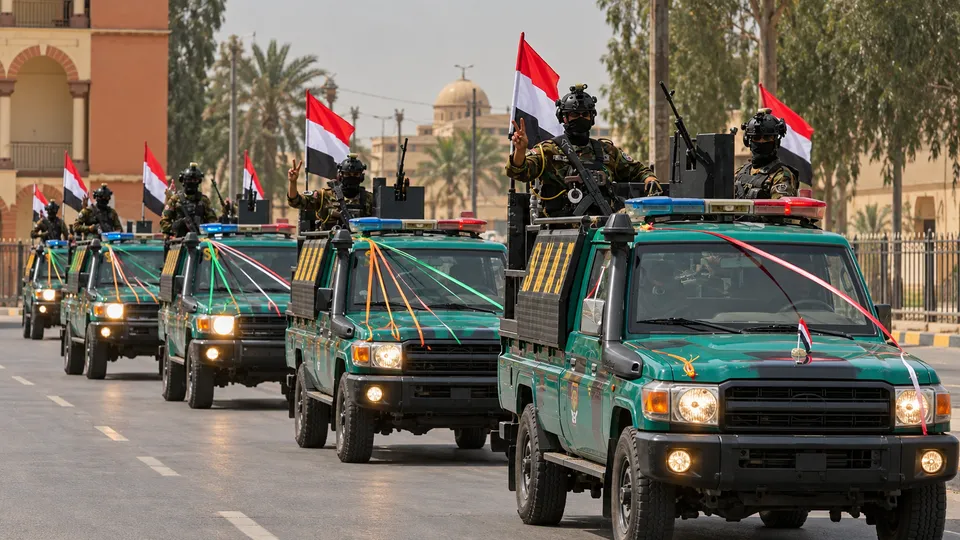
Hours after the pullout was announced, supporters of the pro-Iran groups gathered in a flag-lined public space to celebrate, and leaders delivered speeches from a stage decorated with model drones. A military spokesman for Kataeb Hezbollah said at the event that the factions had been in talks on “regulating” their weapons but “have not yet received a response from the Iraqi government.” They were “not bound by any timeline or agreement,” he said, and kept “the right to directly respond to any American or Zionist violation of Iraq’s sovereignty.”
Prime Minister Ali al-Zaidi of Iraq said “a new phase has begun, defined by Iraq’s sovereignty, the strength of its institutions (and) the readiness of its forces.” Mr. al-Zaidi, who came to power this year with Washington’s blessing, has vowed that the armed factions will hand over their weapons. His government set Sept. 30 as the disarmament deadline, then dropped it while talks on regulating weapons continued.
With several Iran-backed groups refusing to disarm, senior politicians are now seeking a compromise. The factions’ conditions go beyond the withdrawal of foreign troops to include an end to American political and economic interference.
Kataeb Hezbollah called the departure of “the occupation forces ... a start towards achieving full sovereignty” but also warned Mr. al-Zaidi’s government. “A government that doesn’t work for the good of its people will be brought down by all possible means,” the group said.
Pro-Iran factions have demanded an American withdrawal for years, attacking troops with drones and missiles and drawing retaliatory strikes that killed several of their commanders. During the Middle East war that began with American and Israeli strikes on Iran, Tehran and its allied factions intensified their attacks on coalition troops in the Kurdistan region.