
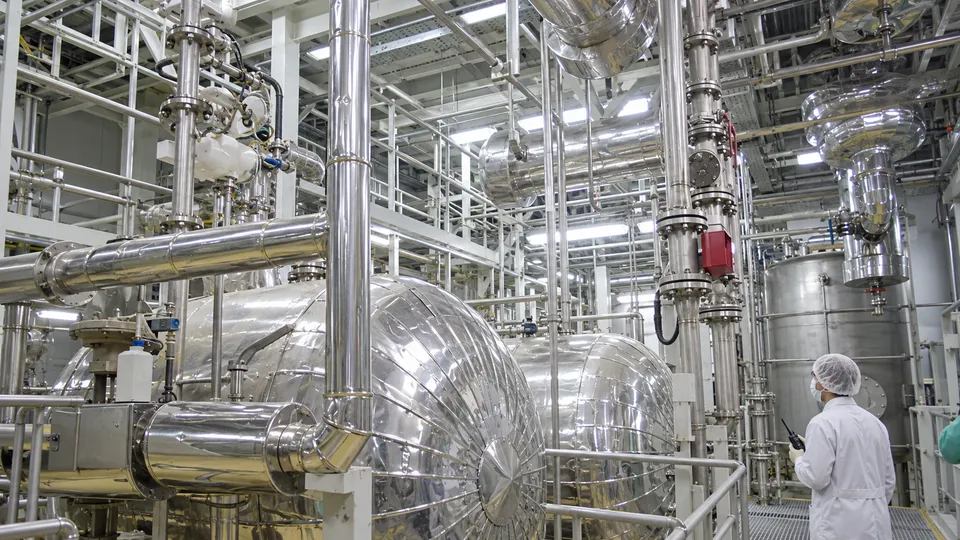
The last hard number anyone agrees on is 440.9 kilograms. That is how much uranium enriched up to 60 percent International Atomic Energy Agency inspectors had counted in Iran before they lost all access to its nuclear sites when the war began on February 28, 2026, according to the IAEA’s report to its Board of Governors, filed in June. Alongside it sat another 184.1 kilograms enriched up to 20 percent. Neither figure has been checked since. The IAEA’s Vienna staff withdrew for their own safety as the strikes started and have had zero access to any Iranian nuclear facility, struck or intact, for what the agency’s report logs as a 97-day blackout that has since stretched into its eighth month.
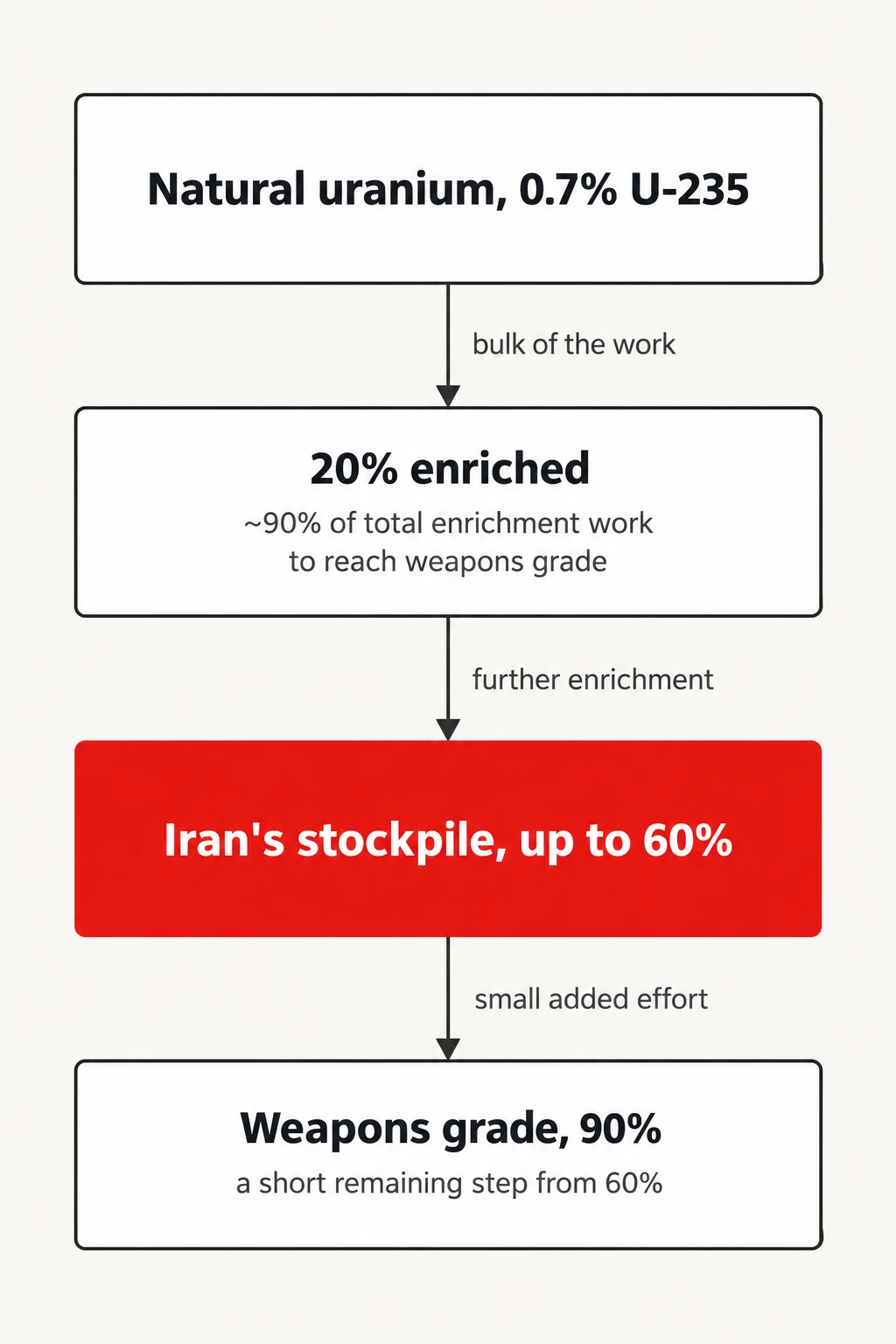
The 60 percent figure matters more than the raw mass. Under IAEA safeguards rules, a state is credited with a “significant quantity” of fissile material for every 25 kilograms of contained U-235 in high-enriched uranium. The uranium content of 440.9 kilograms of 60 percent material is about 265 kilograms of U-235 — more than ten significant quantities, the standard unit the agency itself uses to flag when a stockpile is large enough to worry about. Getting that material the rest of the way to 90 percent, weapons grade, is also the cheap part of the job. Enriching natural uranium, which is 0.7 percent U-235, up to 20 percent consumes roughly 90 percent of the total separative work needed to reach weapons grade, according to a fact sheet from the Center for Arms Control and Non-Proliferation. Past 20 percent, enrichment accelerates: going from 60 to 90 percent takes a small fraction of what it took to get to 60 in the first place. That arithmetic, not the raw kilograms, is why Washington keeps calling 60 percent enrichment a bright line and why Tehran keeps calling it a sovereign stockpile.
| From | To | How |
|---|---|---|
| Natural uranium, 0.7% U-235 | 20% enriched (~90% of total enrichment work to reach weapons grade) | bulk of the work |
| 20% enriched (~90% of total enrichment work to reach weapons grade) | Iran's stockpile, up to 60% | further enrichment |
| Iran's stockpile, up to 60% | Weapons grade, 90% (a short remaining step from 60%) | small added effort |
The war that produced those numbers has run almost eight months. US and Israeli strikes that began on February 28 killed Iran’s Supreme Leader Ayatollah Ali Khamenei on the first day, Al Jazeera reported at the time, and the fighting has since dragged in Yemen as a second front and pushed global energy markets through a crisis that has made petrol prices a live issue in US midterm campaigning. Nuclear enrichment, the stated reason for starting the war, has re-emerged as its central obstacle to ending it, with Iran citing its right under the Non-Proliferation Treaty to enrich uranium and President Donald Trump demanding what he calls zero enrichment.
The clause nobody filled in
The 14-point Islamabad memorandum that Trump and Iranian President Masoud Pezeshkian signed remotely on June 17, as Al Jazeera published it, named downblending under IAEA supervision as the floor for resolving the uranium question. Downblending means mixing high-enriched material with natural or depleted uranium until its U-235 concentration drops low enough that reversing the process back to weapons grade requires fresh separative work, done under inspectors’ eyes rather than taken on trust. The memorandum let Iran do this at home rather than hand the material over, but it fixed no quantity to be downblended, no target enrichment level and no schedule. That gap was supposed to be closed within 60 days by a final deal. It was not: the memorandum lapsed in mid-August with the harder issues, including the uranium, still unresolved, and the ceasefire itself broke down on July 8 after strikes from both sides.
Trump has since moved past downblending to demanding the material leave the country outright. In April he said the US would “go in with Iran, and we will take it together, and we will bring it back. 100 percent of it back to the United States.” Mohsen Rezaei, secretary of Iran’s Supreme National Security Council, closed that door this week in a meeting with Pakistan’s army chief, Field Marshal Asim Munir, who was in Tehran on a mediation trip. “Even a particle of enriched uranium will not exit Iran at all,” Rezaei said, according to comments carried by the semi-official Fars news agency. Iran’s state broadcaster separately quoted him calling the stockpile “a great asset and national wealth for the Iranian people to use domestically,” in remarks reported by Press TV. Rezaei also said talks with Washington will not resume until the US meets Iran’s trust-building conditions first.
Washington’s threshold
Vice President JD Vance supplied the clearest statement of the US position earlier this month, telling Reuters in an interview that Iran must make a “meaningful” cut to its enrichment capacity, not just promise future restraint. “If you don’t want a nuclear weapon, then why do you need 60 percent enriched fuel?” he said, in the interview reported by Reuters. That demand built on remarks he had already made. At a CBS News town hall, reported by Middle East Eye, Vance said the US has “in some ways decisively won” the war and destroyed Iran’s nuclear programme, but that Washington still needs Iran’s “long-term” and “verifiable commitment” against rebuilding it: “Five years from now, could the Iranians rebuild that nuclear arsenal? Could they try to rebuild that enrichment capacity?” Secretary of State Marco Rubio went further, saying flatly that “as long as President Trump is in office, they will not have a nuclear weapon.”
| Issue | US position | Iran's position |
|---|---|---|
| Enrichment level | Zero enrichment; 60% fuel has no civilian justification | Enrichment is an NPT right; unrelated to US demands |
| Stockpile location | Material should leave Iran entirely | Not one particle will exit the country |
| Verification | Need a long-term, verifiable no-rebuild commitment | No talks until US meets trust-building conditions first |
| Hormuz / blockade | Blockade already lifted in June; reopening is Iran's move | Strait stays shut until sanctions lifted, assets released |
Trump has paired the enrichment demand with claims the record does not support. At a rally at Northern Kentucky University he said US strikes had destroyed Iran’s nuclear facilities and that “they cannot have a nuclear weapon.” In Alaska he repeated a line he has used for years before the war even started, that Iran was “two weeks away from having a nuclear weapon” — a claim the IAEA’s own reporting, which tracks enrichment levels and stockpile mass rather than weapon assembly timelines, has never corroborated. Israeli Prime Minister Benjamin Netanyahu reiterated on Sunday his pledge to topple Iran’s government, framing it as the only sure way to stop the programme.
Munir’s Tehran trip, which also took in Iran’s parliament speaker Mohammad Bagher Ghalibaf and President Pezeshkian, produced no shift. Iran’s demands for ending the standoff remain the lifting of the US naval blockade, the waiving of sanctions and the release of frozen Iranian assets, terms this outlet detailed in September, in exchange for reopening the Strait of Hormuz. Foreign Minister Abbas Araghchi said this week that Iran had offered Washington a seven-day plan under which the strait would fully reopen on day six, and that the US had agreed to it but then attached further conditions it has not disclosed, in remarks carried by La Presse. Araghchi also said Trump had reached an understanding with Tehran during a third round of talks but broke it after two weeks — an account Washington has not confirmed or disputed on the record.
Mostafa Najafi, an Iran-based foreign policy analyst, argued in a post on X that the asymmetry is the whole problem: Washington wants “tangible concessions” on the nuclear file while treating the blockade’s removal, already done once in June and reversed, and a partial release of frozen assets as the only things it is prepared to give up in return. “From Iran’s perspective, lifting the blockade and releasing assets is no longer a noteworthy concession for Tehran,” he wrote.
The IAEA’s Board of Governors next meets in Vienna from November 16 to 20, the agency’s own meeting schedule shows. Whether Iran has by then granted inspectors access to the Isfahan tunnel complex where satellite imagery has shown continuing vehicle traffic, and whether any of the 440.9 kilograms can still be accounted for, will say more about where this ends than another round of statements from Fairbanks, Flat Rock or Tehran.