
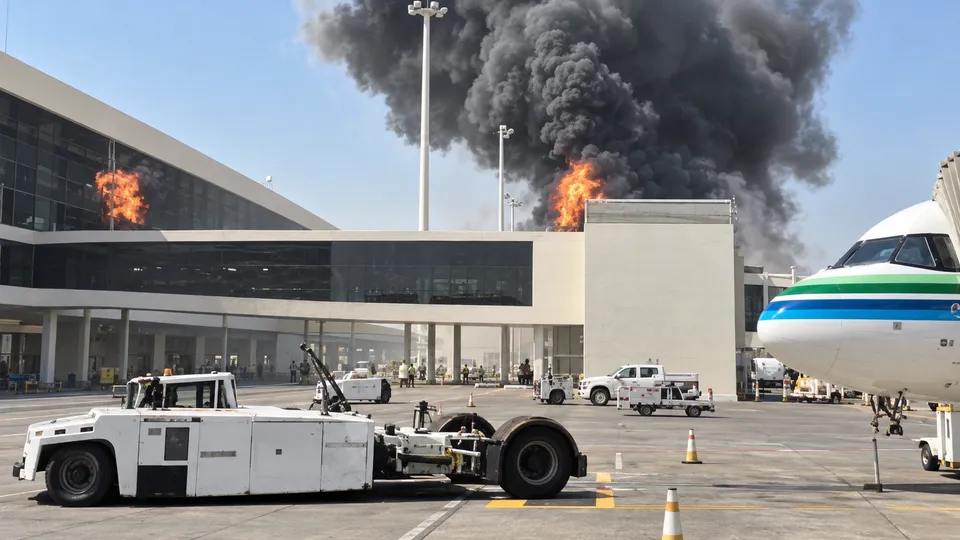
The facts first, because they are grim. Yemen’s Houthis have claimed a Sunday missile attack on King Khalid International Airport in Riyadh that killed one person and injured nearly a dozen. It came a day after another attack on the airport killed 13 people and wounded more than 300. As Al Jazeera’s explainer puts it, the attacks are one of the worst disruptions to Saudi civil aviation in years and the deadliest assault on Saudi soil in more than a decade. The count has moved around: Saudi Arabia initially said 12 were killed and 300 wounded in Saturday’s strike. On Monday, CNN reported that the airport was still closed after a run of attacks that had killed at least 20 people and wounded hundreds over the previous week.
The missiles kept coming. Late Monday, Turki Al-Maliki, spokesperson for the Saudi-led coalition fighting in Yemen, said on X that the Houthis had fired one ballistic missile at Riyadh and two toward Khamis Mushait, a city in the southwest, and that coalition forces had intercepted the one aimed at the capital, Al Jazeera reported. It was the third day in a row that Riyadh had been targeted.
Saudi Arabia has vowed retaliation, and its energy minister has promised a “serious response.” President Donald Trump has said he is considering joining Saudi strikes on the Houthis, after previously turning down Saudi requests for direct US military involvement. The Houthis, for their part, have threatened a “swift and painful” response if he does.
The broker
And then there is Iran. On Sunday Iranian Foreign Minister Abbas Araghchi spoke with his Saudi counterpart, Prince Faisal bin Farhan Al Saud. According to Al Jazeera, it was their first publicly reported contact since the Houthis stepped up their attacks on the kingdom. Iran offered to facilitate talks between Saudi Arabia and the group, and warned that a military solution risks making the regional crisis more complicated. Rews covered the offer as it was made.
I think the interesting question about any broker is what the broker actually controls. A useful intermediary sits between two parties and can deliver something to each of them. Here the evidence points both ways. Writing in an Al Jazeera opinion piece, the analyst Ateq Garallah cites media reports that the Islamic Revolutionary Guard Corps has directed Houthi movements along the coast and encouraged escalation against Saudi Arabia, promising more support. Egypt’s foreign minister, Badr Abdelatty, seems to work on the same assumption: he urged Araghchi to stop the Houthi attacks on Saudi Arabia immediately, which only makes sense if you think Tehran can. But several analysts believe Iran’s influence over the group is limited, even though it gives the Houthis key financial and military backing.
So there are two readings. If Tehran really can turn the attacks off, then the mediation offer is a price: Iran gets a seat at the table, plus some credit with Riyadh, for calming a situation its own Guards reportedly helped stir up. If it can’t, then Iran is offering to sell something it doesn’t fully own. Neither reading is especially comforting for Saudi Arabia, and they help explain why Tehran, already setting prices on the wider war, would rather be seen as the peacemaker in Yemen than as a party to it.
The ground war
The airport strikes sit on top of a war that has been heating up for months. In July the Houthis declared a naval blockade of Saudi ports and of shipping through the Bab al-Mandeb strait. In September a rapid Houthi ground offensive pushed government forces out of the port city of Mocha and took territory along the western coast and the strait, including Mayyun Island. The UN-backed truce of 2022, which had stopped most of the fighting, has effectively collapsed.
Now the internationally recognised government is pushing back. Under Operation Yemen’s Dawn, its forces have moved toward Bab al-Mandeb and are fighting reinforced Houthi positions in Dhubab district and around Dhubab Airport. On Tuesday the government said it had carried out nine air strikes in Taiz governorate: five in Dhubab district and four in al-Masrakh. Al Jazeera also reported that the Yemeni Network for Rights and Freedom accused the Houthis of killing at least five civilians in Taiz over 24 hours, including a five-year-old girl, injuring 17 more and firing more than 180 projectiles across the governorate.

Garallah’s warning about the offensive is worth spelling out. He separates three things: retaking coastal positions, holding them, and actually being able to secure the strait. Taking the coast does not end the threat to shipping, because the Houthis can still launch missiles and drones from elsewhere. And the fighting gets harder as it climbs into the highlands, including the Kahbub Mountains in Lahj. Rashad Al-Alimi, head of the Presidential Leadership Council, has started talking about liberating Sanaa rather than just containing the Houthis. Garallah’s point is that this depends on a coalition that has to stay united, including the southern-based Giants Brigades, which are doing the most effective fighting on the coast. Gulf states are split, especially Saudi Arabia and the UAE, and Pakistan and Turkey have pledged support under the Mecca Pact without saying what that support involves.
The cost
The UN says at least 46 civilians have been killed and more than 130 injured in Yemen since August, many of them children. The International Organization for Migration says more than 200,000 people have been displaced since September. “Civilians are paying an unacceptable price as a result of military operations in the Middle East,” said Mirjana Spoljaric, president of the International Committee of the Red Cross.
Some losses are older and still open. Al Jazeera tells the story of Munif, who left his family’s home in Sanaa in 2020, aged 18, to fight with the Houthis. Six months later his comrades all came home. He did not. Hundreds of Yemenis are still unaccounted for, and their families don’t know whether they were killed or detained. The new fighting is making it harder to find out.
Iran’s offer, then, is to stand between Riyadh and a group whose escalation the Guards reportedly encouraged. That is a strong position to negotiate from, provided the other side believes you.