
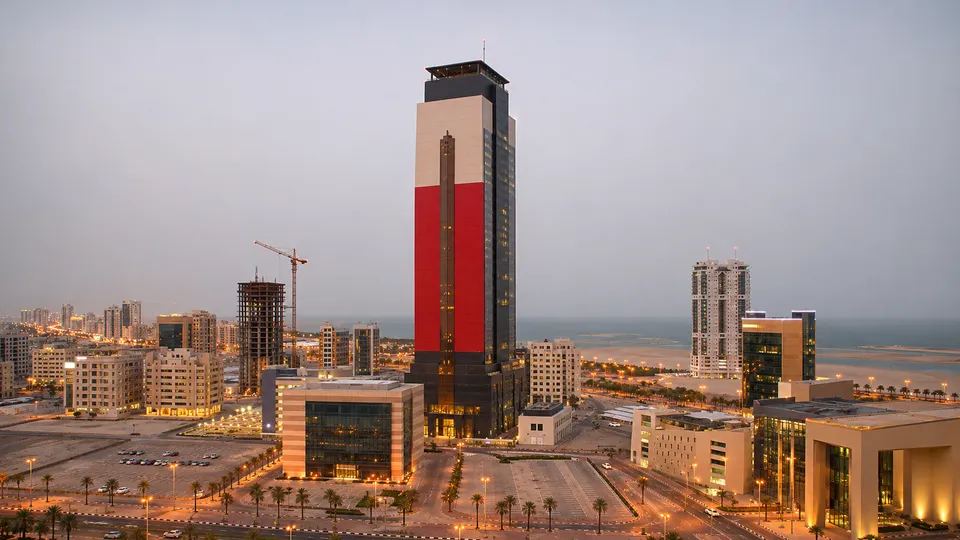
Six drones against two, radar against radar, three days apart. Iran’s Islamic Revolutionary Guard Corps (IRGC) says it hit a US-linked radar site in Bahrain for the second time since Friday, striking what it called the Al-Riffa helicopter base with six drones in the early hours of Sunday. Bahrain’s interior ministry issued two public alerts within about three hours, the first around 4:30am local time, telling residents to “remain calm, proceed to the nearest safe location, and follow news through official channels.” It was the first time sirens had sounded in the kingdom since September.
The IRGC’s statement, carried by Iran’s state broadcaster and reported by RTÉ, named the target precisely: “The US air defence radar system at the Al-Riffa helicopter base in Bahrain was targeted by six drones belonging to the IRGC Aerospace Force,” adding that “the Strait of Hormuz is closed, and any aggression by the American enemy will be met with an even harsher and more forceful response.” Bahrain’s defence force says its air defences intercepted the drones before they reached anything; its foreign ministry says Iran is “turning its territory into an arena for settling scores” and holds Tehran “fully responsible.” Two days earlier an almost identical exchange happened at the same location: the IRGC claimed two drones destroyed a US early-warning radar there; CENTCOM said two one-way attack drones were shot down, with “no injuries or damage,” Al Jazeera reported. Neither claim has been independently verified either time.
Whose radar, whose base
The name Iran gives the target matters. Riffa Air Base, by open-source order-of-battle references, is a Royal Bahraini Air Force helicopter facility with no reported permanent US garrison. The US military’s hub in Bahrain since 1991 is Isa Air Base, roughly 15km away, which has hosted US Navy, Air Force and Marine Corps units continuously and holds prepositioned American equipment. That leaves open what, specifically, counted as “the US air defence radar system” the IRGC says it has now hit twice. The broader pattern of this war — striking the forward bases that house US radar, aircraft and troops rather than Iranian territory itself — has already pushed the Pentagon to disperse assets once concentrated at a handful of Gulf airfields.
What the oil data actually shows
The IRGC’s declaration that “the Strait of Hormuz is closed” sits against measurements that disagree with each other and with it. CENTCOM, which runs Gulf mine-clearance and blockade-enforcement operations, said on October 25 that Gulf partners had exported more than 1.5 billion barrels of oil through Hormuz “since summer” with its support, and that more than 3,000 commercial vessels had transited the strait in the preceding six months, over 95 percent without incident, according to Arab News. The strait carried on the order of 20 million barrels a day before the war — 21.6 million in the EIA’s last pre-war quarter — which makes 1.5 billion barrels roughly 75 days’ worth of normal traffic, spread across a window CENTCOM never dated more precisely than “summer.”
The US Energy Information Administration’s own quarterly figures show how far that baseline fell. Total crude and petroleum-liquids flow through Hormuz, a measure that includes Iran’s own exports, averaged 21.6 million barrels a day in the fourth quarter of 2025, fell to 14.9 million in the first quarter of 2026 and to 4.9 million in the second — a 77 percent drop — according to the EIA’s Short-Term Energy Outlook. The agency notes that ship-tracking signals for the strait have been “especially unreliable” since the war began, which is itself a measure of how contested the waterway is.
By October, independent tanker trackers showed a partial recovery, but a smaller one than the administration claimed. Energy Secretary Chris Wright told an energy conference in Riyadh that Hormuz flows had reached “80 to 90 percent” of pre-war levels, or 13 million to 14 million barrels a day. Kpler’s tanker data put the figure at 10.3 million barrels a day for the week ending October 3, 23 percent below Kpler’s own pre-war benchmark of 13.5 million; Windward, a rival tracker, put it lower still, 9 million to 10 million against a 14.5 million baseline, the Daily Caller reported. Part of the gap is real: Saudi Arabia and the UAE have shifted roughly 40 percent of their crude onto pipelines bypassing the strait, up from 17 percent before the war, which pushed total Gulf exports excluding Iran back to about 16.5 million barrels a day in September, near pre-war levels even though the strait itself is not. Secretary of State Marco Rubio’s claim that Iran has “lost complete control” of Hormuz and the IRGC’s claim that it is “closed” are both, on the numbers available, overstatements pointing in opposite directions.
The ledger so far
The Pentagon’s own accounting of what the war has cost is older than any of those oil figures, and already out of date within the government itself. The Defense Department’s lead inspector general reported that Iranian strikes had damaged or destroyed “hundreds of buildings and structures” at US bases across Bahrain, Kuwait, Qatar, the UAE, Saudi Arabia, Iraq, Oman and Jordan in the war’s first four months, along with roughly $184 million in damage to US embassies and consulates in Iraq, Kuwait, Saudi Arabia and the UAE, including the US Embassy in Kuwait, which suspended operations after being struck, and at least 30 MQ-9 Reaper drones lost or damaged, in a report covering through June 30. It put the war’s total cost at $33.4 billion as of June 29 and recorded 18 US deaths and more than 800 wounded. Weeks later Secretary of War Pete Hegseth told Congress the figure had already reached $37.5 billion, a $4.1 billion jump the inspector general’s own paperwork had not caught up with a month after its cutoff, according to USNI News.
Bahrain’s own tally of what it has intercepted is older still. The Bahrain Defence Force last published a running count on April 5: 188 missiles and 466 drones destroyed since the war’s February 28 start, according to Trade Arabia, and has not updated the public figure since, even as Friday’s and Sunday’s strikes add at least eight more drones to a count that stopped seven months ago. The gap matters for Bahrain’s case at the UN: it has formally invoked Security Council Resolution 2817, adopted 13-0 with China and Russia abstaining, co-sponsored by 135 states — the largest number of co-sponsors for any Council resolution, cosponsors said at the time — which condemns Iranian strikes on Bahrain and six other regional states and demands they stop. Washington’s parallel pressure track, a CENTCOM task force assembled this month to interdict Iran’s overland and Caspian supply routes, has not stopped the IRGC from launching drones at Bahrain twice in three days.
Washington’s incentives
The war is now a domestic political liability the administration has conceded in public. Democrats took back both chambers of Congress in the November 3 midterms; Vice President JD Vance said flatly, “The reason we lost is the war,” adding “the president himself said so last night,” according to ABC News. Trump told the Wall Street Journal the war, then in its eighth month, “was a piece of it,” though he said he thought high fuel costs mattered more; two of his endorsed candidates lost badly, Texas Attorney General Ken Paxton by 12 points and South Carolina Senator Lindsey Graham by 4, the Hill reported.
That domestic cost is the backdrop for a summit the White House and the Kremlin have now both confirmed: Trump, Xi Jinping and Vladimir Putin are set to hold the first-ever trilateral meeting among sitting leaders of the three countries, on November 19 in Shenzhen, with the Iran war and nuclear-arms reduction on the agenda and Ukraine deliberately left off it, Al Jazeera reported. A senior US official told Reuters not to expect much from it: “We do not expect to get to any kind of agreement.” Whether Tehran’s drones this weekend were timed as leverage ahead of that meeting, or a signal that the IRGC intends to keep firing regardless of what the three leaders discuss four days later, is the question nobody in Manama, Washington or Shenzhen has yet answered.