
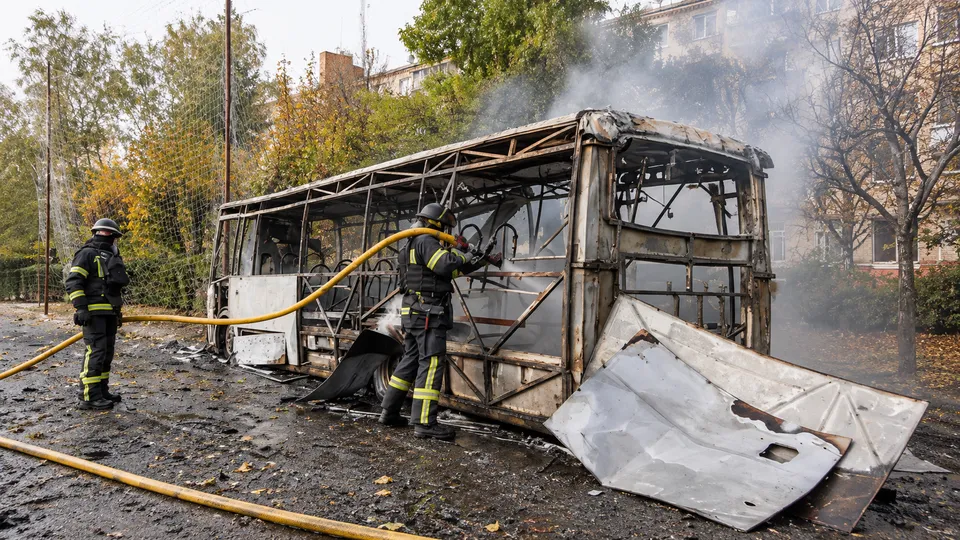
On Thursday morning, 8 October, two city buses were moving along a street in Kramatorsk when the munition came down. That was the whole of their offence: they were running their routes. By the afternoon, local authorities in the Donetsk region said at least 30 people were dead and 18 wounded, as Al Jazeera reported, drawing on AFP and Reuters.
The local prosecutor’s office posted photographs. They show bodies and debris scattered across the roadway, and behind them the shell of a bus, metal, still burning. Nothing needs adding to that picture, and nothing will be.
The counting
In a war like this one, the number of the dead is never fixed. It grows over the hours, as hospitals report and as rubble is lifted. The prosecutor’s office first spoke of 12 killed and 14 injured, then raised the figures to 30 dead and 18 hurt, Ukrainska Pravda reported. Later still, Ukraine’s State Emergency Service put the toll at 33, according to Meduza, and officials warned it could climb further, because the full extent of the damage was still being established.
Twelve. Thirty. Thirty-three. Each revision is a family somewhere in the city learning the worst.
Even the place itself is described in two ways. Police spoke of a street on which two city buses happened to be travelling. President Volodymyr Zelensky called it a bus stop. Accounts of the weapon differ too. Police said a glide bomb hit the buses, and the prosecutor’s office said the attackers had probably used a UMPB D-30SN, a universal glide munition. Other Ukrainian reports citing the Prosecutor General’s Office spoke instead of a multiple rocket launcher. To the people on the buses it made no difference.
A target chosen for its arithmetic
Vadym Filashkin, the governor of the Donetsk region, accused Russia of deliberately targeting civilians. On Telegram he set out what he believes Moscow is calculating, and it was the coldest sentence of the day:
for them [the Russians], a bus with passengers is an attractive target precisely because one strike can kill as many people as possible
Kramatorsk City Council called the strike “yet another horrific crime committed by the Russian army against the civilian population” and said there were “absolutely no military targets” at the site. Dmytro Lubinets, Ukraine’s human rights commissioner, said: “Russia is systematically destroying Kramatorsk and terrorising civilians.” Moscow did not comment straight away. Its standing position is that it does not target civilians.
A reflection, not a finding: an empire at war speaks of fortresses, of belts and salients and conditions for peace. The ruled keep catching the morning bus, and that is where the war meets them.
The city in the way
Kramatorsk lies about 15 kilometres from the front line, by Ukrainian outlets’ reckoning, and drones and artillery fall on it as a matter of routine. It is one of the two largest Donbas cities Ukraine still holds. It has served as a military logistics hub and forms part of what is called the “fortress belt.” Russian troops are approaching its eastern outskirts, and the civilians who remain have been urged to leave. Moscow has said that the capture of these cities, or their voluntary surrender, is a mandatory condition for ending the war.
After the strike, public transport was suspended in Kramatorsk and in neighbouring Sloviansk, and officials repeated their appeal to residents to evacuate. The bus routes stopped, at least for now. Many of the people still in the city are those who could not leave or would not, and for them the routes were one of the few things that kept daily life going.
Two days, two cities
The buses burned a day after a Russian missile hit a five-storey apartment block in Pryluky, in the Chernihiv region. Governor Vyacheslav Chaus said that death toll had risen to 22, five of them children. Zelensky said a cruise missile had struck the building directly. On the same Thursday morning Russia also attacked Kyiv, killing one person, the latest in a run of assaults on the capital.
The long-range war is spreading in both directions. Russia has been hitting Ukrainian data centres and warehouses, part of a campaign against the wires and the grid before winter. On Thursday the Russian company Yandex told AFP that a drone had started a fire at one of its data centres in the Ryazan region. A former head of Ukraine’s Centre for Countering Disinformation attributed the strike to Kyiv and wrote: “Two can play at this game.”
The two kinds of target are not the same. A data centre is a building full of servers. In Kramatorsk the target was a street with two buses on it, and by evening the authorities had counted at least 30 dead.