
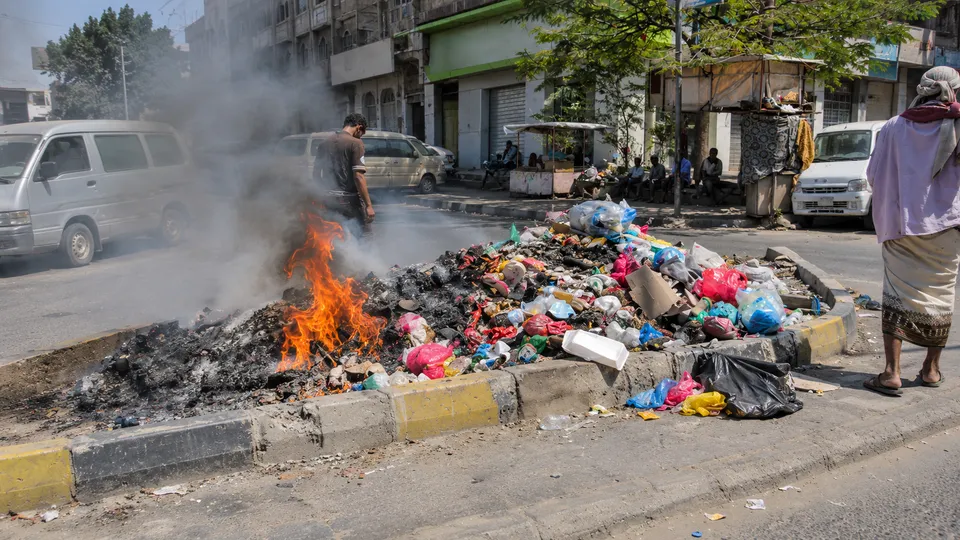
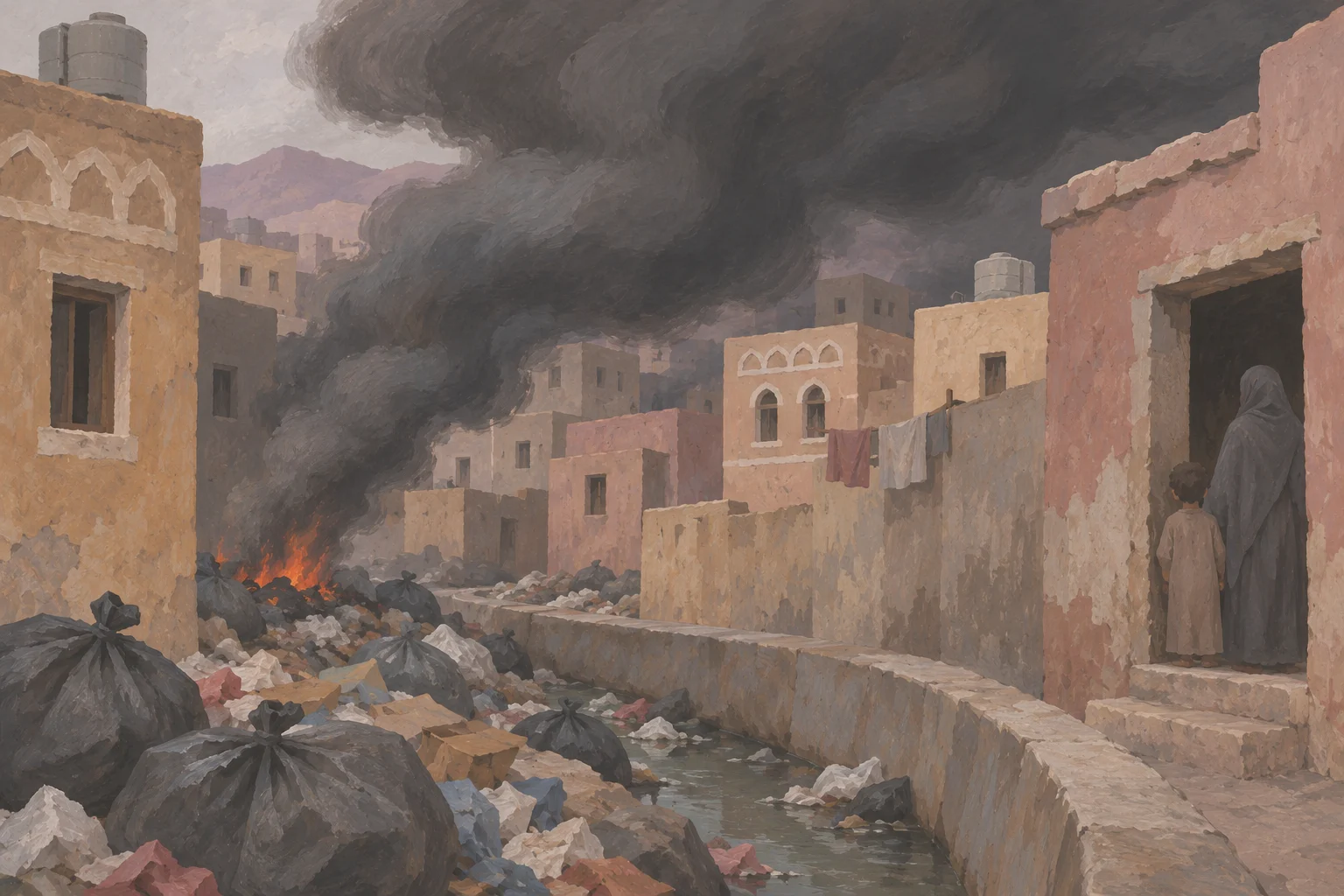
In Usaifira, on the northern edge of Taiz, the black smoke comes from household rubbish set on fire. Along the al-Saeed stream, a waterway that runs between homes, bags of uncollected waste lie heaped from the middle of lower Tahrir Street down to Usaifira. As Suhaib al-Miyahi reported for Al Jazeera, the people of these neighbourhoods now live between the mounds and the fumes, and that has become ordinary.
The reason is simple. The city’s main landfill lies in western Taiz, in territory held by the Houthis, the Iranian-backed movement that has besieged the city for a month. Since early October the sanitation trucks have been unable to get there. Workers say snipers are posted around the site and that crews have come under fire more than once while trying to empty their loads. Fuel is scarce as well. So the rubbish collects in the streets and the storm drains, and residents, out of options, burn it.
“This causes us suffocation and diseases, young and old. The children suffocate from the smoke,” said Abdo Hadi, who lives in Usaifira. “It is a foul smell, and on top of that they burn it.” Then he described the wider siege: “We are besieged from every side, [with] neither gas nor petrol, and a black market.”
The weight of a day
Taiz produces between 550 and 600 tonnes of waste every day, which comes to 16,500 to 18,000 tonnes a month. Mohammed Ibrahim, who runs a cleaning initiative in the city, says collection has been badly disrupted since October 5. His group has also lost funding, and its supplies have stopped arriving. One worker, emptying his truck into the Usaifira stream, put it this way: “We are here with the rubbish in the Usaifira stream because of the war, and the people here are exposed to diseases from the rubbish, and we pile the waste in the stream, leave it to God.”
Wars are usually told through lines on maps. A city’s rubbish tells it differently: it shows the places a truck can no longer reach.
The UN’s ledger
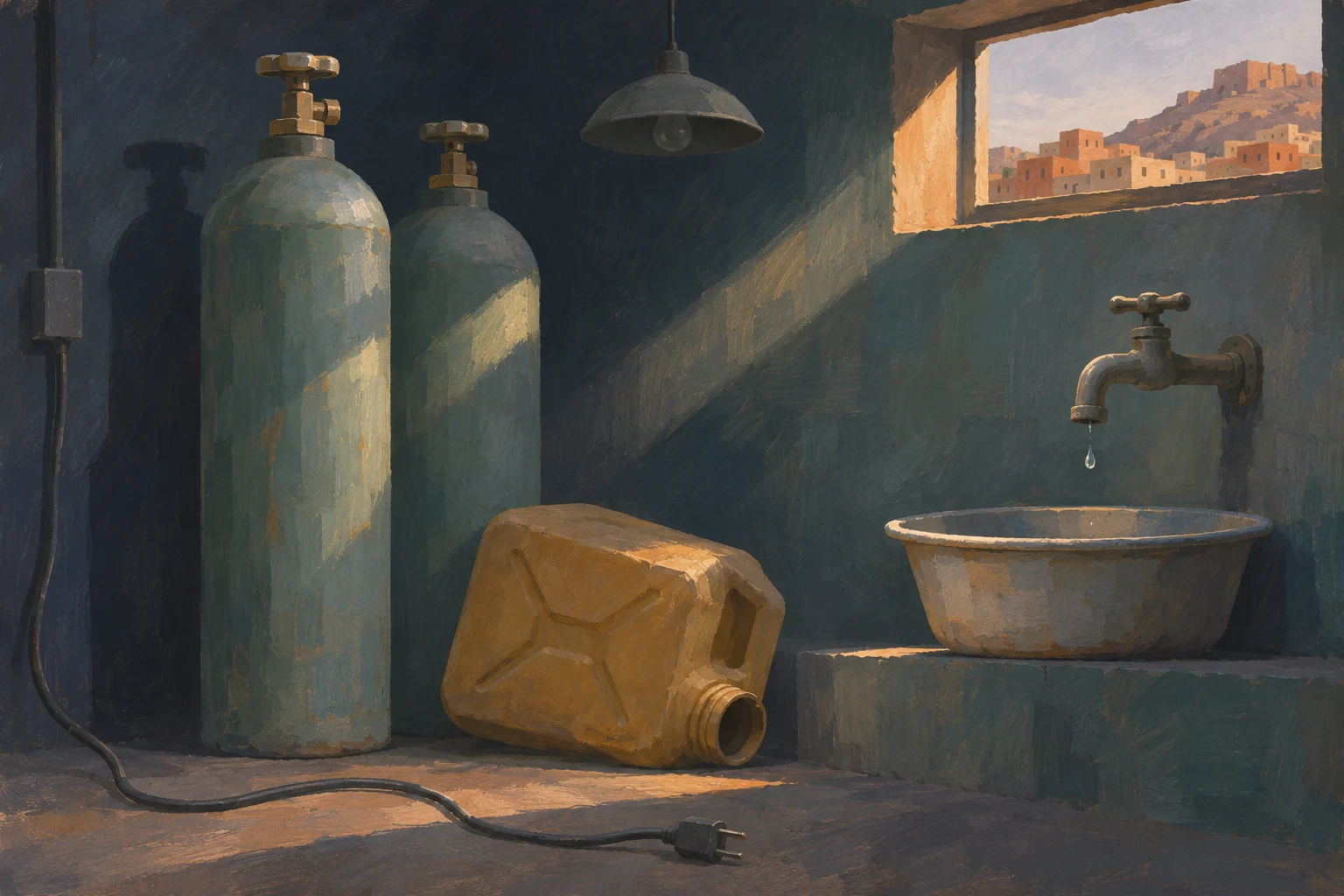
On October 20, Laurent Bukera, the UN Humanitarian Coordinator for Yemen, said in a statement from Aden that he was deeply concerned by the “rapidly deteriorating humanitarian and economic situation” in the city. Road closures and insecurity were keeping fuel and other vital supplies out, he said, and the health system was close to collapse. Water production had halved and the alternatives were running out. He warned that shortages threatened hospital power and medical oxygen, and that the food and fuel still on sale had more than doubled in price. He called on the Houthis to open safe passage for commercial goods, food, medicine and aid.
The World Food Programme said in mid-October that the fighting had cut off lifesaving assistance to 800,000 people, 600,000 of them in Taiz, where they depend on aid. “This is the kind of situation that can rapidly spiral into a humanitarian catastrophe if assistance cannot move safely and reach those who need it most,” said El-Khidir Daloum, the agency’s country director. Jens Laerke of OCHA, the UN’s humanitarian coordination office, said that very little fuel, food or other supplies had reached the city since the access roads were cut. He added that the price of trucked water had tripled. “So, you can imagine what that does to these people who are trapped there.”
UNICEF says it screened more than 168,000 children in Taiz this year and found more than 52,000 acutely malnourished. Even where stocks exist, said its spokesman Ricardo Pires, access constraints make it harder for families to reach treatment safely. Human Rights Watch has accused the Houthis of depriving the city’s civilians of food and medicine. The UN had already warned of a population cut off after three weeks of encirclement.
Dawn of Yemen, one month on
The siege tightened during a larger war. On October 5 the internationally recognised government, backed by a Saudi-led coalition, launched Operation Dawn of Yemen. Its stated aim was to retake every area the Houthis hold, including Sanaa, the capital they have controlled since late 2014. Al Jazeera’s staff in Sanaa spoke to Mohammed Ahmed, a 40-year-old resident, who said: “A state of worry and uncertainty overwhelmed my family and me.” He did not care who won. He feared fighting in the country’s most densely populated city. A month later Sanaa is largely calm apart from repeated air strikes. The Houthis, meanwhile, have gained ground in Taiz and Lahij.
Each side keeps its own count. The government said its forces killed or wounded 1,540 Houthis in 24 hours, and late last week put the total since October 5 at 16,100. It claims to have retaken Dhubab district and positions near the Bab al-Mandeb strait, and on Sunday it said it had taken heights east of al-Hazm in al-Jawf. The Houthis have confirmed no death toll. Their military spokesman, Yahya Saree, says the coalition has carried out 3,939 attacks, including air strikes. The Houthis fire missiles and drones into Saudi Arabia every day and have hit several airports. One recent missile killed at least 70 government security recruits in Shabwah. On Monday the Presidential Leadership Council recommitted to ending the Houthi “coup”.
The analysts disagree. Turki al-Goblan, of the Saudi Daimumah Center for Studies, argues that the offensive has hit the Houthis’ fuel and supply networks, their sea outlets on the western coast, and their hold on the tribes around Sanaa, some of which have declared mobilisation for the government. “Attrition ceases to be the opposite of a decisive victory and becomes the means of achieving it,” he said. He reads the missile fire as a possible “illusion of maintaining the initiative”. Yazeed al-Jeddawy, of the Sana’a Center for Strategic Studies, says the balance of power has not moved in 30 days. He sees the war as tied to the wider confrontation involving Iran and becoming increasingly zero-sum, and he suspects outside help behind the precision of some Houthi strikes.
Colonel Wadah al-Dubaish, a spokesman for the government-aligned forces on the west coast, admits the Houthis have advanced in Taiz. He calls it “a big adventure” and says they have lost more in a month than in all the previous years combined.
His claim cannot be checked. What can be checked is in Usaifira: the trucks are still unloading into the stream, and the fires along it keep burning.