
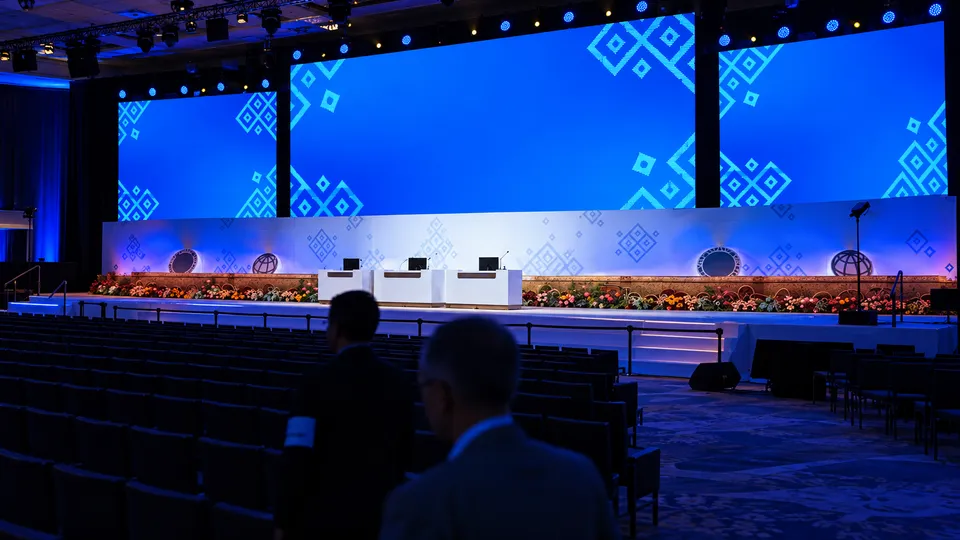
On Monday the keepers of the world’s money arrive in Bangkok. They come from 191 countries, more than 15,000 of them by one count: central bank governors, finance ministers and the bankers who follow them. They will gather at the Queen Sirikit National Convention Center for the annual meetings of the International Monetary Fund and the World Bank, which run from 12 to 18 October. Thailand last played host in 1991. For three years the meetings have been held in Washington, and the move away from it is the first thing to say about this week.
The second is that they arrive under the shadow of a war. As Reuters reported in a dispatch carried by Al Jazeera, the US-Israel war on Iran, now in its eighth month, is expected to dominate the agenda and push other conversations to the side. It comes bundled with what the agency calls the biggest energy supply shock ever recorded, with interest rates climbing, and with a world economy that was already growing slowly before the first strike.
A calendar of downgrades
The forecasts tell the story in instalments. In January the Fund raised its estimate of world growth for 2026. Then the war began on 28 February, and in April the IMF published a World Economic Outlook it titled Global Economy in the Shadow of War, cutting its forecast to 3.1 percent. That figure assumed a short conflict.
The conflict was not short. By the July update the Fund had growth at 3.0 percent for 2026 and expected global inflation of 4.7 percent this year, up from 4.1 percent in 2025. Each revision rested on an assumption about the Strait of Hormuz: when ships would move again, and what oil would cost when they did. Each assumption had to be rewritten as the war went on. Washington has reportedly turned down a Tehran plan to reopen the strait, and Iran has put a price on the waterway. The narrow channel has become a kind of pendulum, and the economists in Bangkok will be measuring its swing.
A forecast is a modest thing. It is a guess, written in decimals, about what other people will decide. When the people deciding are generals, the decimals stop meaning much.
Winter, and the bill for it
Kristalina Georgieva, the Fund’s managing director, has spent the autumn preparing her audience. In late September, Semafor reported, she warned that “winter is coming”, meaning inflation and the central banks’ response to it. In her curtain-raiser speech on 7 October she named three forces pulling at the world economy: the fast rise of artificial intelligence, energy prices that stay high, and public debt at record levels.
Two of the three are old companions of the poor. When energy becomes expensive, it is the countries that buy their fuel abroad, with no reserves and no room to borrow, that feel it first and longest. When rates go up, debt that looked bearable becomes a weight. In America, the yield on ten-year Treasury paper has touched levels last seen in 2007. Money now costs more for everyone. It costs most for governments that already owe a great deal and earn little.
The third force, the AI boom, is the odd one out: investment pouring in at one end of the economy while the energy shock drains it at the other. Whether one can make up for the other is one of the questions the Fund will have to answer in Bangkok, in the World Economic Outlook and the Global Financial Stability Report it is due to publish this week.

Far from the Potomac
There is something fitting in the setting. For three years the institutions built at Bretton Woods held their autumn rites close to their own headquarters, in the capital of the country that is now one of the two powers at war. This week they go to Asia, to a region that imports a great deal of oil and has its own long memory of financial crisis and of the Fund’s remedies for it. Thailand, the Nation reported, will use the occasion to press its own concerns alongside the global outlook and artificial intelligence.
Large gatherings of this kind follow a script. There are plenaries and committees, communiqués drafted in advance and argued over late into the night, and photographs of men and women in dark suits. The script assumes that the people in the room can steer events. This year they must spend the week discussing a war that none of them is running, and an oil price that none of them sets.
In such moments the finance ministers resemble the clerks of a besieged city. They can count the grain, ration the bread and argue about who should pay. They cannot open the gates. Those are in other hands, on the shores of the Gulf, where a strait barely wider than a long day’s walk decides what a family in Lagos or Karachi pays to cook its dinner.
The meetings open on Monday. The war enters its next week on the same day.