
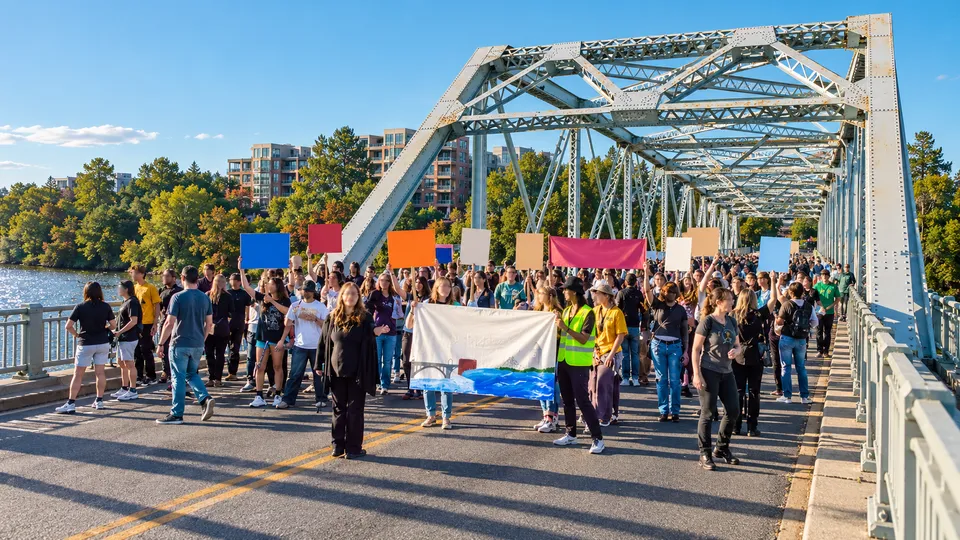
Hundreds of people turned out at 19 events across Washington state on Sunday to press for a statewide moratorium on data center construction, as a backlash against the artificial-intelligence buildout moves toward the Legislature.
The demand builds on local victories. Seattle became the largest American city to halt the buildout in June, and Spokane and Pierce County, home to Tacoma, followed. The organizers, a coalition called Washington AI Resistance, or WAAIR, working with environmental and public-interest groups, want rules that cover the whole state, which is home to the headquarters of both Microsoft and Amazon, [Common Dreams reported](<https://commondreams.org/news/wa-state-data-center-moratorium>). The industry has noticed the trend: Matt Garman, Amazon’s cloud chief, said Friday that more than 100 local moratoriums were under consideration around the country and pledged $1 billion for towns that host data centers.
“We need to demonstrate to candidates and sitting legislators that there is real public demand for a data center moratorium in every corner of the state,” Evan Sutton, a Seattle-based WAAIR activist, told Common Dreams. Lauren Redfield, the group’s president and co-chair of the Seattle Democratic Socialists of America ecosocialism working group, said the day showed “wide-ranging support from diverse communities across Washington that people are angry about data centers.” “Communities have a right to clean air, clean water, affordable energy. Communities have a right to determine which industries get to move into their backyards,” she said, adding that representatives more responsive to the tech industry than to constituents “are going to be held accountable.”
In Seattle, where a moratorium already exists, activists held four separate events, on a freeway bridge in the north end, in West Seattle, outside the light rail station in Beacon Hill and at a central square of the University of Washington. Mr. Sutton, who organized the north Seattle action, said local rules only push developers into unincorporated areas and then across the state. “We shouldn’t have to play whack-a-mole with billionaire developers and AI tech bros,” he said, as passing cars honked in support. “Our legislature should step up and pass rules that everybody has to follow everywhere in the state.”
Thomas Meyer, the deputy political director of Food & Water Watch, led 10 volunteers distributing flyers and gathering signatures in Beacon Hill. Data centers in Seattle are most likely to be proposed in the south end or in nearby cities like Tukwila, Burien and Renton, he said, areas with larger populations of people of color. A study by Front and Centered, a Washington environmental justice group, found that 57 percent of the data centers it surveyed were placed in census tracts with the highest proportion of people of color.
In Olympia, the state capital, protesters put pressure on State Representative Beth Doglio, a Democrat whose bill with basic data center regulations was watered down under tech-lobby pressure in this year’s legislative session and then died in committee. “Washington needs to halt the out-of-control tech oligarchs with a moratorium on data center construction,” said Tina Simcich of Olympia DSA. “Working-class jobs and our land, water, energy, and air resources must be protected from this greed-driven grab.”
In Walla Walla, about 60 people marched downtown to the County Office of Community Development to oppose a planned Amazon data center, projected to use as much power as Seattle, on land the Port of Walla Walla sold the company at the Wallula Gap. Residents listed worries about power bills, water pollution, noise, light, eminent domain and the nearby McNary National Wildlife Refuge, said Allison Carney of the Walla Walla Anti Data Center League. “The biggest thing that unites everyone’s concerns is the fact that we don’t trust Amazon,” she said. “We trust that they’re going to do what’s best for their profits.” Melissa Shumake, the county’s community development director, will decide whether the project requires a full environmental impact statement, which residents are demanding.
The largest action of the day was in Spokane, where 150 people marched from Riverfront Park past City Hall and the Public Works Building. The march came about two months after a wildfire burned through Spokane in August, destroying homes and forcing 600,000 people to evacuate, and residents fear a large data center would drain the water needed to fight the next blaze, said Zenthia Peterson, the lead organizer. “This is what we’re fighting for: our river,” she said. Participants included members of 350 Spokane, the Visibility Brigade and the West Plains Water Coalition.
In Wenatchee, in central Washington, organizers standing beside the Loop Trail along the Columbia River invited passersby to initial a poster board under “YES” or “NO” to a moratorium. The count: 24 yeses and zero noes, one organizer said. The board goes Wednesday to a meeting with Kevin Overbay, a Chelan County commissioner, where residents plan to oppose more data centers in Malaga, an unincorporated community the organizer called “ground zero for hyperscale data centers in Chelan County,” already home to a 288-megawatt Microsoft facility. “The Columbia is the lifeblood of our community,” the organizer said. “These resources do not belong to private corporations like Microsoft to use as they please.”