
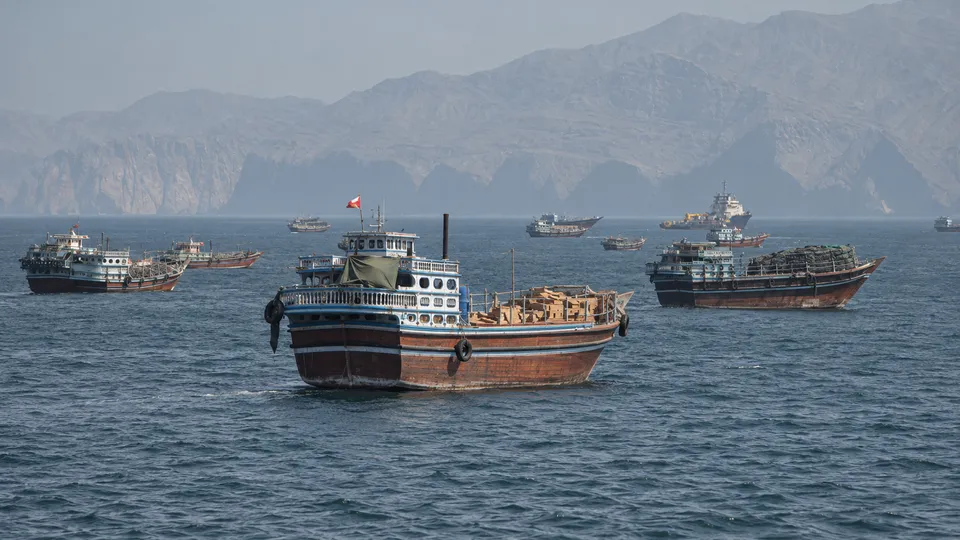
Four million one hundred forty-seven thousand barrels of oil made it through the Strait of Hormuz on Monday, according to Kpler tracking data cited by CNN. The pre-war baseline is roughly 20 million barrels a day: the US Energy Information Administration put average flows through the strait in 2024 at about that figure, so Monday’s transit was around 21 percent of normal. CNN describes it as less than a quarter of pre-war levels, and Kpler’s seven-day average has fallen sharply since early October.
That is a reversal of the previous month. Through September, flows from Gulf producers other than Iran had climbed back toward normal on the strength of night-time “dark” transits — tankers with transponders switched off, moving along Oman’s coast under US military escort, part of the relay described in an earlier account of the shuttle. By the end of September, Gulf exports were near 80 percent of pre-war volume. The recovery is precisely what Iran is now shooting at.
Two sinkings in 24 hours
The Singapore-registered container ship GFS Pride was struck on Tuesday while transiting the strait, caught fire, and later sank, according to the Maritime and Port Authority of Singapore; all crew members were evacuated. Videos verified by CNN show black smoke and the vessel taking on water, with cargo and a small oil slick visible in later satellite images. Iranian state outlet Press TV said the ship had “hit a sea mine on an unauthorized route” — a claim independent experts doubt, judging a drone attack more likely. “The sinking of Singapore-flagged GFS PRIDE marks a dangerous escalation after weeks of near-daily attacks on commercial shipping,” said Charlie Brown, a former US Navy officer and senior adviser to United Against Nuclear Iran, a nonprofit that tracks Iranian sanctions violations — a group with its own policy agenda, though its reading matches that of outside experts here.
The second loss was the Cape Dao, registered in Antigua and Barbuda, which sank after first being hit by a projectile on September 23; one Indian crew member was killed, according to International Maritime Organization data. Many vessels have been hit in the strait this year, but these are only the second and third ships to sink in the Middle East since the war with Iran began in February, per the IMO. The wider pace is what the UK Maritime Trade Operations numbers capture: nine attacks in or near the strait reported between Monday and Wednesday, one of them a drone strike on a tanker.
The escort was working, which is the problem
Iran’s military says it has expanded its surveillance of the strait by deploying new units to target ships, Al Jazeera reported, framing the move as part of a contest with Washington over control of the waterway. With the US naval blockade of Iranian southern ports in place and sanctions tightening, Tehran says it is pursuing military and diplomatic pressure to force the strait reopened on its terms.
The economics of that pressure run in both directions. The blockade has, by CNN’s account, left Iran’s economy in tatters and visibly cost Tehran its leverage: once other producers’ crude was moving near pre-war rates under escort, an Iranian threat to close Hormuz stopped pricing. The logic of the current escalation is to make the escort insufficient — raise the attack rate until escorted transits no longer restore flow — and to do it on a calendar chosen in Washington, with US midterm voters already listing gas prices, tariffs and the cost of living among their top concerns.
The pump-price clock
The Trump administration has looked for relief elsewhere, including a deal announced last week to drop some sanctions on Russia in exchange for a relatively small volume of Russian diesel. The deal drew bipartisan criticism, and analysts quoted by CNN warn diesel prices could approach all-time highs by November regardless — in an election month.
Brown’s question, asked after the GFS Pride went down, remains unanswered: “But the real question is what response will other nations take? How long will the world tolerate this threat to shipping, seafarers and freedom of navigation?” The numbers to watch in the meantime are Kpler’s seven-day average — down sharply since early October, with no floor yet visible — and whether UKMTO keeps logging attacks at nine per 48 hours.