
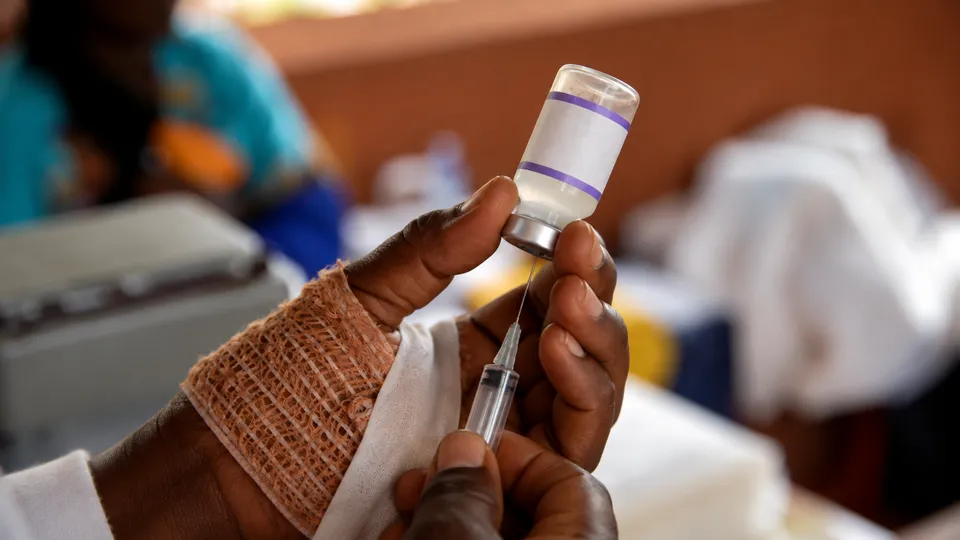
On Monday, judicial police in Bissau searched the local office of the Bandim Health Project and seized a batch of hepatitis B vaccine doses earmarked for a clinical trial on newborns. The police said, in a Facebook post translated from Portuguese and reported by Ars Technica, that the operation aimed at “clarifying the circumstances related to the said batch of vaccines,” and that a seizure “does not allow, in itself, to conclude the existence of irregularities in the quality, safety, or effectiveness of the vaccines.” That’s a narrow claim. The doses themselves are ordinary, WHO-prequalified hepatitis B vaccine, the same product already in Guinea-Bissau’s routine immunization schedule. What’s under investigation is not the vaccine. It’s who, if anyone, authorized giving half of roughly 14,000 enrolled newborns a six-week-late dose instead of the standard birth dose.
The money behind the trial is specific and traceable. In December 2025 the US Centers for Disease Control and Prevention awarded about $1.6 million over five years to the University of Southern Denmark to run it, an amount matched by the Pershing Square Foundation and the Bluebell Foundation for a combined $3.2 million, according to CIDRAP’s report on the award. The grant went out as an unsolicited, non-competitive award rather than through CDC’s normal review process, which is why virologist Angela Rasmussen told CIDRAP it had “the appearance of blatant cronyism.” The university’s Bandim Health Project, a research outpost in Guinea-Bissau founded by the anthropologist Peter Aaby in 1978, is where the trial would actually run.
The design, per CIDRAP’s later reporting: about 14,000 newborns, half vaccinated against hepatitis B at birth as usual, half vaccinated six weeks later instead. That’s roughly 7,000 infants going six weeks without a shot the World Health Organization has had in national schedules for three decades, in more than 115 countries, because it prevents 70 to 95 percent of mother-to-child transmission. In Guinea-Bissau, where close to one in five adults carries chronic hepatitis B, that transmission risk is not abstract: without the birth dose, up to 90 percent of newborns exposed at delivery go on to chronic infection, and 15 to 25 percent of chronically infected people eventually die of liver failure or liver cancer. WHO’s spokesperson Tarik Jašarević called a design that withholds the vaccine “unethical” and said it “exposes newborns to serious and potentially irreversible harm,” in a formal WHO statement issued in February.
Two approvals, no authorization
After that February backlash, Guinea-Bissau’s foreign minister, João Bernardo Vieira, told Reuters the trial was off: “It’s not going to happen, period,” as cited in CIDRAP’s reporting. The Bandim team redesigned it over the summer, apparently settling on the birth-versus-six-week comparison rather than an outright no-vaccine control arm, and resubmitted. Guinea-Bissau’s national ethics committee signed off on July 14; a Danish research ethics committee approved it earlier in October. Bandim posted the national approval letter publicly. None of that is authorization to run the trial, which is a separate, political step that sits with the health ministry rather than with an ethics committee. Health minister Quinhin Nantote told reporters last week, according to Ars Technica’s account of a press conference, that the government had not signed off, and that “any scientific research initiative involving human beings, particularly children, must strictly comply with applicable national legislation, international ethical principles, competent evaluation and approval mechanisms.” Asked by the Guardian whether the trial was moving forward anyway, Nantote said: “This is not even remotely true.”
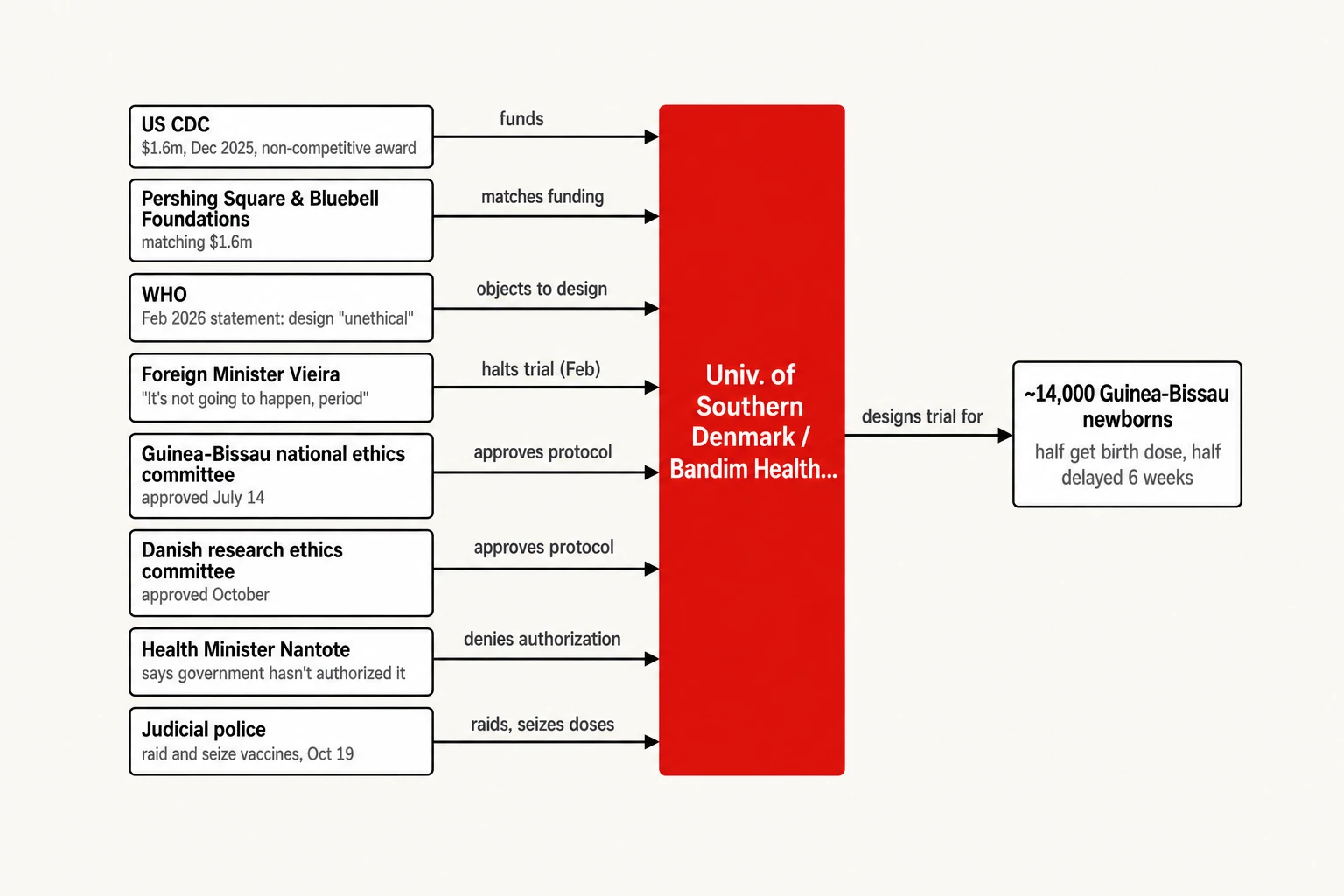
| From | To | How |
|---|---|---|
| US CDC ($1.6m, Dec 2025, non-competitive award) | Univ. of Southern Denmark / Bandim Health… | funds |
| Pershing Square & Bluebell Foundations (matching $1.6m) | Univ. of Southern Denmark / Bandim Health… | matches funding |
| Univ. of Southern Denmark / Bandim Health… | ~14,000 Guinea-Bissau newborns (half get birth dose, half delayed 6 weeks) | designs trial for |
| WHO (Feb 2026 statement: design "unethical") | Univ. of Southern Denmark / Bandim Health… | objects to design |
| Foreign Minister Vieira ("It's not going to happen, period") | Univ. of Southern Denmark / Bandim Health… | halts trial (Feb) |
| Guinea-Bissau national ethics committee (approved July 14) | Univ. of Southern Denmark / Bandim Health… | approves protocol |
| Danish research ethics committee (approved October) | Univ. of Southern Denmark / Bandim Health… | approves protocol |
| Health Minister Nantote (says government hasn't authorized it) | Univ. of Southern Denmark / Bandim Health… | denies authorization |
| Judicial police (raid and seize vaccines, Oct 19) | Univ. of Southern Denmark / Bandim Health… | raids, seizes doses |
That’s the mechanism of the standoff: a scientific ethics committee can bless a protocol on consent forms and risk-benefit language without the government that actually runs the health system agreeing to let it proceed. Bandim’s researchers, Christine Stabell Benn and Peter Aaby, plus lead researcher Frederik Schaltz-Buchholzer, did not respond to the Guardian’s questions about the trial or the raid. Schaltz-Buchholzer had earlier told Reuters, per CIDRAP, that he was hopeful a revised proposal could still be approved.
What the trial is actually testing, and why statisticians don’t trust the record
The scientific premise is Aaby and Stabell Benn’s long-running theory of “nonspecific effects”: that some vaccines, independent of the disease they target, shift overall mortality up or down, and that certain non-live vaccines like the hepatitis B birth dose might carry hidden costs. That theory is also the one US Health Secretary Robert F. Kennedy Jr. has leaned on; he called Aaby and Stabell Benn “revered deities of vaccine research” and cited their 2017 study when he cancelled more than $1 billion in US funding for global childhood vaccination programs in June. The trial the CDC funded is, in effect, a chance to generate fresh data for a hypothesis that already shapes US policy.

The couple’s own record on that hypothesis has not held up well under outside review. A commentary in the journal Vaccine by four Danish statisticians, led by Henrik Støvring, examined 25 of the group’s trial publications over 25 years and found that 23 of them highlighted secondary findings as evidence for nonspecific effects; once properly corrected for multiple comparisons, 22 of those 23 findings lost statistical significance, according to the commentary. Støvring’s summary: “When you look at the overall picture, there are almost no real findings left.” Aaby and Stabell Benn disputed the analysis and asked the journal to retract it; the request was denied. Separately, the pair are reported to have gone 14 years without publishing the results of a randomized trial on the DPT vaccine, and Denmark’s Committee on Research Misconduct is reviewing unrelated allegations against them, following a months-long investigation by the newspaper Weekendavisen. They have said they “categorically deny that we have deliberately withheld data or attempted to misrepresent our research.”
The CDC’s $1.6 million is, as rews reported earlier this month, still sitting unspent at the University of Southern Denmark, five-year clock running, even after Guinea-Bissau’s own officials said the trial wouldn’t proceed. The raid doesn’t change that funding status; it adds a criminal investigation on top of a political one, in a country the nonprofit Stand Up for Science has described as having gained little in research capacity from five decades of Bandim’s presence, and which had a military coup less than a year ago. Whether the seized vaccines turn out to be the wrong product, improperly imported, or simply awaiting an authorization nobody can produce, is the open question the police investigation is supposed to answer. The ethics committees have already answered theirs.