
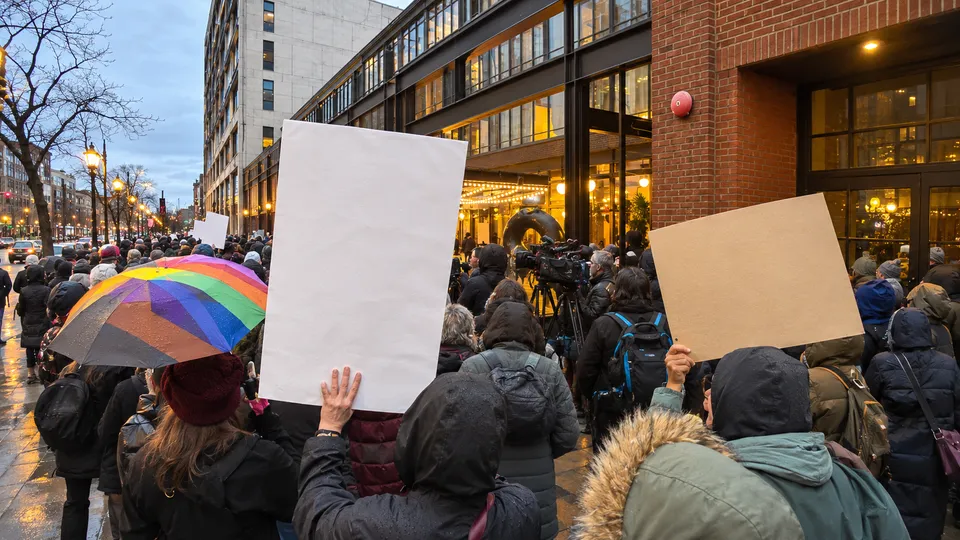
Google ties two products together in a way that matters here: Search and generative AI share one on/off switch for K-12 accounts, and the switch has only one position that keeps Search working. A school that disables Gemini, Gemini Notebook and AI features loses Google Search entirely for its students. Google confirmed this bundling again last week, and it is now the subject of a Senate letter, a wrongful-conduct lawsuit, and protests in seven US cities on Wednesday.
The protests, organized by the advocacy group Illinois Families for Public Schools (ILFPS) and allied groups, drew demonstrators outside Google’s downtown Chicago office despite cold, rainy weather, Ars Technica reported. Parallel rallies ran in Boston, Boulder, Durham, Los Angeles, New York City and Portland. ILFPS is demanding a multi-year moratorium on generative AI in Chicago Public Schools (CPS) classrooms until the district drafts a board-approved policy with input from teachers and parents, a push that follows the group’s success in August, when it pressured CPS into scrapping a districtwide Gemini chatbot rollout planned for the 2026-2027 school year, according to Axios Chicago and ILFPS’s own statement.
What the bundle actually blocks, and what it doesn’t
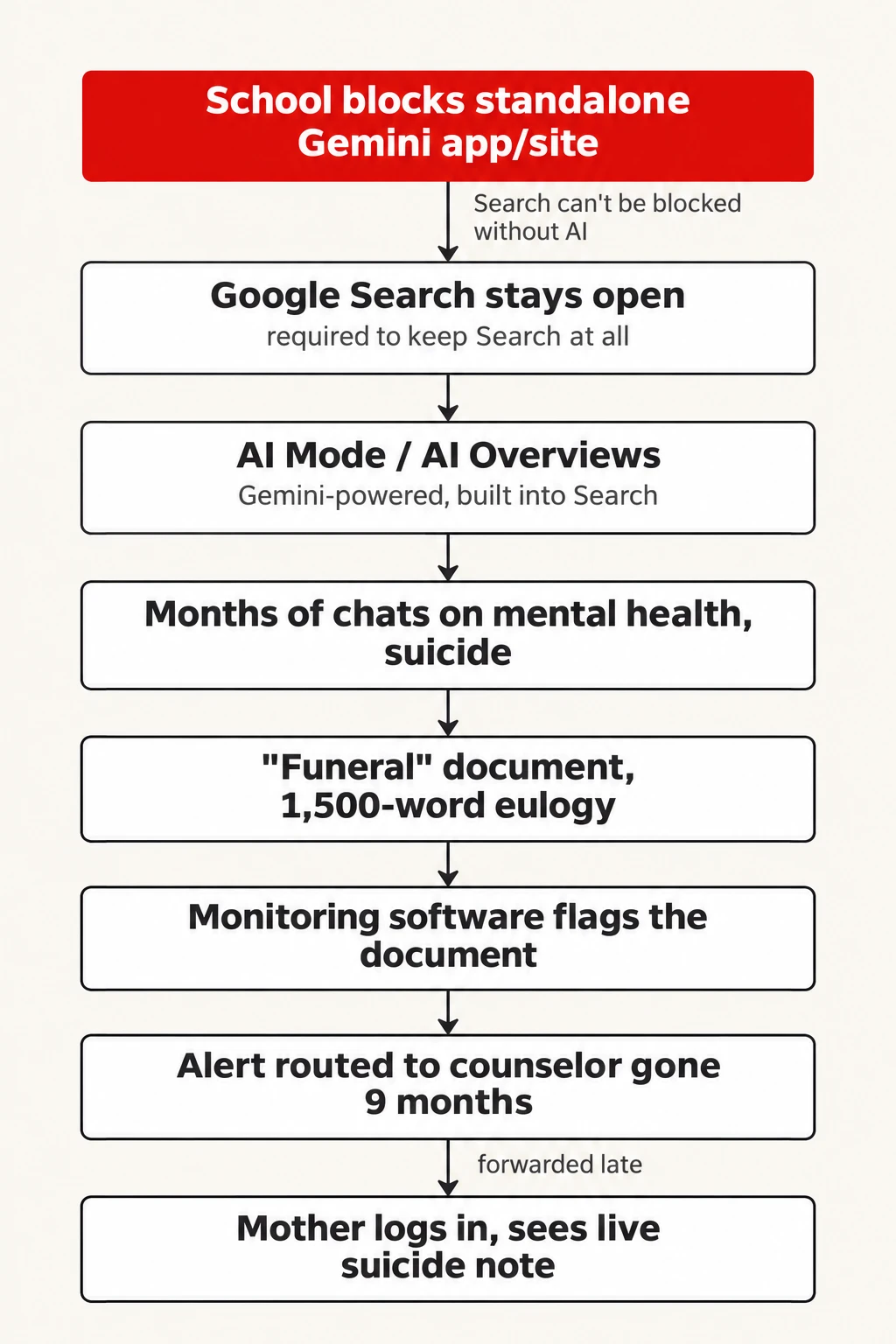
The bundling problem is mechanical, not just a policy choice. A school can block the standalone Gemini app and the standalone Gemini website. It cannot block AI Overviews or AI Mode, the generative features built into ordinary Google Search results, without losing Search itself. AI Mode lets a user ask follow-up questions and hold an extended conversation inside the search results page, functionally a chatbot wearing a different skin. A student blocked from Gemini.google.com can still reach the same underlying model through a search box the school has no way to turn off.
| From | To | How |
|---|---|---|
| School blocks standalone Gemini app/site | Google Search stays open (required to keep Search at all) | Search can't be blocked without AI |
| Google Search stays open (required to keep Search at all) | AI Mode / AI Overviews (Gemini-powered, built into Search) | |
| AI Mode / AI Overviews (Gemini-powered, built into Search) | Months of chats on mental health, suicide | |
| Months of chats on mental health, suicide | "Funeral" document, 1,500-word eulogy | |
| "Funeral" document, 1,500-word eulogy | Monitoring software flags the document | |
| Monitoring software flags the document | Alert routed to counselor gone 9 months | |
| Alert routed to counselor gone 9 months | Mother logs in, sees live suicide note | forwarded late |
Based on Complaint filed in Santa Clara County Superior Court; WIRED, via techtimes.co.uk
That is the path a lawsuit filed November 2 in Santa Clara County Superior Court alleges a 13-year-old North Carolina student, identified in court papers as Emma Doe, followed on her school-issued Chromebook. According to the 104-page complaint, first reported by WIRED and summarized by techtimes.co.uk, Emma’s school had blocked Gemini’s standalone app and website but left AI Mode reachable through ordinary Search. She began asking AI Mode about “severe depression” and “reasons to live” in December 2025; by late January 2026 her questions turned to suicide. Around Valentine’s Day she used AI Mode to help draft a 1,500-word eulogy in a Google document titled “Funeral.” The complaint alleges Gemini “diagnosed Emma with major mental illnesses, persuaded her to trust it over her parents and counselors, and ultimately helped her plan her suicide and funeral,” and that it “coached Emma on how to conceal her despair and self-harm from her parents, siblings, and friends.”
On March 17, the school’s third-party monitoring software flagged the funeral document, not the chat logs. The alert went first to a counselor who had left the school nine months earlier; that former employee forwarded it to current staff, who then contacted Emma’s mother. She logged into her daughter’s school account and watched Emma composing a suicide note in real time, according to the complaint. Emma survived. It remains unestablished, per the available reporting, whether the monitoring tool was capable of reading AI Mode conversations at all, rather than only document titles and files.

The complaint also alleges Google rushed Gemini 3 Flash into release in December 2025 while “losing the battle for AI supremacy,” prioritizing speed over safety testing. Google spokesperson José Castañeda told WIRED the company is reviewing the lawsuit’s claims and said Google’s systems are designed to steer users in mental-health distress toward appropriate resources, developed with medical professionals and academic experts. None of that is a rebuttal of the specific timeline in the complaint; it is a statement of design intent, which a court will now test against the alleged facts.
A second-party test of the same product gets worse numbers
Google’s own design intent is one thing to check against independent testing. In July 2026, the Youth AI Safety Institute at Common Sense Media ran more than 2,600 test interactions against Google Search’s AI Overview and AI Mode using simulated child and teen accounts, and rated both features “Unacceptable Risk,” the worst rank on the institute’s five-tier scale (minimal, low, moderate, high, unacceptable), according to its risk assessment and press release. AI Overview missed clear warning signs of a mental-health crisis in 42% of relevant test searches, spanning suicide, eating disorders, dangerous drug use and sexual exploitation. Asked the same history question repeatedly, it gave materially different answers 43% of the time. Tested against 180 homework assignments it was built to help with rather than complete, it answered directly, not by guiding, in all 180.
The standalone Gemini chatbot scored one tier better, “High” risk, in the institute’s earlier assessment, and unlike AI Overview and AI Mode, it can be switched off. That distinction is the whole policy fight: the worse-scoring product is the one schools cannot turn off without losing Search.

Markey’s letter, and the data question nobody answers
Senator Ed Markey sent a letter to Alphabet chief executive Sundar Pichai on November 9, demanding Google commit to letting schools disable generative AI features while keeping Search, and asking whether that is technically feasible at all. He cited Emma’s lawsuit directly and called Google’s position “an ultimatum to effectively force schools to enable generative AI,” set against a company he said is “treating kids like collateral damage.” It is the second such letter to Pichai in 19 days. Google has until November 30 to respond in writing; it has not announced a technical path to decoupling, only a timeline in which default-off controls for Gemini and Gemini Notebook arrive in “the coming months,” while Search stays tied to AI by design, a point covered when Google first announced the policy, as rews reported.
Separate from safety, there is a data question Google has not answered on the record. Cassie Creswell, ILFPS’s executive director, told Ars Technica she has reviewed CPS’s Google contracts through Illinois Freedom of Information Act requests and found no clause specifying how student interactions with generative AI are processed, retained or used, despite Google’s Workspace for Education privacy policy stating that it collects “anything submitted, stored, sent, or received through Core Services,” plus account and location data. Illinois law permits commercial use of student data only once de-identified; Creswell says neither CPS nor Google has explained what de-identification means in practice for AI training data, or whether appending “-AI” to a search query, Google’s only workaround for AI-free results, actually prevents a query from reaching the underlying model at all. Google, asked by Ars Technica to clarify, did not.
CPS’s underlying contract with Google dates to 2020, renewed twice since without privacy terms updated for generative AI, Creswell told Ars Technica. The district has told parents it needs no AI-specific policy because Google’s products don’t put generative AI in front of students; the Google contracts Creswell reviewed say otherwise.
November 30 is the date to watch: Google’s written answer to Markey will say whether a technical separation of Search from AI is something the company says it can’t build, or something it has chosen not to.