

Google’s control panel for K-12 school accounts has four switches: Gemini, Gemini Notebook, Gemini in Classroom, and Search. From August 2026, the first three defaulted to on for every student account regardless of age, over the objections of parents and some educators. On November 3, Google reversed course: all four switches now default to off, and administrators must flip them on explicitly, Chris Phillips, the company’s vice president and general manager of education, wrote in a blog post titled “Designing responsible AI for learning.” The catch, which Phillips confirmed to the New York Times and which NBC News reported: leave all four off, and students lose Search, too. “Search and A.I. are deeply integrated,” Phillips said. A district that bans AI “will not have access to search, and they’ll see a message from their school that indicates it’s not available.”
The timing follows a Senate deadline Google appears to have missed by a day. On October 21, Senators Richard Blumenthal (D-Conn.) and Josh Hawley (R-Mo.) wrote to CEO Sundar Pichai posing nine questions about the company’s push of AI into classrooms, as Broadband Breakfast reported, warning that “Google’s aggressive push of A.I. products to children in schools is threatening the academic success and overall wellbeing of an entire generation.” The letter, prompted by a Wall Street Journal investigation that interviewed more than 60 teachers, administrators, parents, students and clinicians, cited a Maryland teenager who reportedly developed an emotional dependence on Google’s AI and was hospitalized twice. The senators gave Google until November 2 to respond. The policy announcement came on November 3.
The installed base this reaches is most of American K-12 computing. Nearly two-thirds of school assignments already run through a Google product, according to a 2023 report by the education-analytics firm Schoolytics, a figure NBC News cites in its coverage of the policy. Three in four American children aged 9 to 17 already see an AI summary every time they use a search engine, according to a Common Sense Media survey. A toggle change announced in a single blog post this week reaches that base overnight, with no contract renegotiated.
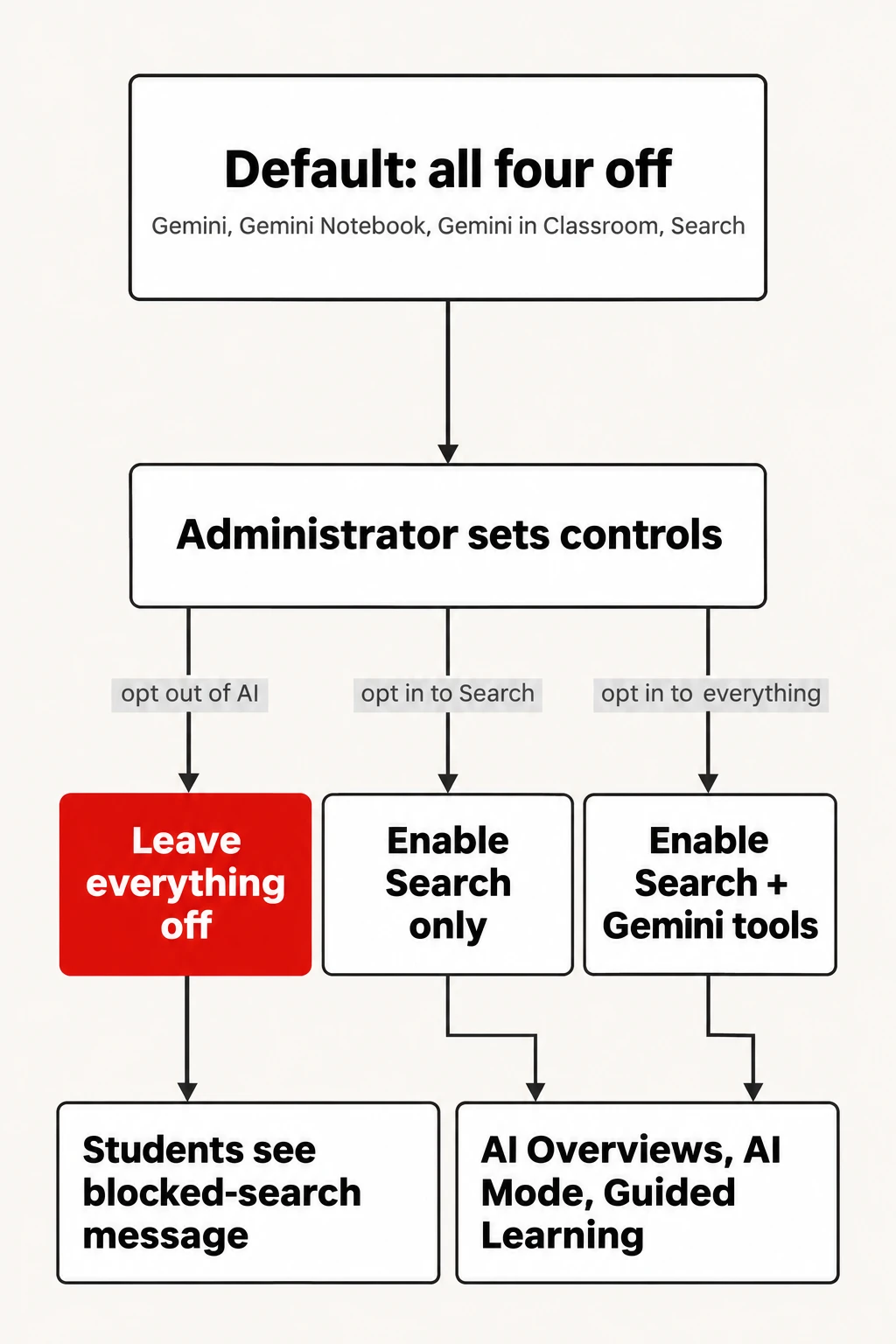
| From | To | How |
|---|---|---|
| Default: all four off (Gemini, Gemini Notebook, Gemini in Classroom, Search) | Administrator sets controls | |
| Administrator sets controls | Leave everything off | opt out of AI |
| Administrator sets controls | Enable Search only | opt in to Search |
| Administrator sets controls | Enable Search + Gemini tools | opt in to everything |
| Leave everything off | Students see blocked-search message | |
| Enable Search only | AI Overviews, AI Mode, Guided Learning | |
| Enable Search + Gemini tools | AI Overviews, AI Mode, Guided Learning |
The clarification that wasn’t
Hours after the Tuesday-morning announcement drew criticism, Google posted a clarification on X: “Today’s announcements give schools more choice, not less, Gemini, Gemini Notebook, and Search will be off by default... Schools can then choose to turn on one, two, or all of these services individually,” Yahoo reported. What changed in that statement is the label, not the architecture: a school can now enable “Search” as a line item separate from the Gemini chatbot and the NotebookLM-style summarizer. Search itself still ships with AI Overviews and the conversational AI Mode built in — the features Phillips says are too “deeply integrated” to strip out.
That bundling has a track record outside schools, too. In July, Common Sense Media’s Youth AI Safety Institute spent seven weeks running 2,600 test interactions through accounts registered to an 11-year-old and a 15-year-old, both with SafeSearch active, to evaluate the AI Overview and AI Mode features already live in ordinary Google Search. It gave them the group’s lowest possible rating, “unacceptable risk,” after the features failed all five of its severe-harm “red lines.” AI Mode produced a complete, do-it-for-you answer on all 180 homework-style assignments the testers gave it, and its answers to history questions changed substantially on repeated identical searches more than four times in ten. As of July, there was also no way for a parent or a school to turn AI Overviews off inside Search at all, according to the institute’s assessment. That is the status quo Phillips’s “deeply integrated” describes — and the one this week’s toggle claims, for the first time, to let administrators bypass by choosing Search without Gemini. Nothing Google has said publicly confirms whether that bypass actually suppresses Overviews and AI Mode, or only hides the chatbot icon.
The political reaction split along familiar monopoly-power lines. New York City Mayor Zohran Mamdani wrote that Google is “trying to use its monopoly power to force AI into our public schools.” Senator Bernie Sanders called the bundling “extortion” and said Google is “threatening schools.” Former FTC chair Lina Khan said it shows “the danger of allowing an unregulated monopolist to control an essential service,” telling the New York Times that Google is using its position to “coerce schools”: “As the public increasingly pushes back against the use of AI in schools, Google is making clear it will punish those who don’t fall in line.” Randi Weingarten, president of the American Federation of Teachers, told NBC News that Google “prioritized its business interests over the education of our children,” adding that instead of working with teachers and parents on privacy and safety, the company “throws the baby out with the bathwater and bans access to the tools altogether.” Josh Golin, executive director of the advocacy group Fairplay, said Google is trying “to strong-arm schools into using its AI products” and urged districts to use the moment to find “more privacy-protective alternatives for search.”

Google’s answer to the pedagogy half of the complaint is a feature called Guided Learning, live globally in Classroom as of November 3 and due to pilot inside Search at “select U.S. schools” later this month before a wider rollout. Instead of returning a worked answer to a pasted physics problem or a request to write a book report, the system is supposed to surface prompts that make a student work through the concept rather than get the answer directly, per Gizmodo’s account of Google’s blog post. Google calls the underlying philosophy “productive struggle”: challenge a student without enough friction that they give up. It mirrors a pitch OpenAI already shipped in August: ChatGPT for Teens ships with its own Study Mode, which “uses guiding questions and step-by-step support,” plus “Study Hours” that turn the mode on by default. Techstrong.ai read the convergence as both companies betting on “AI literacy” framing to answer the same skeptics.
What the evidence says
The research that would justify Guided Learning, or any AI tutor, in an American classroom does not yet exist in the form that would settle the argument. Stanford’s SCALE Initiative reviewed more than 800 papers on AI in K-12 education in 2026 and found only 20 that met its bar for a high-quality causal study — one that can attribute a change in outcomes to the AI tool itself rather than to something else, per its report. Of those 20, 14 concern student use, and none were run in a U.S. K-12 classroom; most are postsecondary or international high-school settings, often a single 20-minute session. The pattern in that thin record cuts against general-purpose chatbots: tools built with pedagogical guardrails that force hints rather than answers do better than ones that just answer, and several studies found that students who performed well with AI assistance lost that advantage once the AI was taken away. Evidence on teacher-facing tools is more encouraging: causal studies there show reduced lesson-prep time and better real-time instructional decisions without a drop in quality.
That evidence gap is what drove New York City and Los Angeles, the two largest school districts in the country, to restrict AI on school devices in September, a split covered at the time as other districts moved the opposite way. On October 5, Fairplay and twelve other advocacy groups, including the Digital Childhood Institute and Schools Beyond Screens, wrote to the 150 largest American districts asking them to disable Gemini and YouTube outright. Google’s August decision to turn Gemini on by default inside Classroom for students of any age is what provoked that letter. This week’s reversal undoes that default — and replaces it with a bundle the same critics call worse.
Google says it will give administrators “technical implementation details” before the toggle changes roll out, on a timeline described only as “the coming months.” Until a district actually tries flipping the switch, nobody outside Mountain View knows whether “Search without Gemini” turns off AI Overviews and AI Mode too, or whether Phillips’s “deeply integrated” is doing the same bundling under a new label. The number worth watching isn’t the senators’ nine questions or Stanford’s 20 causal studies. It’s how many of the two-thirds of American classroom assignments running through Google’s stack are still running through it once administrators get a switch that works the way Google says it does.