
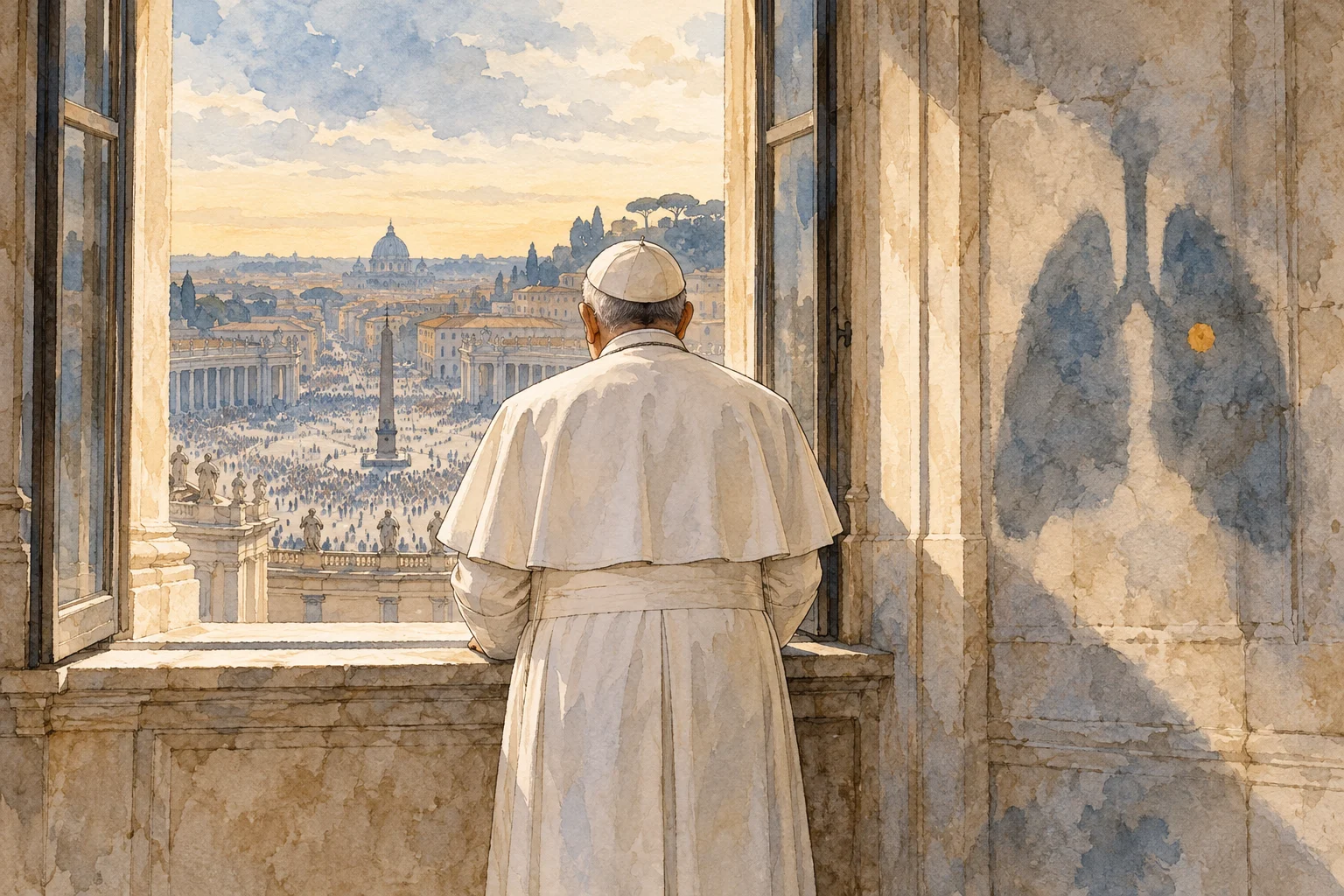
Sunday, 11 October, noon, St. Peter’s Square. Pope Leo XIV had already given the crowd its usual portion. He preached on the Gospel of the wedding feast, the banquet a king lays on for his son, and according to the Vatican’s text of the Angelus he called Christian joy “profound, concrete, and real.” He turned to the war in Ukraine and to the grain that cannot cross the Black Sea. “The daily bread of millions of people cannot be held hostage by war,” he said, as NPR’s Ava Pukatch reported. The day before, on X, he had called the death penalty “inadmissible because it is an attack on the inviolability and dignity of the person.”
Then, at the very end, speaking in Italian, the 71-year-old pope talked about his own body.
During a recent medical check, doctors found a small, localized nodule in my lung. It was detected at a very early stage and is circumscribed. The doctors believe it’s best to take action, so, following their advice, I’ve decided to have surgery to remove it.
That is how the Associated Press rendered his words, carried by the New York Post. “The surgery is already scheduled for the coming days,” he went on. “Thank you for your spiritual support, and I entrust myself to your prayers.” NPR’s version of the thanks ran a little differently: “I thank you for your spiritual closeness and entrust myself to your prayers.” Translators disagree on small things. On the main facts they all agree.
The communiqué
After the pope had spoken, his spokesman took over. Matteo Bruni, director of the Holy See press office, answered reporters: “the operation is scheduled for the first days of this week and the estimated post-operative recovery time will be about one week.” OSV News reported the second half of that sentence differently, as an expected post-operative hospital stay of about one week. A week of recovery and a week in hospital are not the same thing, and the difference may become clearer later. Bruni gave no date beyond the first days of the week.
The place, at least, was never in doubt. Bruni confirmed the operation would be at Rome’s Gemelli Polyclinic, where popes go for treatment, the US bishops’ news service reported, and where a suite on the tenth floor is kept for the pontiff. Francis was treated there, and so were the popes before him.
What the Vatican did not say also matters. It has not said whether the nodule is cancerous. It has not given the size, said which lung, or described the surgical method. The Sicilian daily La Sicilia reported that the nodule turned up a few days earlier, during tests for a suspected inflammation. The Vatican has not confirmed this.
Medicine defines the thing more plainly than the Holy See does. The American Cancer Society, cited by NPR, describes a lung nodule as a small abnormal area of 3 cm or less, often found on a chest or abdominal CT scan done for some other reason. Euronews quoted the American Lung Association, which calls it a “small mass of dense tissue on the lung” and says most are benign, though some are cancerous. “If the nodule looks cancerous (malignant) or your health history suggests a higher risk for cancer, physicians will order tests to learn more about your nodule(s),” the association says.
The tennis player and the old man’s lungs
Until Sunday the Chicago-born pope, elected in 2025, had no known health problems. CBS News, drawing on AP, describes a man who plays tennis every week and swims at the summer retreat in Castel Gandolfo. Only last month he was moving briskly through Paris and Lourdes, warning France about the machines.
Rome remembers the lungs of the last pope. Francis had chronic lung disease and lost part of one lung as a young man. He died on 21 April 2025, of a stroke, after a long hospitalization that started with a respiratory crisis and became double pneumonia. For weeks that winter, the city read bulletins from Gemelli.
Giorgia Meloni was one of the few outsiders who visited Francis in that last hospital stay. On Sunday the Italian prime minister sent Leo her support and the Italian government’s “as he faces this challenge in the coming days.” She said “the serenity and calm with which he spoke about it” were reassuring.
A reflection, and nothing more: a body that holds power is never entirely private. Courts have often learned too late what their rulers’ doctors already knew. On Sunday the body spoke first, through its owner, from the window. The communiqué came afterwards.
The road south
The calendar does not move for anyone. From 6 to 17 November Leo is due in Uruguay, Argentina and Peru. Angelus News put this trip less than a month away, and the US bishops’ service called it his longest journey abroad so far. Earlier in the same address, according to the Vatican text, he thanked a Peruvian group “for your prayer for my apostolic visit that I will make to Peru.” He said he means to go. Whether the surgery and the recovery will allow it is still unclear.
For now the Vatican has given a hospital, a stretch of days and a recovery of about a week. It has not named the date.