
By 1pm on Saturday, France’s interior ministry had logged 32,800 demonstrators across 140 separate actions in the provinces — not counting Paris — and 166 arrests nationwide, in a live count relayed through Le Monde. Two hours later the national arrest tally had climbed to 272. By the end of the day, the CGT, France’s largest trade union, was claiming more than 500,000 people had taken part across the whole country, as Al Jazeera reported. Nobody in the record so far has reconciled the two numbers, because they were never measuring the same thing: one is a police headcount of people physically present at specific locations at specific hours, the other is a union’s own estimate of everyone who marched, blocked a roundabout, or picketed a fuel depot anywhere in France over the course of the day.
The gap is not new. Even the pre-event planning numbers didn’t agree with each other. Authorities’ official estimate, cited by France 24, put likely nationwide turnout at 70,000 to 140,000. A police source cited by the same outlet put it higher before the march even started: roughly 150,000 outside metropolitan Paris plus 40,000 in the capital, close to 190,000 — above the ministry’s own ceiling. On the logistics side, the interior ministry’s count of planned disruptions, roughly 500 actions and more than 90 structured marches, was dwarfed by the Yellow Vests’ own figure for their coordination site: around 1,500 planned actions nationwide, a count never audited by anyone outside the movement.
What made October 17 different from the preceding four weeks of unrest was its attempt to fuse three separate grievance machines into one march, under the slogan “Yellow Vests and Youth, Our Struggles Meet.”
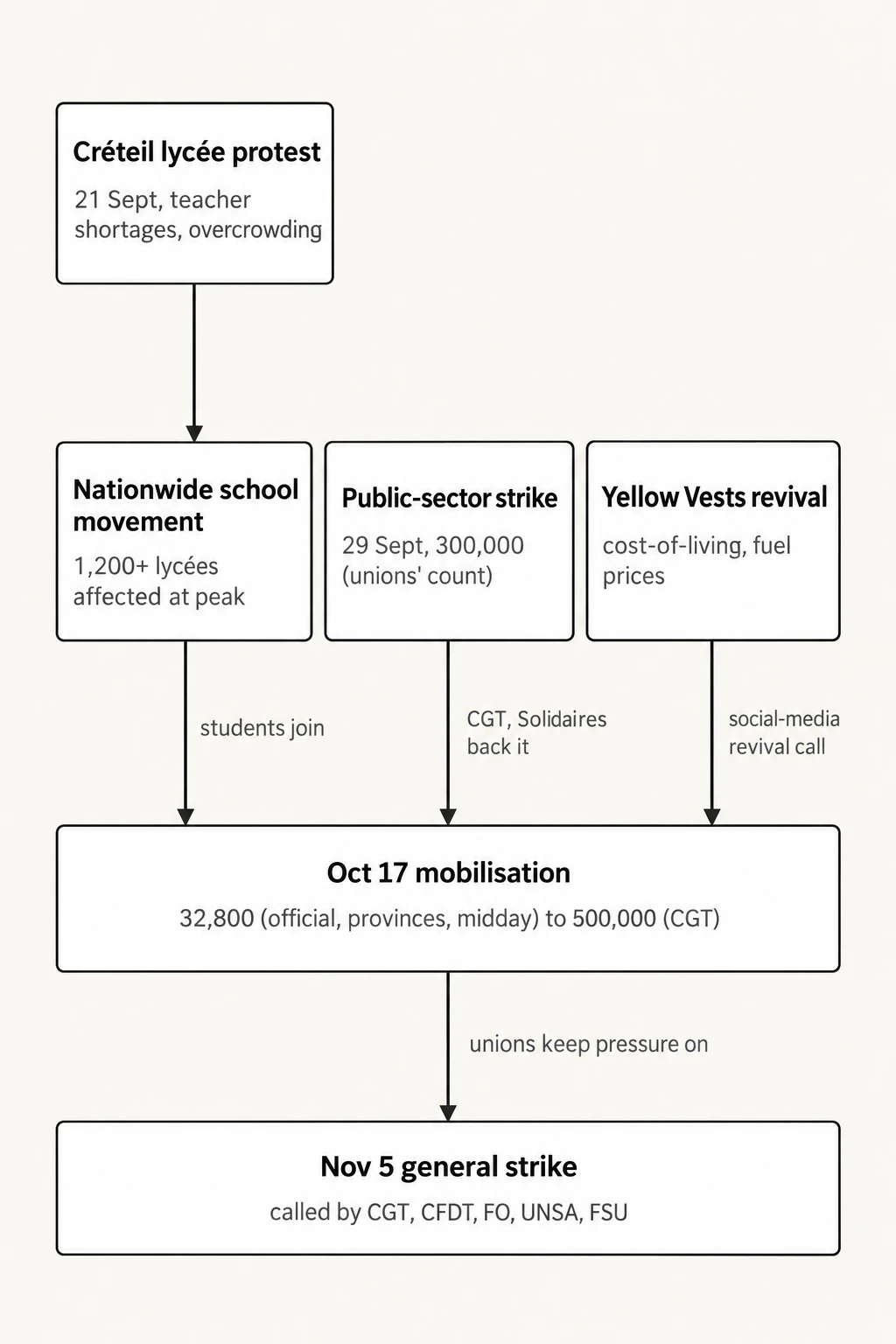
| From | To | How |
|---|---|---|
| Créteil lycée protest (21 Sept, teacher shortages, overcrowding) | Nationwide school movement (1,200+ lycées affected at peak) | |
| Nationwide school movement (1,200+ lycées affected at peak) | Oct 17 mobilisation (32,800 (official, provinces, midday) to 500,000 (CGT)) | students join |
| Public-sector strike (29 Sept, 300,000 (unions' count)) | Oct 17 mobilisation (32,800 (official, provinces, midday) to 500,000 (CGT)) | CGT, Solidaires back it |
| Yellow Vests revival (cost-of-living, fuel prices) | Oct 17 mobilisation (32,800 (official, provinces, midday) to 500,000 (CGT)) | social-media revival call |
| Oct 17 mobilisation (32,800 (official, provinces, midday) to 500,000 (CGT)) | Nov 5 general strike (called by CGT, CFDT, FO, UNSA, FSU) | unions keep pressure on |
The school leg of the movement started on 21 September at Lycée Antoine-de-Saint-Exupéry in Créteil, over teacher absences, overcrowded classrooms and shabby buildings, and spread through the Paris suburbs before going national. By 6 October, the government’s own count of participants had already more than doubled from where it started, as rews reported: the state put nationwide turnout that day at 250,000, unions at 450,000 — the same measurement gap, a month before October 17, running at a ratio of 1.8 to 1 rather than the roughly 15 to 1 implied by comparing the lunchtime official count to the CGT’s evening claim on the 17th. Cumulative Justice Ministry figures as of 6 October put total arrests since 21 September at 5,060, 87 percent of them minors, with 1,800-plus facing prosecution and 790 cases already dismissed; Le Monde’s own running count, covering a slightly longer window to 8 October, had reached 6,877 arrests. Lecornu’s office counted 715 police officers and 215 teenagers injured over the same stretch. One of those injuries became its own story: a 15-year-old in Lens lost a hand to a police grenade on 5 October, as rews covered.
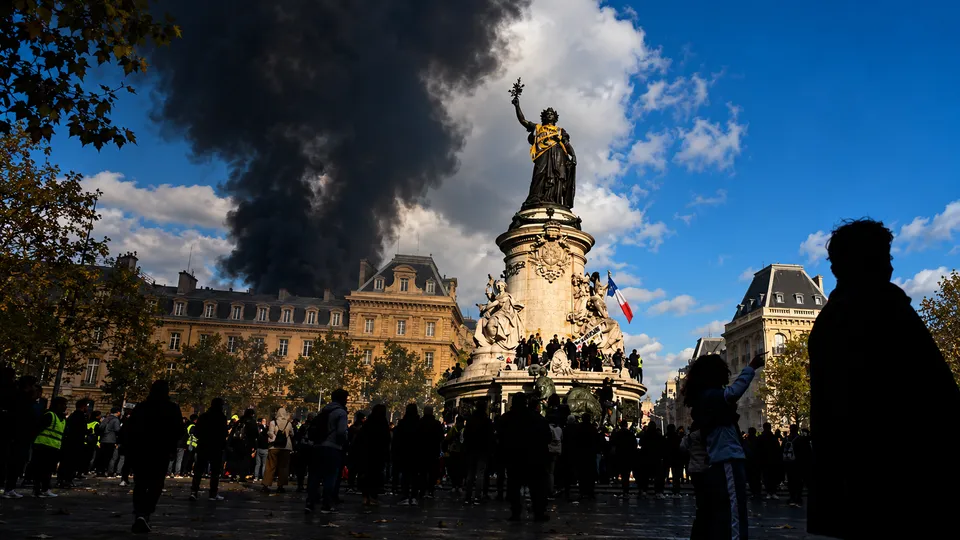
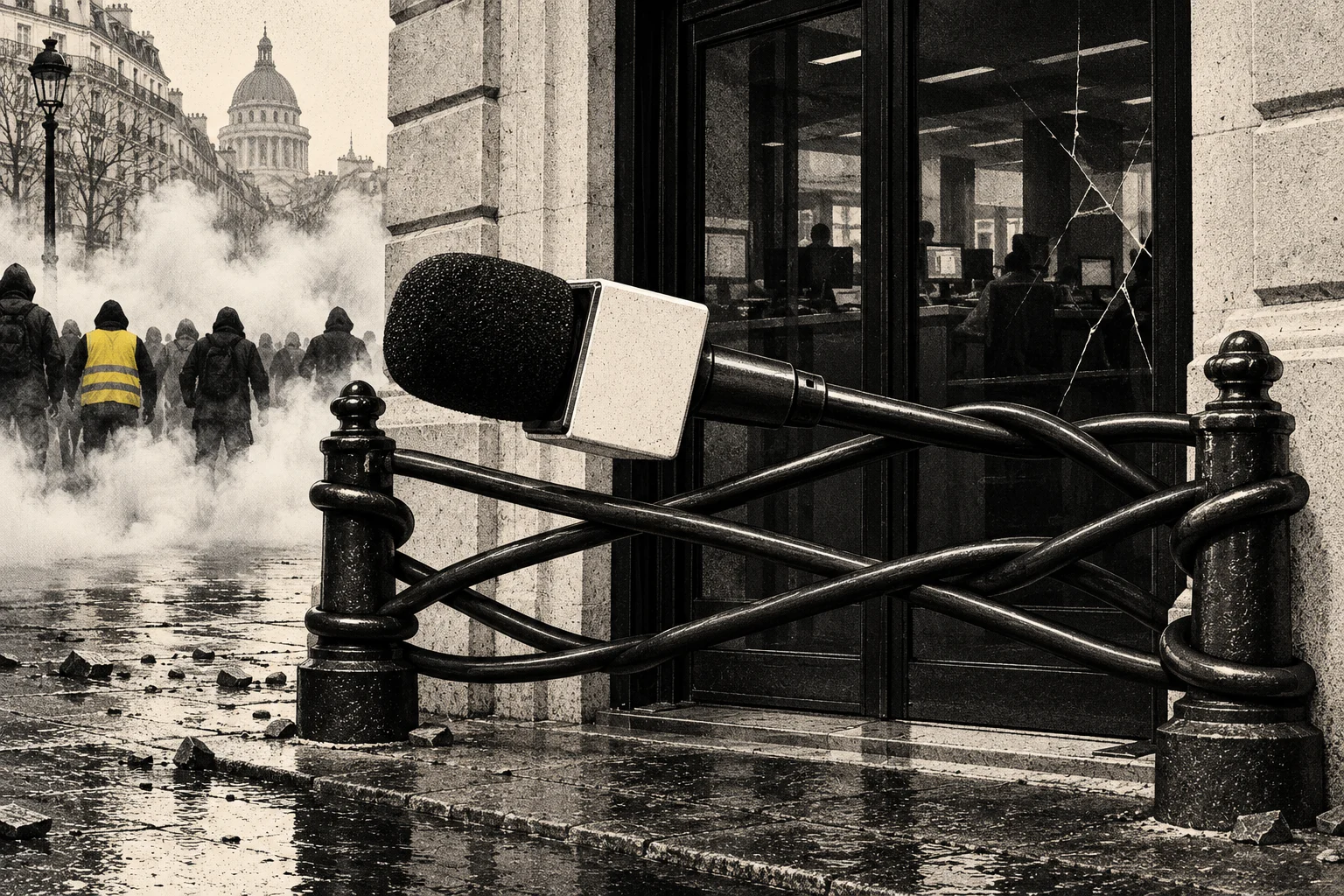
On October 17 itself, Paris saw tear gas deployed at Place de la République before the main march had even departed, after two spontaneous processions were dispersed in the morning; one offshoot column got to within 150 metres of the Élysée before being stopped. A car and a newspaper kiosk were set on fire. By 11am the Paris police prefecture had recorded 61 arrests and 589 preventive stop-and-searches in the capital alone. The most pointed incident of the day: roughly 100 masked people blocked the car-park entrance to the Paris headquarters of the broadcaster CNews, which also houses the Europe 1 newsroom, threw projectiles and smashed windows before 21 of them were arrested, an episode TRT Français tied to a wider pattern of press obstruction the day drew criticism from Reporters Without Borders for.
Outside Paris, Marseille saw shops damaged, a municipal police station targeted and protesters briefly inside the town hall lobby, where fittings were damaged. In Lyon, riot police used tear gas to clear a gathering near Lyon III university and again near a tourism office where a protester threw a projectile; near Place Bellecour a police officer was evacuated and a second person carried away on a stretcher, with neither person’s condition confirmed. Arrests were also reported in Rennes, Toulouse and Angers, while the Solidaires union had separately called supporters out in Dijon.
Prime Minister Sébastien Lecornu had set the government’s tone two days earlier, saying Thursday that what began as a school movement had turned into what he called “un mouvement de violences urbaines” — a movement of urban violence — a sharper line than his offer a week and a half before of fuel-price relief and a consultation process, as rews reported. Interior Minister Laurent Nuñez warned that blockades of “structuring routes and major, important, essential facilities” would not be tolerated, and said stun grenades — suspended for use against the school protests specifically — could return for incidents of “extremely serious urban violence.” Lecornu convened an interministerial crisis cell on Saturday at the level of ministerial chiefs of staff. The interior ministry attributed the disorder to “hooded individuals” and the “ultra-left”; Matignon had earlier characterised the broader unrest as a manoeuvre organised by La France Insoumise and allied groups, a framing the party’s leadership rejected. Speaking from Brussels on Friday, President Emmanuel Macron defended the right to protest while urging respect for other people and their property, without addressing the specific grievances driving the movement.
The chart puts October 17 in context. Even on the most generous reading — the CGT’s 500,000 — this mobilisation falls well short of the original Yellow Vest movement’s official peak of 287,710, counted by the interior ministry on 17 November 2018, a figure the police union France Police–Policiers en colère disputed at the time as too low by a factor of more than four, putting its own estimate at 1.3 million. The quarrel over who counts crowds correctly in France is eight years old and unresolved; October 17 simply reran it with new participants.

Underneath the headcount dispute is a budget dispute. France’s 2026 budget was adopted in early February after four months of parliamentary deadlock and two failed no-confidence votes, as Al Jazeera reported at the time; it combined deficit-reduction measures with higher military spending. Its education provisions, according to Morocco World News, included cutting 1,588 teaching positions, reducing university funding by €200 million, and freezing housing benefits and student grants — the specific line items the lycée movement in Créteil was reacting to. CGT general secretary Sophie Binet has called the follow-on 2027 budget plan one that “sacrifices young people,” dismissing the government’s concessions so far as “cosmetic announcements” and saying “we cannot play Russian roulette with our children’s future.”
That 2027 budget is also why October 17 was not the end of the calendar. A five-union coalition — CGT, CFDT, FO, UNSA and FSU — has called a national strike and demonstration day for 5 November, as vousnousils.fr reported, demanding higher wages, pensions and the minimum wage, and protesting roughly €43 billion in public savings the unions attribute to the 2027 budget plan, alongside what they put at €211 billion in public aid to businesses they want evaluated and conditioned. A first public-sector strike day on 29 September, under the same banner, drew a union-claimed 300,000 people nationwide — a figure, like all the others in this story, that the government has never matched in its own count.
What the interior ministry’s final, reconciled nationwide figure for October 17 actually was had not been published by the time this was filed; the available numbers stop at the midday partial count and the day’s arrest tallies. Whether November 5 draws more people than October 17’s disputed total, by either side’s counting method, is the next data point that will tell you whether the three movements that marched under one banner on Saturday are actually converging, or just agreeing to share a date.