
In 2022, in Benin, a security officer named Anicet Etekpo clicked on a Facebook link sent by someone he believed was his friend. “The link led me to a fraudulent platform that asked for my personal information, including my bank account,” he told the BBC’s Adrienne Bernhard. He lost a significant sum of money and began to doubt the safety of everything about himself he had put online. He had been on the internet for only a few years. The men who took his money had been waiting for people exactly like him.
There will be more of them, in numbers that belong to the histories of migration rather than of technology. An estimated 2.6 billion people, roughly a third of humanity, still have no internet access; if connectivity keeps spreading at its current rate, about two billion more will come online by 2030. They will meet spam, ransomware and fake websites for the first time. For the cybercriminal it is a gold rush. For the arrivals, the systems that might protect them, digital literacy training, consumer fraud law, have not grown at the same pace as the cables and the towers.
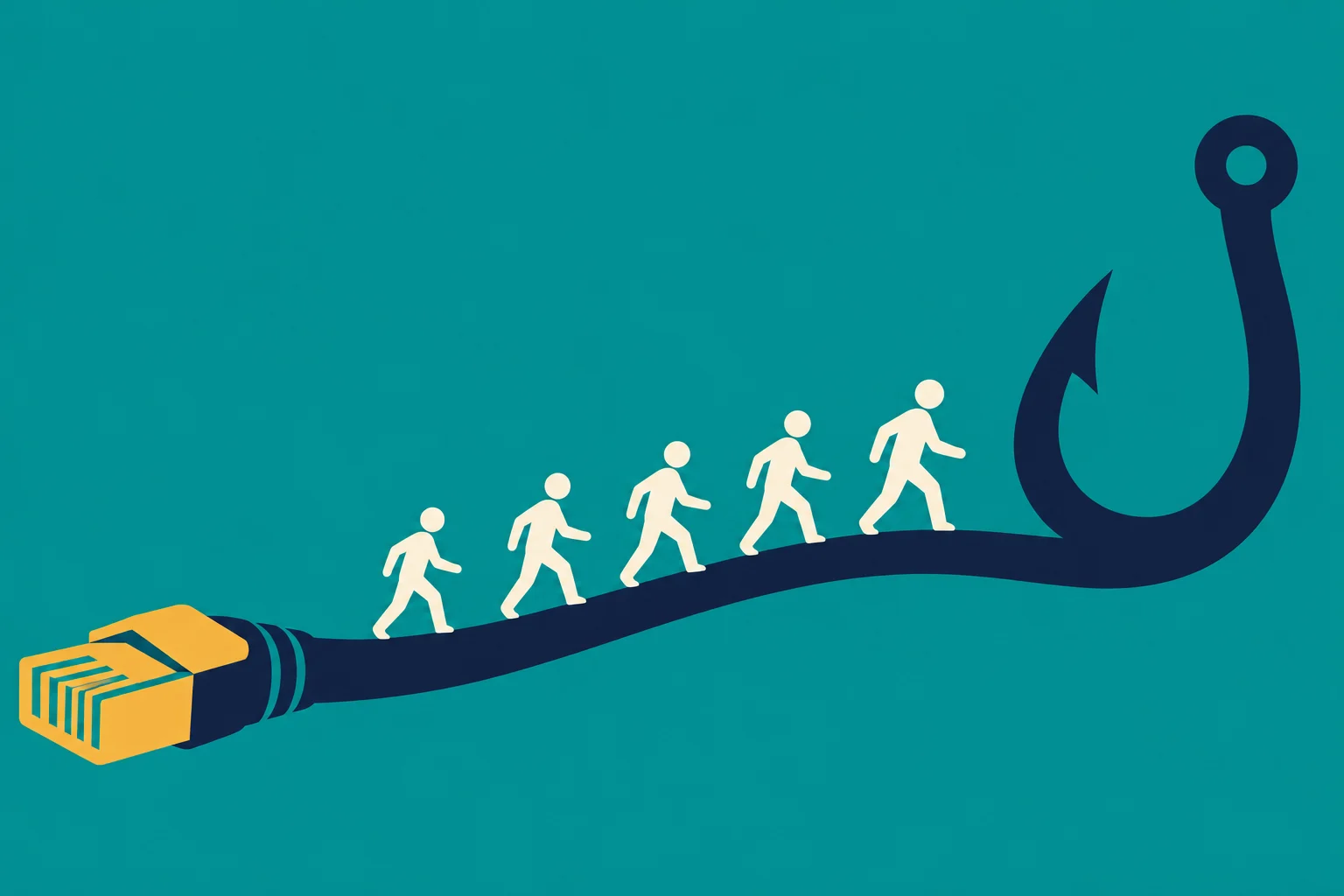
The professionalization of deceit
“What we’re seeing is an increasingly professionalised and opportunistic cybercrime ecosystem,” says Zeki Turedi, field chief technology officer at CrowdStrike. The old scam was a badly spelled letter from a prince; the new one is automated, AI-assisted and tailored, impersonating a local bank in the local language, offering fake government assistance, hiding spyware inside mobile apps that look benign. “We expect this to intensify as criminals adapt their tactics for AI-generated content and deepfakes,” Turedi adds. On dark-web forums and encrypted channels the trade is coordinated, and some groups sell what they call starter kits: pre-packaged phishing supplies and stolen credentials that let a technically unsophisticated man enter the profession the way a franchise lets a man open a restaurant.
International law enforcement has taken note; agencies warn that cybercrime has become organised and commercialised, and the International Telecommunication Union’s Global Cybersecurity Index lists fraud, phishing and rising ransomware among the dangers facing new users. But watch where the institutions point their tools. The UN Office on Drugs and Crime builds detection technology and native security measures. The FBI keeps specially trained cyber squads in every field office. Britain’s National Crime Agency has run successful international investigations into criminal gangs. These are instruments of after. They investigate the crime. The new user’s problem arrives before.

The least connected continent, the fastest growing
Africa remains the least connected region on Earth and one of the fastest-growing in internet adoption. South Africa and the Seychelles approach 80 percent penetration, while rural Benin and the vast Democratic Republic of the Congo stay largely offline; satellite connections are expensive, fixed-line infrastructure thin and unreliable. The number of internet users in Africa is forecast to grow by more than 280 million over the next four years. According to Interpol, cybercrime-related losses on the continent have more than doubled since 2024, from $192m (£141.5m) to $484m (£357.6m). “I felt very vulnerable,” Etekpo said of his own loss, and he locates the vulnerability not in ignorance but in trust: “Many people trust their online contacts and react quickly, without verifying a message’s legitimacy.” The weakness the web now manufactures is, in the end, the oldest one of all, the confidence between people.
Governments are experimenting. The African Union made cybersecurity a priority under its Agenda 2063; Interpol teaches African police agencies and small businesses to fend off scams. Myanmar’s Department of Foreign Affairs funded an awareness campaign aimed specifically at new users after the country’s rushed 2010s expansion online. Nigeria revised its Cybercrimes Act in 2024 with protections for emerging digital markets. India built a national hotline where victims can report a scam at once and freeze stolen funds through banks and payment apps, the closest thing anyone has built to an instrument of before.

Yet the state is an ambiguous guardian of the screen. “Governments implement digital lockdowns, [preventing] open use of communications during elections, civil disruptions or national disasters,” notes Robert Anderson, founder of Telecom4Good, a nonprofit that helps other nonprofits obtain safe, affordable connectivity. The ministry that promises to protect the citizen from the swindler keeps, in the same drawer, the key that silences the citizen. The technology companies, for their part, pledge much: Microsoft’s 2018 Cybersecurity Tech Accord gathers more than 150 firms behind foundational principles, and Google’s Kimberly Samra points to its password manager, two-step verification, passkeys and Advanced Protection Program. Asked about a cybercrime gold rush, Samra answered: “I don’t think we have much visibility there, given it’s speculative.”
Speculative. By 2030, industry forecasts say, more than 38 billion devices, power plants, pacemakers, self-driving cars, will be connected, each one a door. “The challenges the new wave of internet users will encounter are considerable,” says Turedi, who recommends that organisations treat cybersecurity “not as a checklist, but as a continuous process of improvement.” The empires of the network extend themselves into the last unconnected villages of the earth, and where the flag goes, the grifter follows; he has always followed. The question the BBC leaves hanging is no longer whether the two billion will meet him, only how ready they will be when they do.