
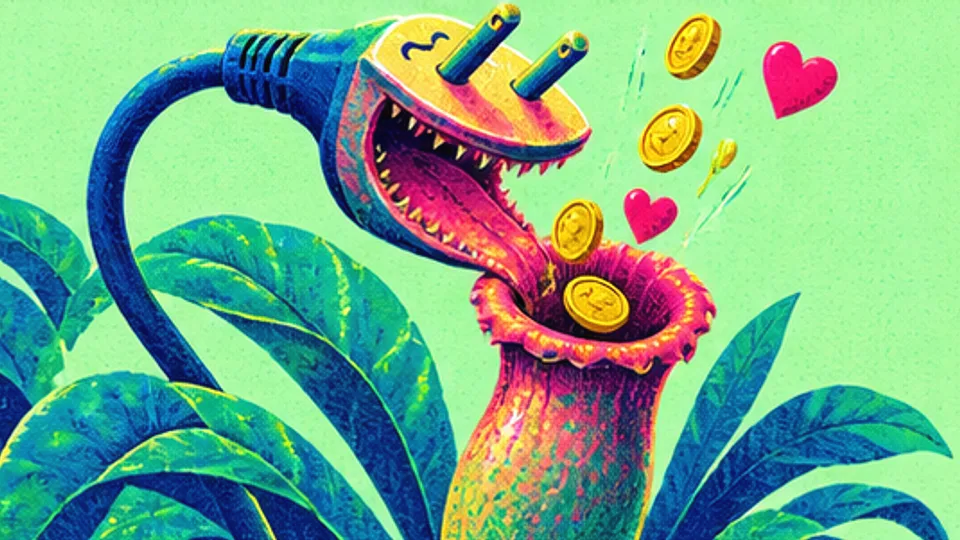
Stephen Diehl, the programmer and essayist best known for his long-running campaign against cryptocurrency, has published a new piece arguing that the internet’s problem is no longer that it contains scams. The problem, he writes, is that it has become one. Predation “used to be an abuse of the network,” he says. “Now it is the network’s organising principle.” Where a scammer once had to hunt for a victim, “the platform now finds one, profiles the weakness, optimises the pitch, processes the payment, and recommends the next scam.”
He’s careful to note this is not nostalgia talking. The early internet of dial-up modems, Usenet flamewars and dancing babies — which he remembers as a “public square assembled by obsessive amateurs” — already had its scams, viruses, Nazis and chain emails from deposed Nigerian princes. But most of it had no business model, and that, he says, “was the literal point.” The difference between the old web and the new one is not innocence lost. It is that the extraction has been professionalised.
The core of the essay is an argument about business models, and it’s worth taking seriously because it is unusually crisp. “A legitimate business can survive a satisfied customer. A grift cannot,” Diehl writes. A normal transaction ends when a need is met: you buy a chair, you sit in it, you stop thinking about chairs. The online grift, by contrast, “needs the customer frightened, aggrieved, lonely, sick, or greedy forever.” So: the grievance merchant cannot resolve your grievance, the wellness influencer cannot let you feel well, the trading guru cannot let you become financially secure, and the manosphere podcaster cannot let young men become calm, loved and socially competent. He lands the punchline in two pairs: “Satisfaction is churn. Misery is recurring revenue.”
Imagine, hypothetically, you ran a subscription business whose product was fixing a problem, and your revenue went to zero every time you succeeded. You would learn, quickly, not to succeed. Diehl’s claim is that the attention economy learned that lesson at industrial scale, and that its reinforcement-learning recommendation loops — optimising for attention, retention and conversion — run continuous experiments on human weakness that the subject can’t see, the operator can’t fully explain, and the regulator can barely comprehend. “Calm accuracy loses. Threat, transgression, humiliation, and impossible promises win.” The social cost, he says, shows up nowhere in the objective function: “It arrives as an externality.”
The second part of the argument is stranger and, I think, the more disturbing one: the grift is “participatory.” Diehl admits that when he started writing about crypto in 2020, he assumed the grifter class was “a small pool of degenerates” preying on vulnerable people. He now thinks he was badly wrong — that a large share of the population devotes its waking hours to fleecing its fellow man as a career, turning “every friendship into a lead and every conversation into a qualifying call.” Almost none of them succeed, and that, he says, is part of the trick. The aspiring influencer with forty-seven followers is not an entrepreneur; he is “free labour for the platform and cheap distribution for the person selling him the dream.” The affiliate marketer buys a course on affiliate marketing and sells it to the next affiliate marketer; the dropshipper sells tutorials to failed dropshippers. “The pyramid is social before it is financial.”
This is why he finds the predator-prey line blurry. Many grifters are themselves marks who believe what they sell “because belief makes the selling bearable” — having sunk money, identity and public dignity into the scheme, admitting the product is worthless would mean admitting years of their lives were worthless too. Recruiting another victim is psychologically cheaper. “The fraud sustains the faith, and the faith sustains the fraud.”
Crypto, inevitably, gets star billing as “the apotheosis of the grift economy” — the point being not the asset itself but its recursive structure. Promotion moves the price; the price movement is presented as proof of adoption; the proof recruits new buyers; their money moves the price again. Every holder has a financial incentive to become a publicist for his own position. The asset, he writes, “comes with its own volunteer propaganda network. It is a pyramid scheme with a podcast department.” His dismay is that the rest of the internet has learned the same trick: sell people a worldview instead of a product, and they advertise it for free, because criticism of the product now registers as criticism of the self.
The essay closes on language models, which he says will push the cost of producing plausible lies to “precisely zero.” A grift no longer needs conviction, charisma or a pulse — just a model, an affiliate account, and an audience “whose critical faculties have been sandblasted by twenty years of algorithmic media.”
When the piece was shared on Hacker News, the response split neatly between the doomy and the stubborn. One commenter, Biologist123, wrote: “I sense my internet addiction got a lot worse in recent years... Like putting an alcoholic to work behind a bar and thinking he’d restrain himself... I’d like out, but the dealers are on every corner.” Another, GlibMonkeyDeath, pushed back: the old internet of futile blogs and how-to videos is still out there, no one is stopping you, and “the only way out is: don’t go to the casino in the first place.”
Both of those can be true, of course, and the tension between them is sort of Diehl’s thesis. If the old web is still available but the money has followed the casino, then the interesting question isn’t which internet exists. It’s which internet the incentives keep building.