
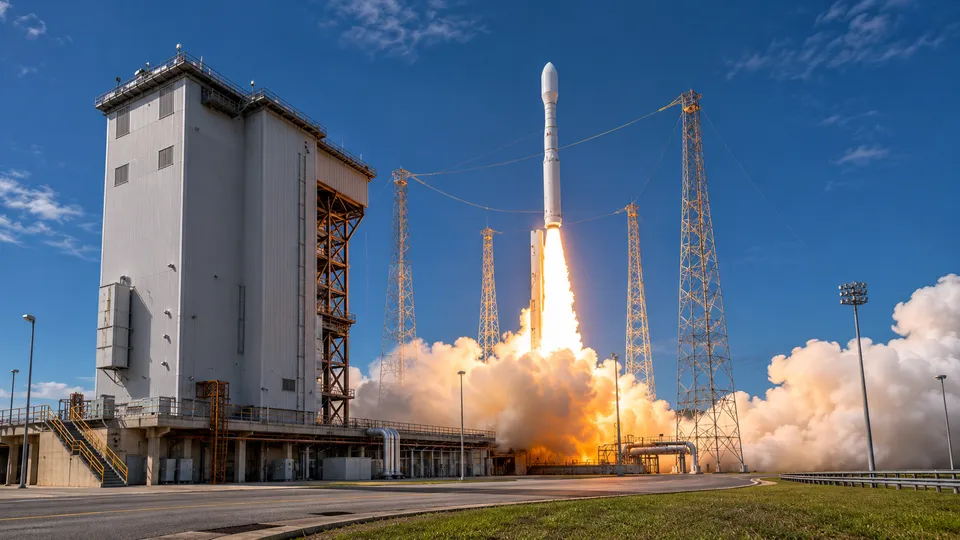
ICEYE, the Finnish radar-satellite operator, offered €41.00 a share for Avio, the Italian rocket maker — about €2.05 billion, which Reuters converts to $2.2 billion, as Ars Technica’s Stephen Clark reported on Tuesday. The all-cash bid, run through an Italian subsidiary called Iris 2 S.p.A, sits 21.3% above Avio’s Monday closing price and 34.8% above its three-month average, according to ICEYE’s own tender notice. Avio’s board says it has only “taken note” of the offer so far. Leonardo, the Italian state-backed defense group holding an 18.04% stake, has given an early nod — CEO Lorenzo Mariani called it “a good signal,” Breaking Defense reported.
What Avio makes is Vega C, a solid-fueled rocket that lifts up to 3.3 metric tons to low-Earth orbit. It has flown seven of eight missions successfully since 2022, following an earlier Vega that went 20-for-22 since 2012. Final assembly happens at a factory near Rome, the rocket flies from Kourou, French Guiana, and Avio only took launch operations in-house from Arianespace this year. The European Space Agency is effectively the only customer that matters: Vega C’s commercial order book is thin, and the rocket flies, on average, fewer than three times a year.
The price tag explains why. A dedicated Vega C launch runs about $55 million for 3.3 tons, or roughly $16,700 per kilogram. NASA’s own cost reference puts a dedicated Falcon 9 at $67 million for 22,800 kg to orbit — $2,940/kg, a figure that’s almost certainly stale by 2026 but is the only on-the-record number that pairs cost with mass. Even on that old number, Vega C costs about 5.7 times as much per kilogram as the rocket it nominally competes with. Almost none of ICEYE’s satellites have ridden on Vega C; nearly all went up as Falcon 9 rideshare payloads at roughly $700,000 a slot, a program SpaceX plans to retire after 2028 in favor of Starship flights reserved for its own Starlink and Starmind satellites. Fold Avio’s books into ICEYE’s and a comparable satellite could launch on Vega C for two to three times the old rideshare price — $1.4 million to $2.1 million, by Ars Technica’s math.
ICEYE’s own numbers explain why it can make that bet. The company says it has launched 84 synthetic-aperture radar satellites since 2018; Breaking Defense, citing Reuters, puts the operating constellation at 77 — the gap between the two counts, neither broken down further by either outlet, is presumably attrition, since small SAR satellites in low orbit carry limited propellant and have a limited working life. ICEYE closed a €450 million Series F round in June led by General Atlantic, putting its valuation at €10 billion ($12 billion) — roughly four times what it was six months earlier — and giving Finland’s sovereign-wealth arm Solidium a 12% stake, Via Satellite reported. ICEYE reported €250 million ($289 million) in 2025 revenue and says it can build 50 satellites a year now, aiming for 100 by 2028, on top of turnkey satellite sales to the governments of Finland, Poland, Germany, Sweden, Portugal, Greece and the Netherlands.
Sovereignty, not just satellites
ICEYE’s radar data already feeds Ukraine’s tracking of Russian troop movements. Its reach is about to extend into communications: on October 22, during the Finnish prime minister’s visit to Kyiv, Ukraine’s defense ministry signed a letter of intent with ICEYE and fellow Finnish company Nokia to explore a sovereign low-orbit broadband constellation, CNBC reported — ICEYE’s first move into communications satellites, built on Nokia’s network-security experience. The letter followed Ukrainian officials’ reports of new restrictions on Starlink and Starshield service, which SpaceX’s Elon Musk attributed to alleged terms-of-service violations after Ukraine’s military began striking Russian oil refineries. President Trump called Musk on October 23 to ask that the restrictions be lifted, according to airforce-technology — an episode that other NATO governments have already treated as reason enough to diversify away from a single American supplier.
Modern warfare has proven that reliable communications are a matter of national security. We must all rely on capabilities that we can control.
ICEYE and Nokia have set a target of 50 satellites launched per year starting in 2028, without publishing expected throughput, latency, or the total constellation size needed for coverage — likely hundreds to thousands of satellites, depending on altitude. Starlink runs more than 11,000 operating satellites today for comparison. There is, as yet, no signed contract behind the letter of intent, only the intent — and the launch vehicle for those 2028 satellites doesn’t exist yet either, which is presumably part of the logic for buying one.
Closing the Avio deal is its own long path. ICEYE needs foreign-investment clearance in Italy, France, Britain and the United States, plus a European Commission sign-off, and needs 66.67% of Avio’s shares tendered or otherwise acquired to force a delisting from Euronext Milan. It’s funding the all-cash offer from balance-sheet cash plus acquisition debt, and has promised to keep Avio’s brand, its workforce and its European program commitments intact, with another €1 billion of investment in Italy over five years. Leonardo, Advent and Goldman Sachs — Avio’s other major shareholders — are being offered the option to roll their proceeds into ICEYE equity instead of cashing out entirely.
Avio isn’t only a launch company. Through Avio USA, run by retired Missile Defense Agency Vice Admiral James Syring, it’s building a $500 million solid-rocket-motor plant in Hurt, Virginia, under agreements with Lockheed Martin and Raytheon to supply motors for the Army’s Precision Strike Missile and Extended-Range GMLRS programs, plus engineering work on the Mk104 motor used in Raytheon’s Standard Missile family. That business, as much as Vega C, is presumably why the deal needs sign-off from US regulators, not just European ones.
Everyone wants their own rocket now
ICEYE isn’t alone in deciding that owning satellites means owning the ride. SpaceX built Falcon 9’s business case partly on launching its own Starlink satellites; Rocket Lab moved from flying its Electron rocket into building satellites and in-space hardware once Electron proved reliable. United Launch Alliance is now the only major US launch company with no satellite or in-space-services arm at all.
| Company | Rocket | Satellite/orbital business | Status |
|---|---|---|---|
| SpaceX | Falcon 9, Starship | Starlink, Starshield, Starmind AI satellites | Flying, prioritizing own payloads |
| Rocket Lab | Electron, Neutron | Satellite manufacturing, in-space services | Flying |
| ICEYE + Avio (proposed) | Vega C, Vega E in development | SAR imaging, ICEYE/Nokia comms constellation | Tender offer pending EU/US clearance |
| AST SpaceMobile | Blacklift (in development) | BlueBird direct-to-device satellites | First flight targeted late 2028 |
| Cowboy Space | Big Iron (in development) | Orbital AI data centers, Stampede constellation | First flight targeted 2028 |
| United Launch Alliance | Vulcan | None | No satellite business |
Source: Company statements, compiled
Two more companies joined the queue this month, for reasons that have more to do with the coming Falcon 9 shortage than with sovereignty. AST SpaceMobile, whose BlueBird satellites have launched mostly on Falcon 9, unveiled a 20-ton reusable rocket called Blacklift on November 12, under a $1.3 billion propulsion deal with Firefly Aerospace covering Miranda and Vira engines — engines that have never flown. Cowboy Space, the orbital-data-center startup formerly known as Aetherflux, unveiled its own rocket, Big Iron, on October 26: an 86-meter stainless-steel vehicle whose upper stage is meant to stay in orbit as a satellite carrying GPU racks and six laser links at 1.2 terabits per second each, part of a planned 20,000-satellite constellation called Stampede. Both companies are targeting first flight in 2028. Neither has flown an orbital rocket before, and the industry’s own track record suggests first-flight dates set this far out rarely hold.
Avio’s own reusable-upper-stage program — a roughly $50 million joint design study with ESA for a smaller, methane-fueled analog to Starship meant eventually to replace Vega E’s current upper stage — is a reminder that even Europe’s incumbent rocket maker is years from matching what SpaceX already flies routinely. Whether ICEYE’s cash turns that into a faster production ramp, or just a more expensive one, depends on regulators in four countries and Brussels signing off on a deal that has so far cleared nothing but Avio’s own shareholders’ curiosity.