
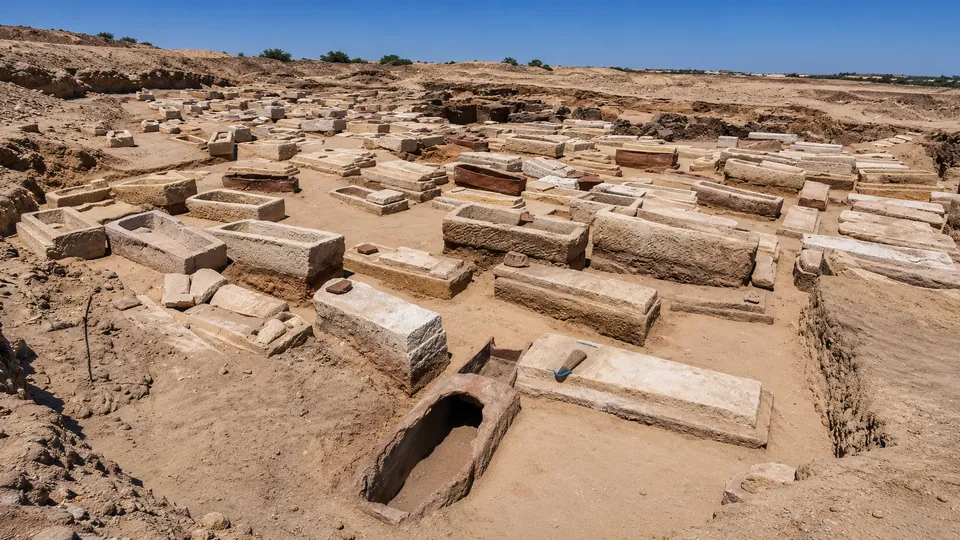
Egypt’s Ministry of Tourism and Antiquities announced on November 18 that an excavation team from the Supreme Council of Antiquities had uncovered hundreds of stone and pottery coffins at Tell Kom Abu Billo, a site in the Nile Delta’s Menoufia governorate, as arkeonews.net reported. The dig sits inside the footprint of the ancient city of Terenouthis, and the burials date mainly to the 3rd and 2nd centuries BCE, with some graves running back into the late Pharaonic period and others forward into the early Roman era, Daily News Egypt reported. That puts the oldest burials at more than 2,200 years old and the youngest at closer to 2,000.
The location explains the trade this cemetery’s occupants likely worked in. Terenouthis sat at the eastern entrance to Wadi El Natrun, the depression that supplied natron, the naturally occurring sodium carbonate and bicarbonate salt that ancient Egyptian embalmers packed around a body to draw out water and halt decay. A mummification industry needs a salt supply chain upstream of it and a burial ground downstream of it; Terenouthis appears to have sat at both ends.
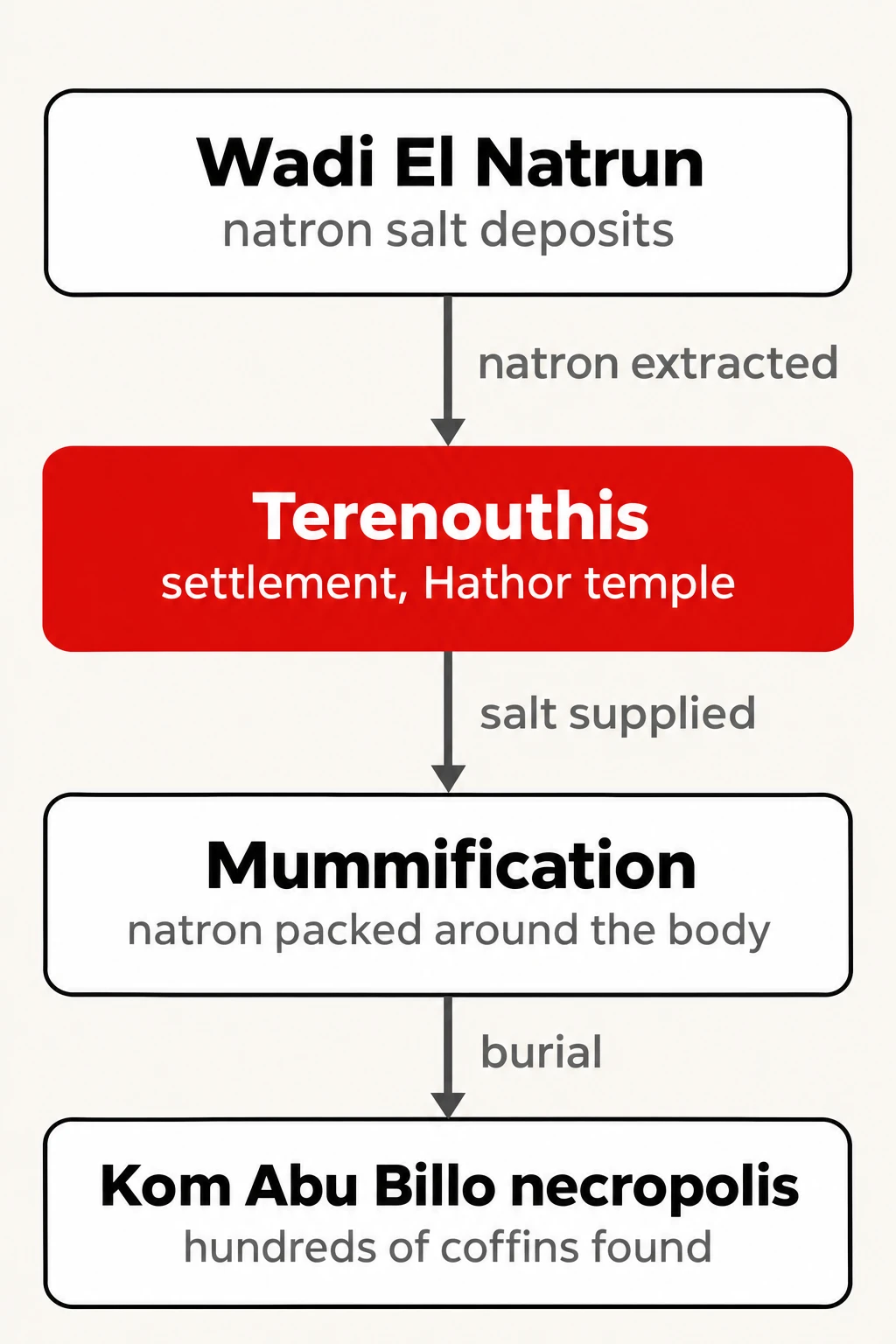
| From | To | How |
|---|---|---|
| Wadi El Natrun (natron salt deposits) | Terenouthis (settlement, Hathor temple) | natron extracted |
| Terenouthis (settlement, Hathor temple) | Mummification (natron packed around the body) | salt supplied |
| Mummification (natron packed around the body) | Kom Abu Billo necropolis (hundreds of coffins found) | burial |
The diagram is the simple version of a point the Ministry’s own account makes at length: earlier work at the site, by the French Institute for Oriental Archaeology, had already found a temple to Hathor, the goddess associated with turquoise, at Terenouthis, confirming the settlement predates the cemetery layer now exposed.
Dating a cemetery without carbon
No radiocarbon figures appear in any official statement. Mohamed Abdel Badie, head of Egypt’s Antiquities Sector, told reporters the 3rd-to-2nd-century BCE range comes from stratigraphy, pottery typology, coffin style, burial custom and tomb architecture, as Daily News Egypt reported — that is, relative dating by comparison with artifacts of known age elsewhere, not an absolute measurement on the remains themselves. That method is standard for Egyptian funerary archaeology and generally reliable within a century or two, but it is a different kind of number from a lab result, and the Ministry’s own framing treats the range as preliminary, pending further study.
The variety of burial types is itself a data point. Archaeologists catalogued stone sarcophagi, some missing their lids or damaged by past looting and stone-quarrying; terracotta coffins, some fully anthropoid and others with exaggerated facial features; remnants of wooden coffins that did not survive intact; mudbrick tombs built with vaulted roofs; and at least one tomb lined internally with limestone. Hisham el-Leithy, the Supreme Council’s secretary-general, said finding this many burials clustered together in one open courtyard had not been documented at the site before, and that some tomb structures still lie under sand and debris that has not yet been cleared.
| Structure | Material | Condition reported |
|---|---|---|
| Stone sarcophagi | Carved stone | Some missing lids, damaged by looting/quarrying |
| Anthropoid coffins | Terracotta | Human-shaped, some with exaggerated features |
| Coffin remnants | Wood | Did not survive intact |
| Vaulted tombs | Mudbrick | Domed roof structures |
| Lined tomb | Limestone interior | At least one example |
Source: Supreme Council of Antiquities, via Egyptian Ministry of Tourism and Antiquities
Five distinct construction methods in one burial ground, used across roughly two to three centuries, is consistent with a population stratified by wealth more than with one ethnic or religious group doing things one way. Human remains inside the coffins were poorly preserved, but archaeologists still found mummification resin, traces of linen-and-plaster cartonnage, and plaster painted in yellow, red, blue and gold — evidence that even burials without stone sarcophagi got the standard embalming treatment, just with cheaper housing around the body.
A goddess built from two cultures
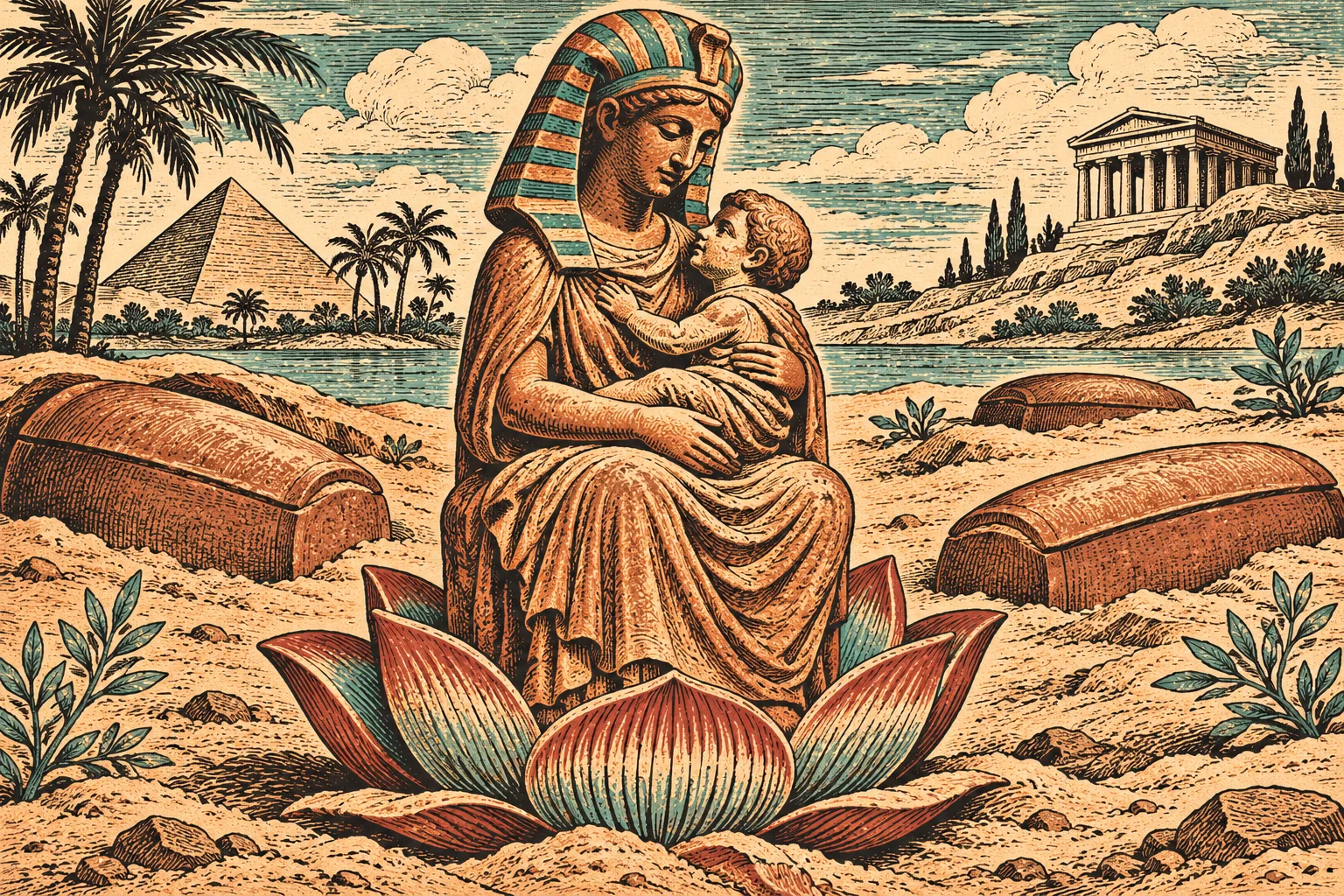
The find that gives the dig its religious interest is three terracotta figurines of Isis-Aphrodite, plus a coffin-lid fragment showing the same figure seated on a lotus and nursing her son Harpocrates. Isis-Aphrodite is a composite: Egyptian funerary and maternal iconography (Isis, mother of Horus) layered onto Greek iconography of Aphrodite, goddess of love. The composite only makes sense after 332 BCE, when Alexander’s conquest put Macedonian Greek rulers over an Egyptian religious bureaucracy that had no reason to discard its own gods and every reason, administratively, to let Greek settlers recognize their own gods in Egyptian temples. Harpocrates is the parallel move on the other deity: the Greek name for Horus-the-child, the infant form of the falcon god whose adult form appears elsewhere in the same cemetery as statue fragments and as two buried falcons.
The mechanism is the same one behind a bronze figurine of child Horus found elsewhere in Egypt and reported on here last month: a single iconographic type gets read two ways by two audiences sharing one territory, and over a few generations the two readings fuse into a third figure that is legible to both. What the Kom Abu Billo cemetery adds is that this fusion shows up in a middle-class burial ground, not only in temple or elite contexts — the composite goddess was not confined to people who could afford a stone sarcophagus.
What was not found matters too: no title, no name on a sarcophagus so far identified as belonging to an official or priest, nothing the Ministry has flagged as elite. The gold objects recovered — an earring, a necklace pendant, gold foil sheets, and gold tongue-shaped amulets placed in the mouths of some mummies on the belief the dead needed to speak in the afterlife — are modest by the standard of royal or priestly Egyptian burials, where gold shows up by the kilogram rather than the gram. Combined with the faience ushabti figurines (servant figures meant to perform labor for the deceased in the afterlife, some inscribed with hieroglyphs) and schist and lapis lazuli scarabs, el-Leithy’s team reads the assemblage as belonging to Terenouthis’s middle class rather than its elite — a reasonable inference from grave-goods value, though one the Ministry itself labels an initial assessment rather than a settled finding.
The presence of so many sarcophagi and burials together in an open cemetery courtyard is an unprecedented situation for the site.
Minister of Tourism and Antiquities Sherif Fathy’s own comment on the find, that the range of burial styles and objects underscores the site’s historical significance, is the kind of line a press release needs and a number doesn’t back up on its own — it says nothing about how many coffins remain unopened, how far the courtyard extends under the sand, or when full osteological and residue analysis will produce a firmer chronology than pottery typology can. The Supreme Council says excavation, documentation and dating work continues; the open numbers are how many more tombs lie under the unexcavated debris, and whether isotope or radiocarbon work on the surviving organic material will narrow the century-wide dating window the pottery currently allows.