
Between the first and third centuries CE is the proposed date for a bronze Harpocrates in Türkiye’s Hierapolis Archaeology Museum. That is a stylistic attribution, not a date established by an excavated deposit. The distinction matters: the figure provides evidence of how an Egyptian deity was represented in the Roman world, but its appearance alone cannot establish where or how someone worshipped it.
Archaeologist Esma İvrendi Şenol of Pamukkale University examines the object in a study reported by Leman Altuntaş in Arkeonews. This is an assessment of an existing museum object, not the announcement of a new excavation. The figure combines a crown resembling Egypt’s double crown, a finger raised toward the mouth, Greek-influenced bodily modeling and a cornucopia—the horn of plenty.
The study’s published abstract describes a method based on visual examination, comparisons with other representations and stylistic analysis. Şenol interprets the combination as religious syncretism: traditions interacting to produce a deity whose visual features and meanings cross cultural boundaries.
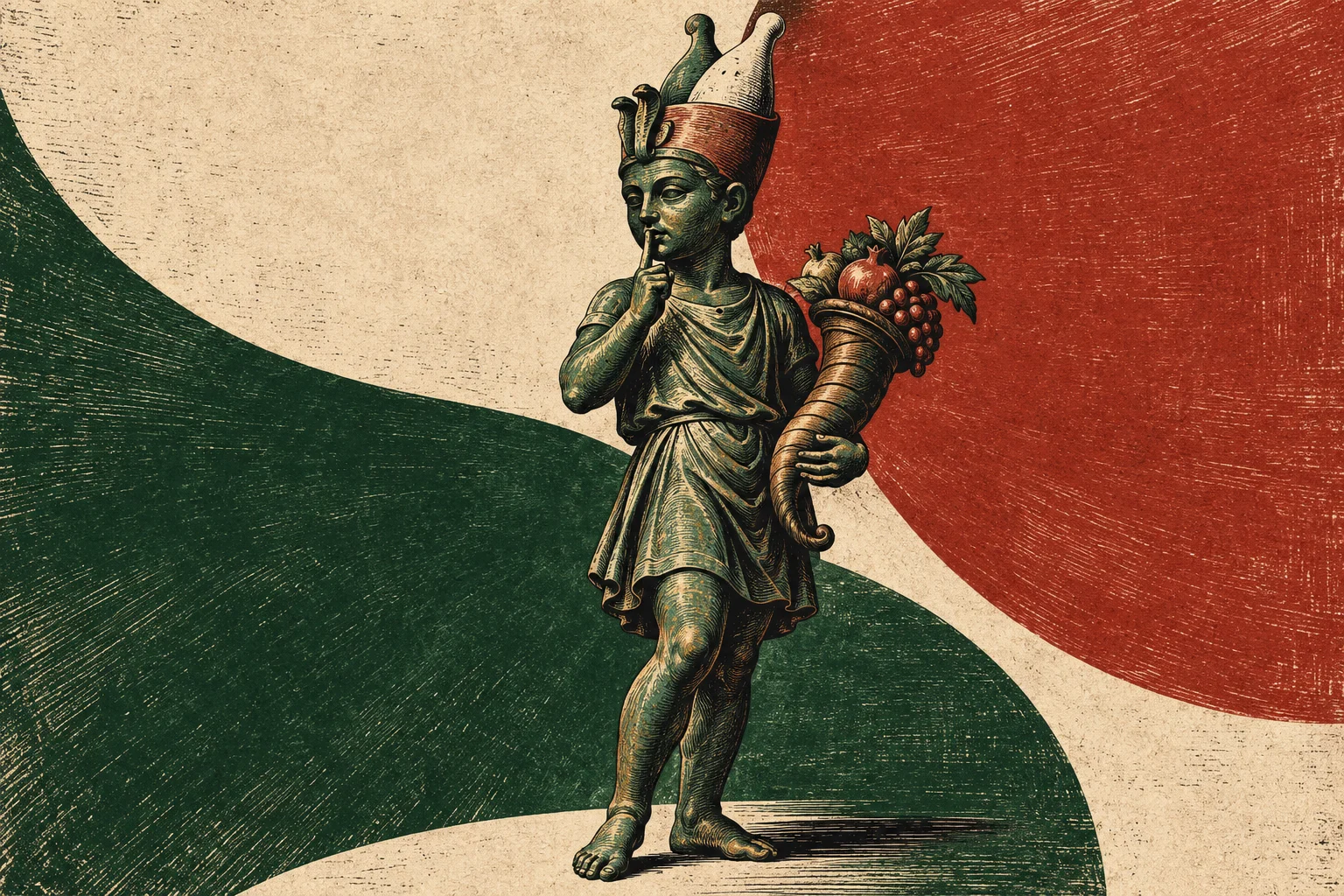
One gesture, different meanings
Harpocrates derives from the Egyptian Hor-pa-khered, meaning “Horus the Child.” In Egyptian mythology, Horus was the son of Isis and Osiris. His childhood was associated with renewal, divine protection and the continuity of legitimate kingship. Egyptian artists used a finger near the mouth as a convention for depicting a child.
Greek viewers gave that gesture another meaning. They associated it with silence, secrecy and the safeguarding of sacred knowledge. The physical pose could remain recognizable while its interpretation changed. That is the mechanism behind the study’s argument: an image did not have to be replaced to acquire a different religious function.
The crown retained an Egyptian reference. The treatment of the body and stance drew on Greek sculptural conventions. The cornucopia connected the child god with abundance and material well-being, concepts already familiar in Greek and Roman religious imagery. Şenol reads these features together rather than treating any one of them as sufficient evidence of the figure’s meaning.
| Feature | Religious or artistic association |
|---|---|
| Egyptian-style double crown | Egyptian identity and kingship |
| Finger toward mouth | Childhood; reinterpreted as silence |
| Cornucopia | Abundance and prosperity |
Source: Esma İvrendi Şenol, Cedrus; Arkeonews. These are iconographic interpretations, not evidence establishing the object's original use.
The combination does not document three separate communities using the same object. It shows a representation drawing on several traditions. Calling the result Egyptian, Greek or Roman describes parts of its visual vocabulary; none of those labels, by itself, explains the whole figure.
Portable does not establish personal worship
Şenol suggests that portable figures of this type could have supported private devotion, protection against harmful influences and religious practices associated with Isis. Harpocrates remained closely linked with his mother as her worship spread through the Hellenistic and Roman Mediterranean. Serapis belonged to this wider circulation of Egyptian-associated deities.
Those proposed functions remain interpretations. A cornucopia supports an association with abundance. It does not identify an owner’s occupation, the blessing that owner sought or the room in which the bronze stood. Likewise, a protective interpretation is not evidence that this particular object was carried as an amulet.
The repository record identifies the paper as a contribution to volume 14 of Cedrus, pages 349–361, published on October 12, 2026. Its abstract proposes a connection with the spread of Isis worship around the Lykos Valley. Neither that abstract nor the journal’s landing page supplies a findspot or acquisition history. Museum custody should not be converted into an archaeological provenance.

The city is context, not a findspot
Hierapolis, near modern Denizli in southwestern Türkiye, developed under the Attalid rulers of Pergamon in the late second century BCE. Its thermal springs and geological activity were part of its religious setting. Apollo was its principal deity, and his sanctuary stood near faults releasing gases from below ground.
The city’s Ploutonion was regarded as an entrance to the underworld. Gas emerging near a cave could kill animals brought into the sanctuary. Modern research attributes that danger to high concentrations of carbon dioxide. Religious explanations and a physical mechanism attached to the same place.
That setting helps explain why Hierapolis belongs in an account of interacting religious traditions. It does not establish that this bronze came from an Apollo sanctuary, the Ploutonion or a local household. The next evidence that would narrow the interpretation is a documented findspot or acquisition record linking the figure to an actual place of use.
Sources:
Arkeonews report; Şenol’s study abstract; publication record