
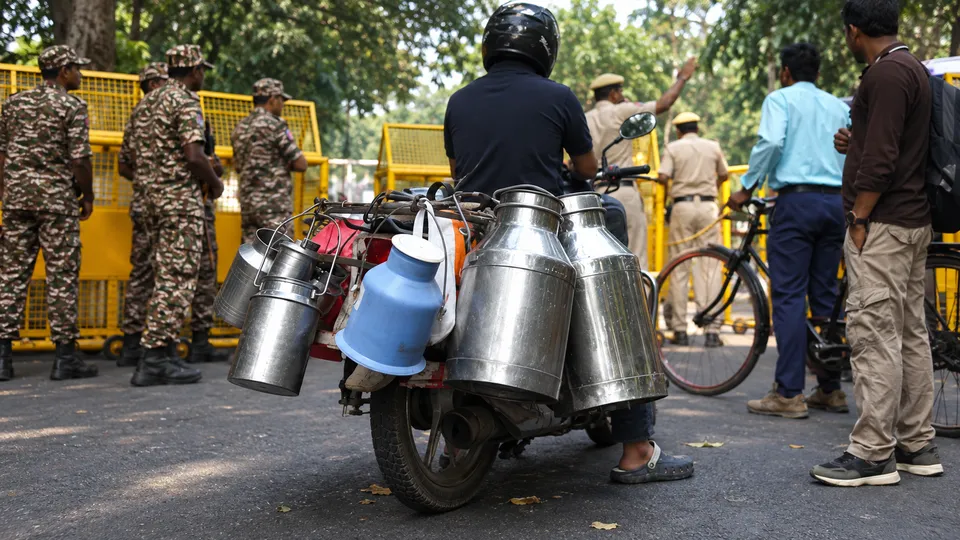
On the morning of Saturday, 10 October, heavy police barricades lined the streets around Connaught Place, the colonial-era square near Jantar Mantar in New Delhi. Police were already detaining groups of protesters as they arrived, Yashraj Sharma reported for Al Jazeera. Nearly 30,000 personnel had been sent onto the streets. Over parts of the city’s centre, he wrote, an eerie silence hung.
A government does not produce a silence like that cheaply. On Friday it cancelled every train into New Delhi. It locked down more than 50 metro stations and shut off the internet. It sent personnel to thousands of students in their own neighbourhoods to warn them not to come.
The people the state feared were mostly young.
A party named after an insult
They were coming for the Cockroach Janta Party and the wider Gen-Z movement around it. Its demands are the resignation of Chief Election Commissioner Gyanesh Kumar, sweeping reforms, and the reversal of a voter-revision exercise that has struck 130 million names from India’s electoral rolls. Abhijeet Dipke, a political communications strategist, founded the party on 16 May. Reuters has described how he took a “cockroach” jibe aimed at unemployed youth and built a nationwide movement out of it. In July its protests choked key streets in the capital and forced out the education minister, Dharmendra Pradhan. The movement calls this round “Season 2”, CNN reported. Earlier this month police had already detained protesters demanding Kumar’s resignation, and on 6 October the opposition leader Rahul Gandhi was briefly detained during a march on the same official.
Dipke flew in from Mumbai. Indian television channels reported early on Saturday that officers met him at the airport and told him to call off the protest because the authorities had banned it. He was detained. So were two other party leaders, Saurav Das and Ashutosh Ranka, taken from their flight when it landed, according to a statement from the movement. Dipke went live on Instagram as officers boarded the plane, ABC News reported. In footage of the detention an officer tells him he is not under arrest and that his cooperation is sought.
Narendra Modi just made EMERGENCY official. This intimidation is not going to work, Modi. The youth of this country are no longer scared of you.
Dipke posted those words on X.
The year that comes back
The comparison was deliberate. In 1975 Prime Minister Indira Gandhi suspended civil liberties, censored the press and jailed her opponents, and for many Indians the shut stations and cancelled trains brought that year back. Neha Bora, national president of the left-wing All India Students’ Association, went further back still. She likened the government to the British colonial forces that failed to crush the independence movement, and she called on the public to join the protest.
How many people were held depends on who is counting. The movement says thousands have been detained across India. Gulf News reported that Delhi Police detained hundreds on Saturday alone. Students travelling to the capital from other states were dragged off trains and buses. Many are under house arrest in cities hundreds of kilometres from Delhi.
One of them is Arif, 24, a district coordinator for the Students’ Federation of India, who asked that his full name not be used. He has been confined to his home in Saharanpur, nearly 200km from New Delhi, under round-the-clock police watch since Thursday. “Several police officials started beating my door out of nowhere late at night, asking my parents for details of my whereabouts,” he told Al Jazeera. He said the officers were threatening to book him in criminal cases and “destroy my future”. It is the first time he has been detained.
At the barricades
Santosh Kumar, 29, sweeps the streets of Connaught Place’s outer circle. He said it frustrated him to watch teenagers being detained at the barricades. “How can you stop these kids? They are detaining 10; 50 more are coming,” he said. He predicted that Modi would not last until the next election in 2029, and he pointed to the youth-led uprisings in Nepal and Bangladesh as the example to follow.
Sameer Irshad, a 28-year-old engineer from Gurugram, came up to the barricades pushing his mother, Sheeba Abdi, 57, in a wheelchair. “Why has government turned this place into a fortress?” she asked. “Why are they so scared of citizens like me?”
The list
The dispute itself is about a register of names. Last month an investigation by The Indian Express reported that Kumar had overruled concerns from the commission’s other two members about the integrity of the changes being made to the voter database. The commission has called the reported disagreements “differing views and deliberations” rather than formal objections. The revelations led the opposition to seek Kumar’s removal, and NPR reported that protests had spread across the country.
India is one of the few countries that has gone out of its way to enrol every last voter. Critics say the revision reverses that principle by making citizens prove their right to vote, and that it falls hardest on Muslims, the poor, minorities and others who are least able to produce paperwork.
Twenty-five years
This week Modi and his Bharatiya Janata Party celebrated 25 years of his time in office. That count starts in Gujarat, where he was chief minister during the 2002 pogrom against Muslims, and runs through his years as prime minister since 2014. Analysts and political observers say he has never looked weaker.
Nilanjan Mukhopadhyay, a Modi biographer, said the lockdown reflects the prime minister’s wish “to retain the aura and image of a leader who never yields to public pressure, someone who is invincible”. He also pointed to a paradox. Modi is at his lowest point in public perception, he said, even though he keeps “some of the most important autonomous institutions, large sections of the bureaucracy, and state wings in tight control and acting at his behest.”
A reflection, then, and only that. A ruler who controls the ministries, the police and the railway timetables can empty a square. What he cannot easily do is explain why he needed to. Each barricade on Connaught Place answers Sheeba Abdi’s question, though not in the way the government would choose.
Prashant Bhushan, a senior Supreme Court lawyer and rights activist, had planned to join the protest on Saturday. “Modi’s government looks quite scared of the people,” he told Al Jazeera. “When the government gets scared, they adopt draconian measures to stay in power. But only more and more people will rise from repression.”