
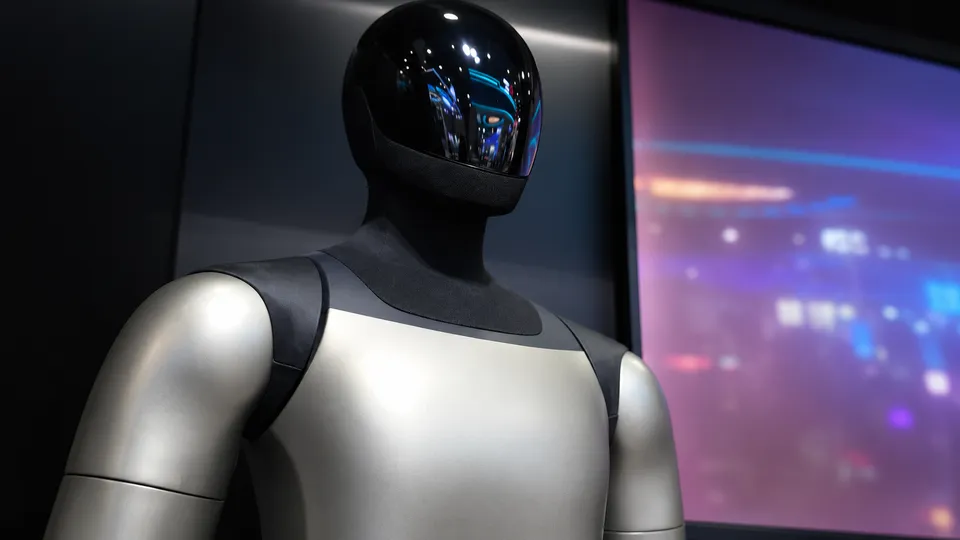
Dan Ives, the Tesla bull who moved from Wedbush Securities to Yorkville Ives, told clients this week that about two-thirds of his $500 price target for the company rests on robotaxis and humanoid robots still in their early stages.
In the note, which kept his Outperform rating, Mr. Ives put Tesla’s existing businesses at about $165 a share if it’s valued as a carmaker and assigned the other $335 to autonomy and Optimus. “We view Tesla as one of the clearest ways to own physical AI in the public markets,” he wrote, as Pras Subramanian reported for Yahoo Finance. Tesla shares rose more than 2 percent on Friday.
The $500 target is his first on Tesla since the move. He set it on Oct. 7, when he began covering the stock at the new firm, and it is $100 below the $600 he carried at Wedbush, according to eletric-vehicles.com, which said the note didn’t explain the cut. The figure implied 32.3 percent upside from Tesla’s close of $377.81 that day.
His case is that Tesla already owns pieces most AI and robotics efforts still buy from partners: a fleet of several million cars collecting driving data, the AI models and in-house chips that train on it, and the factories to build at volume. “Investors valuing it primarily as an automaker are pricing a fleet rather than the platform being built on top of it,” he said.
That view comes with a high multiple. Mr. Ives used a sum-of-the-parts valuation based on 2028 revenue estimates, which puts Tesla at roughly 12.2 times revenue. The peer median is about 5.3 times.
He called Full Self-Driving the bridge between the car business and an autonomy business. The subscription is attached to more than 55 percent of new North American electric vehicle sales, lifting software revenue per car. Tesla’s robotaxi service runs in six U.S. cities with paid miles approaching 2.5 million, and a Nevada permit covers 5,000 vehicles. The Cybercab, built with no steering wheel or pedals, is in production and carrying paying riders in Austin.
Mr. Ives said the number to watch is the size of the fleet, “as unsupervised vehicles move from dozens toward thousands, autonomy moves from optionality to revenue.”
For now it is dozens. Only 45 Cybercabs are authorized to drive without a human in Texas, he noted. Tesla expects about 2,500 vehicles in Nevada in the first year, half of what the permit allows. And the company’s second-quarter update dropped both the Cybertruck and the Optimus robot from its list of products set for volume production in 2026.
Regulators could slow things further. The National Highway Traffic Safety Administration issued a Special Order demanding sworn answers on how Tesla self-certified the Cybercab under federal safety standards. The response was due Sept. 30, but Tesla asked for eight more weeks, citing the “voluminous nature of the request,” and the agency gave it 30 days, pushing the deadline to Oct. 30, Not a Tesla App reported. The order carries penalties of up to $139 million. No decision has been announced. A finding against Tesla could limit where the Cybercab is allowed to operate.
Other analysts are more cautious on price. UBS raised its target to $391 and kept a Buy rating, Stocktwits reported. Tesla reports quarterly earnings on Oct. 21.