
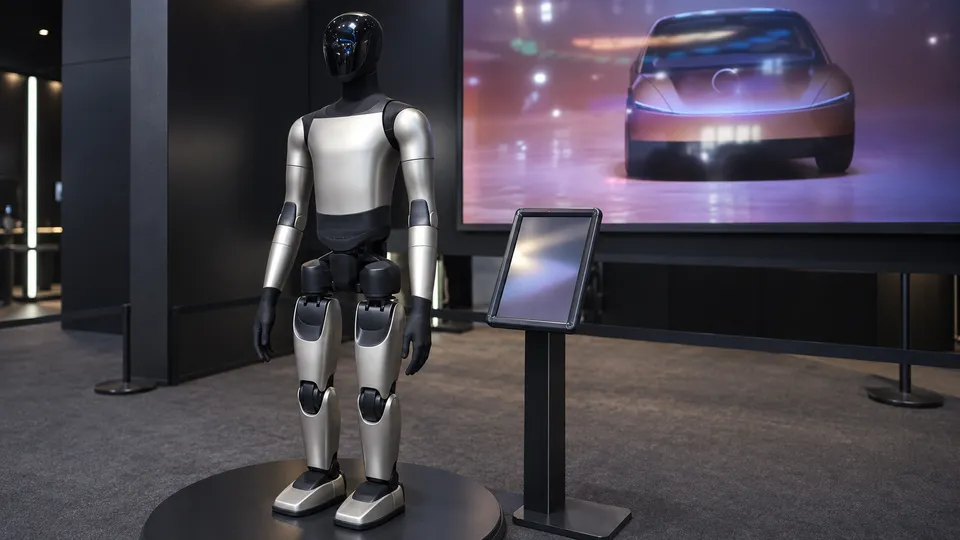
The phrase Elon Musk chose, on an investor call in July, was “the biggest product ever.” Not the biggest car, not the biggest battery. The product was Optimus, the humanoid robot he first announced in 2021, when the project was still called the Tesla Bot. A working prototype was shown the following year. Since then the pitch has steadily widened — factory work, household chores, eventually, Mr. Musk has suggested, babysitting.
This week brought a more granular accounting, via reporting by The Information. Tesla built several hundred Optimus robots a week last month, up from just a few dozen a week only months earlier — still far from the company’s stated goal of roughly 20,000 robots a week. Ars Technica’s account of the same reporting cites a nearer target: 1,000 robots a week by the end of 2026. To clear floor space for the line, Tesla earlier this year wound down production of the Model S and Model X at its Fremont, California, plant — the two cars that once announced the company’s arrival — and turned the space over to Optimus V3, a lighter version carrying more cameras.
The problem, at the moment, is the hand. Each hand and forearm contains more than 100 screws and other small parts, all of them assembled by people, by hand. Equipment at several stations on the line — the stations that build hands and joints among them — does not always align parts precisely, so newly produced robots come off the line already needing repair. The hands themselves are not durable enough for sustained use, and their touch sensors have proved unreliable, so Tesla devised a workaround: a replaceable “sensing glove” carrying the sensors, so the whole hand need not be swapped out when they fail. The glove goes into next year’s model. The hand that was meant to justify the robot currently requires its own disposable accessory.
The software is in much the same condition. People familiar with the matter told The Information that Optimus still has to be programmed and trained for individual jobs, with basic tasks requiring several days to learn. One source described robots performing specific duties in carefully controlled environments. Most of what Tesla produces is kept in-house, for testing, training and data collection, in what the report calls “tightly controlled areas where their movements and tasks can be closely supervised.”
The data has to come from somewhere. The binding problem in robotics is a shortage of training data for manual tasks, and Tesla’s answer has been imitation: factory workers at plants in Texas and California were put into motion-capture suits and recorded doing their jobs. Some of them complained, The Information reported, because they “knew the robots were designed to eventually replace them.” The suits did not go away. The wearing of them was reassigned to dedicated teams, and Tesla has set up “training hubs” where those teams now work. The company did not respond to Gizmodo’s request for comment.
Then there is the question of where the parts come from, which is largely China. The Information notes Tesla’s continued reliance on Chinese suppliers for robot components, and it has previously reported on Silicon Valley startups carrying robotic parts into the United States in their luggage. All this has persisted through an administration devoted, in its own telling, to rebuilding domestic supply chains: in July, the Federal Communications Commission banned new foreign-made robots — humanoids, four-legged robot dogs and vacuum cleaners alike. A ban does not build a hand.
The field, meanwhile, is not waiting on Fremont. Toyota plans to invest billions of dollars in factory automation, including some humanoids. Hyundai intends to deploy as many as 25,000 Atlas robots, developed by its American subsidiary Boston Dynamics, over the next several years. Oregon-based Agility Robotics first put its humanoids to work at an Atlanta-area warehouse owned by GXO Logistics in 2024 — among the furthest commercial deployments to date, in a business that still has to prove the economics hold over sustained runs, and that the machines can work safely in the presence of people.
Mr. Musk said earlier this year that Tesla could begin selling Optimus by late 2027. The current plan, per The Information, is to lease the robots to commercial customers first, and to harvest the data those customers’ factories and warehouses generate to improve the AI. The biggest product ever would then learn on someone else’s payroll, one programmed task at a time.
Each hand a hundred screws and more, assembled by a person, mended by way of a glove.