
For nine months, the Rev. Edward Moultrie of St. Paul CME Church and his congregation kept turning up at Colleton County meetings in South Carolina. They wanted officials to reject a huge data center planned near their church and their homes outside Walterboro, and they warned that it would threaten the waterways they rely on and bring pollution to their doorstep. On Monday they won, or mostly won. As Adam Mahoney reported for Capital B, the Southern Environmental Law Center reached an agreement with the county that settles the lawsuit residents filed in January. That suit challenged the county’s attempt to change its zoning code so data centers could go in rural areas.
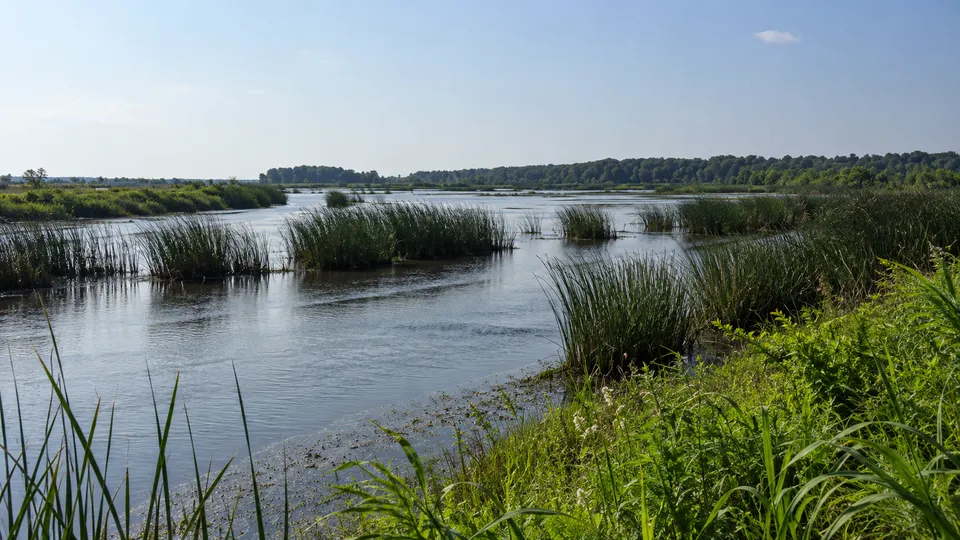
The settlement works by drawing a map. According to the law center’s announcement, the county will create a “Data Center Exclusion Area” covering most of the ACE Basin inside Colleton County, including some of the most ecologically sensitive land along the Ashepoo, Combahee and Edisto rivers. The county will add the area to its Comprehensive Plan as land unsuitable for data centers. The zone includes the parcel at the headwaters of the Ashepoo where Eagle Rock Partners proposed its complex in December 2025. The law center describes that project as 850 acres and $6 billion, and says the application filed under the county’s new rules was for 859 acres and 1,000 megawatts. Divide $6 billion by 850 acres and you get roughly $7 million an acre, which gives you some idea why a rural county might be tempted to rewrite its zoning code.
I think the mechanism is worth spelling out, because these fights are rarely about whether anyone likes data centers. A data center is legally a land use, and counties decide which land uses go where. If the code doesn’t allow data centers on rural land, a developer has to get the code changed. If the county changes it, the neighbors can sue on the grounds that the change itself broke the rules. That’s what happened here. The suit, brought on behalf of landowners Jennifer Singleton and Miles Crosby, argued that the new ordinance violated state law, the county’s comprehensive plan and its own zoning code. The county then zigzagged. By the law center’s account, it voted unanimously in July for a moratorium on data center approvals, so the law center paused the suit for six months. Two months later the county approved a “Digital Infrastructure Overlay District” that opened much of its rural land to data centers, and it partly repealed the moratorium west of Interstate 95 and in areas already zoned industrial.
Crosby’s interest was not abstract. “The original data center complex that was proposed would have surrounded my property on three sides and completely changed the area,” he said. He said he was thankful for an outcome that “not only prevents data centers from surrounding my home but also protects the majority of the ACE Basin in Colleton County from data center development.”
County Council Chairman Scott Biering called it a “historic settlement agreement” that “sets the framework for legislative action that will ensure responsible conservation of natural resources while securing the economic future for citizens of Colleton County.” Translated, that means the county isn’t giving up on data centers. It is agreeing on where they can’t go, which leaves everywhere else.
The second county
How Eagle Rock ended up in Colleton is the uncomfortable part. Last year a majority-white county in Georgia blocked a data center, and the developer then proposed a similar project in Colleton County, where the share of Black residents is nearly twice as high. Analyses have found that the communities closest to EPA-regulated data centers in the U.S. are “overwhelmingly” nonwhite. Nobody has reported what was in Eagle Rock’s site-selection spreadsheet, and I won’t guess. The structure is simple enough, though. If one county’s “no” just sends a developer to the next county on the list, the projects end up wherever saying no is hardest, and that tends to be where people have the least spare time, money and political pull to spend nine months at county meetings.
Moultrie called the settlement “a relief.” “I can’t preach to my people that God is making a way for them and offering them hope, and then have something like this come into the community to take people’s hope away,” he said. “Black people here have worked hard all their lives to survive and thrive and protect their land. It gives us some kind of sense of pride knowing that we’re not going to go by the wayside or be destroyed or taken for granted — for now.”
Colleton is one data point in a big trend. Capital B cites Data Center Watch, a group that tracks the industry, as saying local residents blocked at least 115 data centers nationwide in the first half of 2026, with combined price tags of roughly $200 billion. That works out to about $1.7 billion a project. The group’s own quarterly reports use a broader category, projects “blocked or delayed”: at least 75 projects worth about $130 billion in the first quarter and 45 worth $68 billion in the second. Together that’s 120 projects and about $198 billion. Construction keeps climbing anyway. August set a record for U.S. spending on data center construction, up more than 73% over 12 months. The opposition and the building are both at record highs, and the builders say they aren’t much bothered.
The power plant
A data center needs a lot of electricity, and the electricity has to be generated somewhere. A new methane gas power plant, proposed in part to keep this and other data centers running, is moving ahead in a majority-Black area of Colleton County. A pollution analysis by the Southern Environmental Law Center estimates it would cause more than $30 million in local health care costs as residents deal with respiratory illness. Gas plants emit fine particulate matter, PM2.5, which can get deep into the lungs and bloodstream. It causes respiratory and cardiovascular disease and is linked to asthma attacks, strokes, dementia and cancer. Black Americans have the highest death rate from this kind of pollution in the country.
Elsewhere in the South, utilities have used gas plants as the answer to data center demand, as in North Carolina’s $500 million plant for Amazon, and Congress has declined to make data centers pay for grid costs. Chris DeScherer, who directs the law center’s South Carolina office, said the group will keep working to “help ensure that any data center projects in Colleton County and beyond are developed responsibly with respect to surrounding communities and natural resources.”
The exclusion area decides where a data center can sit. A power plant serving data centers is a different land use, and nothing in the settlement stops it from being built a few miles away.