
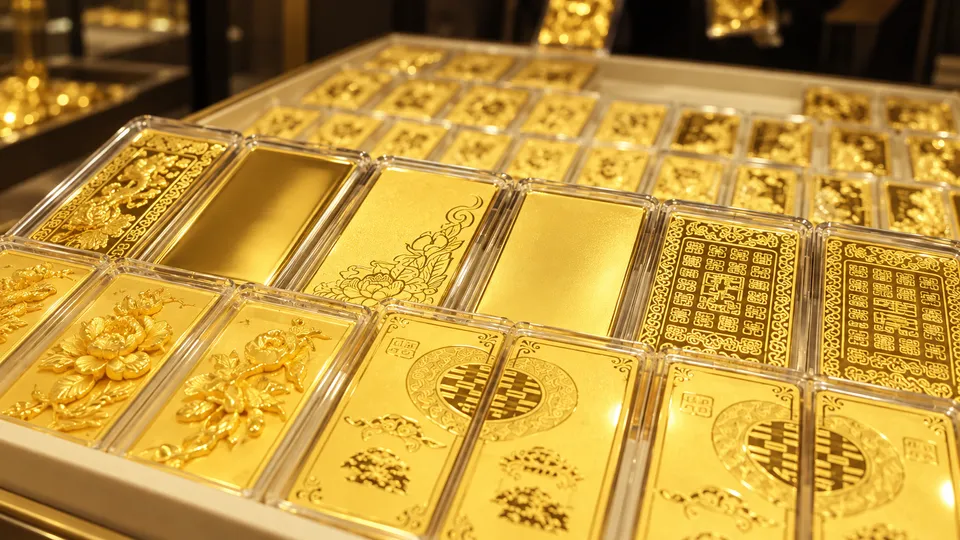
Two kinds of buyer are at work in China’s gold market this autumn. One is the People’s Bank of China in Beijing, which has bought for 23 months without a pause. The other is the Chinese household: a family whose apartment no longer works as a store of wealth, whose shares have lost value and whose bank deposit pays almost nothing. Their reasons differ in scale but not in kind. Each is looking for something that another party’s decision cannot freeze, devalue or empty.
The numbers come in layers. As Anniek Bao reported for CNBC, the central bank added about 23 tonnes in September, according to State Administration of Foreign Exchange data. That was its largest monthly purchase in almost three years, and it extended the longest buying streak since at least 2015. Official figures put the bank’s holdings at 77.47 million fine troy ounces at the end of September, up from 76.73 million a month earlier. The monthly additions have grown all year: 160,000 ounces in March, 480,000 in June, 650,000 in August and 740,000 in September. China Daily called it the biggest monthly rise in the country’s official gold reserves in three years. The tallies do not all agree: Kitco put the September addition at 21 tonnes.
A country at the customs window
The bank’s figures are only part of the picture. According to customs data, China spent a record $158.8 billion on more than 1,000 tonnes of imported gold in the first eight months of 2026. In the whole of 2025 it spent $96.5 billion on 886 tonnes. Eight months have outrun twelve by roughly $62 billion.
Aakash Doshi, head of gold strategy at State Street Investment Management, said consumer gold imports set a record over the same period. The rising premiums on China’s onshore prices, he said, point to “stronger winter seasonal demand.”
The lesson of 2022
Carsten Menke, an analyst at Julius Baer Group, thinks the central bank’s main motive is political. He cites “the weaponization of the U.S. dollar and the related desire to be less dependent on U.S. Treasuries as a reserve asset.”
The lesson was taught in 2022. After Russia invaded Ukraine, Western governments froze its central bank’s assets, and every government with reserves abroad saw what that meant. Money held in someone else’s system is held on someone else’s terms. Gold in a country’s own vaults is out of their reach. Russia has since learned where its own metal can still go: Hong Kong recently took in a record 112.7 tons of Russian gold while London stayed shut.
Beijing has been reducing its exposure. U.S. Treasury data show Chinese holdings of Treasurys fell to $618 billion in July, an 18-year low, as China kept diversifying its foreign-exchange reserves. Menke also links the buying to Beijing’s plan for a deeper domestic gold market, which requires the state to build up inventories. He estimates the central bank bought about 190 tonnes by the end of August, and that 110 tonnes of it went unreported. If he is right, the official ledger shows only part of what the bank is doing.

One could put it this way: a state that once trusted the dollar has decided to rely on metal it can hold. That is a view, not a statement from any official. But the record of purchases fits it.
Nowhere else to put it
The households are buying for plainer reasons. Worried about a weak economy, Chinese consumers are buying gold jewelry, bars and coins. The property market, once where most family wealth was kept, has been in a slump for several years. The benchmark CSI 300 index is down around 8% this year, while the S&P 500 has gained 13%. Returns on deposits and bonds have fallen as borrowing demand stays weak. China’s one-year government bond yields about 1.2%, against about 4.46% in the United States.
“The opportunity cost of holding gold is also much lower in China than in many Western markets,” said Ole Hansen, head of commodity strategy at Saxo Bank. Gold pays no interest, and in China the alternatives pay very little.
A floor under a falling price
All this buying is happening while the price falls. Gold dropped more than 8% in September, to about $4,176 an ounce, after reaching a record above $5,500 in January. The official data show the paper cost: China held more gold at the end of September, yet the value of its gold reserves fell to $323.52 billion from $350.08 billion a month earlier.

Analysts argue the fall would have been steeper without China. Gold usually weakens when interest rates rise, and high U.S. yields have kept a lid on demand. “Chinese buying has become an important source of structural support for gold prices,” said Ewa Manthey, commodities strategist at ING Bank. She noted that central banks buy for the long term and care far less about price than retail investors do. Menke made a related point: gold has stayed above its summer levels even though rate expectations and bond yields have risen more sharply. The Federal Reserve has signalled another rate increase for 2026.
Doshi expects gold to reach $4,750 to $5,500 per troy ounce by the end of the first quarter of 2027. The World Gold Council puts China’s holdings at 2,387 tonnes as of August. That makes China the fifth-largest holder, with less than a third of what the United States holds. For a buyer this determined, there is still a long way to go.
Hansen named what could slow the buying: renewed confidence in Chinese property and stocks, a weaker yuan that makes gold dearer at home, or higher interest rates that make deposits worth holding again. The bigger change, he said, would come if central banks lost interest in diversifying their reserves and geopolitical tensions eased. On that, he added, “neither appears particularly imminent.”