
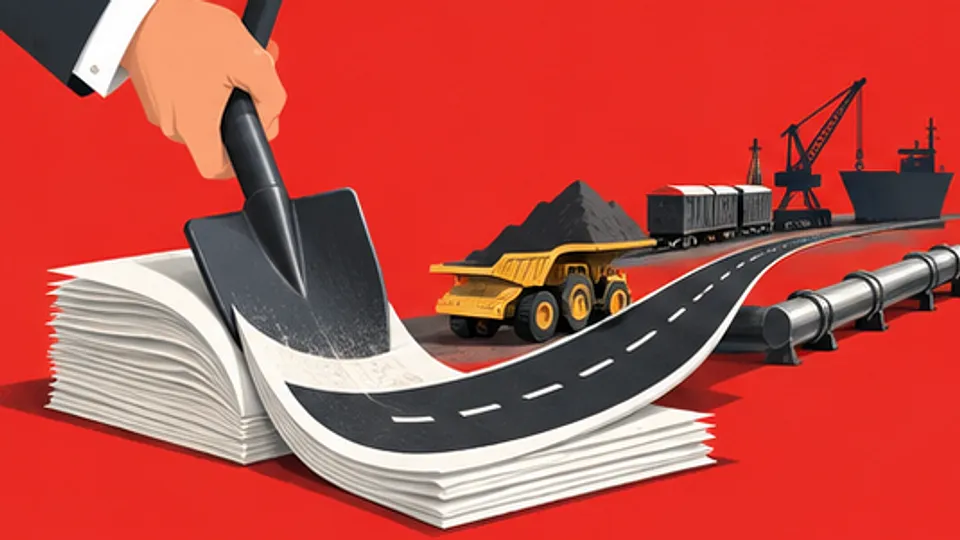
Prime Minister Mark Carney’s government would like Canada to build things — mines, railways, ports, pipelines — faster, on the theory that the economic threats coming from Donald Trump’s Washington leave no time for the usual deliberation. It has tabled the Building Canada Strong Act, Bill C-39, which Government House Leader Steven MacKinnon, when he tabled it, called one of the most important economic pieces of legislation in a generation. Its core promise is decisions on major projects within one year. Its core method is amending a lot of other laws to make sure nothing slows that down.
CBC News went through the bill’s more than 200 pages — over 300 clauses touching more than a dozen federal statutes, including laws protecting species at risk, water quality and fisheries, plus changes to the Labour Code that have already angered unions — and asked environmental and development experts what it all does. The short answer: quite a lot, mostly in one direction.
Shovels before science
Normally, before a mine, railway or port can be built, the environment and climate change minister signs off on an impact assessment — a full review of a project’s environmental, social, economic and health effects. Under C-39, Ottawa could grant permits for preliminary construction before the Impact Assessment Agency of Canada has finished its work, so long as the minister deems it “enabling activities” in the “public interest.” The government would keep the right to halt a project if the assessment later says no. That last part is meant to be reassuring, and you can decide how reassured you are. Imagine, purely hypothetically, that you are the minister being asked to stop a project on which a company has already spent tens of millions of dollars doing “enabling activities” under a permit you signed. The theoretical right to say no survives. The practical appetite for saying it may not.
The government insists nothing is being sacrificed. “We are not rolling back our environmental regulations,” said Environment Minister Julie Dabrusin. Critics read the same text and see clawbacks dressed in vague wording that asks the public to trust the government’s future interpretation. “I want to see evidence that our government understands what the national interest is because I think it’s in our national interest not to poison our lakes and rivers,” said Megan Leslie, president and CEO of World Wildlife Fund Canada, adding it is also in the national interest “not to have species go extinct.” Gretchen Fitzgerald, executive director of the Sierra Club Canada Foundation, named the trade-off directly: “It greatly saddens me that in standing up to bullying from the United States, we are willing to put some of the things that make Canada so special on the table.”
The steelman case comes from Heather Exner-Pirot of the Macdonald-Laurier Institute, who calls the bill, overall, “very positive” and says early construction would be confined to narrow exceptions — minor work rushed in before winter. “Canada’s construction season is very constrained,” she said. “And so if you can get something done … you can save months and millions or tens of millions of dollars on the project.”
The king’s powers, without the expiry date
C-39 also makes permanent a set of powers the government gave itself through last year’s Bill C-5, the Building Canada Act, which lets Ottawa exempt projects deemed in the national interest from a wide set of environmental regulations and acts of Parliament — powers academics and critics have labelled Henry VIII clauses, after the autocratic English king. C-5’s powers came with a five-year sunset; C-39 deletes it. An Alberta West Coast pipeline and a port expansion in B.C.’s Lower Mainland are already on track for the national-interest treatment. Exner-Pirot’s answer to the worry is that “any Parliament can revoke laws that were made in the previous Parliament” — which is true, and is also the formal answer available to any objection about any law ever passed.
Zones of national interest
The bill also scales the “project of national interest” idea up into entire regions of national interest. Once Ottawa completes a regional environmental assessment — one is underway for the Ring of Fire, the mineral-rich, ecologically sensitive stretch of northern Ontario — cabinet could designate the whole area and approve future activities, within types and criteria federal officials say would be spelled out at designation. Critical-minerals mining might get the green light along with roads, bridges and high-voltage power lines, while a natural gas pipeline through the same zone might not. Julia Levin of Environmental Defence Canada calls it “essentially the Building Canada Act on steroids,” and the regions “sacrifice zones where projects could get rubber stamped.” Yet the same tool could fast-track clean power: a regional assessment for offshore wind off Nova Scotia is already complete, and the 300,000-square-kilometre study area could unlock significant sustainable generation. University of Calgary law professor David Wright agreed such projects are “more possible than ever under this act” — while warning it “could come at the expense of the rights and interests of Indigenous Peoples, ecosystems, species at risk and private landowners.”
Lakes, species, fish
Then come the statutes. Today, a proponent that wants to dump stone, gravel or rubbish in a river — or drain a lake entirely — needs approval from the federal cabinet. C-39 would let the minister exempt water bodies from that requirement. “What this power allows the minister to do is exempt those water bodies so that there’s no more oversight,” said Anna Johnston, a staff lawyer with West Coast Environmental Law — no small thing in northern Alberta, where oilsands companies use considerable amounts of water.
The Species at Risk Act keeps its “jeopardy test” — the rule stopping any project that could drive a species extinct — but only after academics wrote an open letter and environmentalists campaigned to save it, and even then the fisheries and environment ministers could weigh “technical, economic and practical” considerations before permitting construction in sensitive areas. “That’s really backwards thinking,” said Lisa Gue of the David Suzuki Foundation. “It looks like nature is going to be steamrolled.” The Fisheries Act would similarly allow harm to fish and fish habitat where protection is not economic or practical, offset through an expanded fish habitat bank that proponents would pay into for restoration — a mechanism the bill does not actually explain. Margot Venton of Ecojustice Canada worries about ecosystem collapse and recalls the closure of Newfoundland’s cod industry in the early 1990s.
Carney’s one-line defence of the exercise is that “high standards do not mean decisions have to be slow,” which is surely right and not quite the question. The question the bill poses, clause after clause, is who decides when slow becomes too slow. The old answers were the assessment, the cabinet, the statute. The new answer, recurring across 300-odd clauses, is the minister. The safeguards are not so much removed as consolidated into a single universal safeguard, which is that the minister will do the right thing. Perhaps so. It is a lot to leave on one desk, especially on a one-year schedule.