
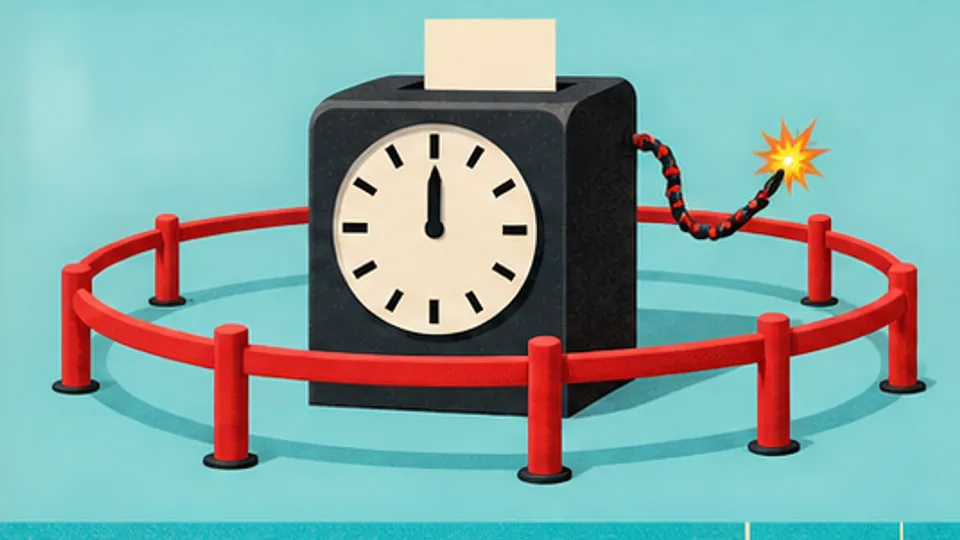
The word the government keeps using is guardrail. A guardrail is a thing installed beside something dangerous. It does not remove the dangerous thing. It sits there, reassuring at speed, while the dangerous thing goes on being used.
The dangerous thing, in this instance, is Section 107 of the Canada Labour Code, a clause that gives the responsible minister broad powers to, in the statute’s own phrase, “maintain or secure industrial peace” — powers that since 2024 the federal government has used, repeatedly and controversially, to order striking workers back to their jobs and send their disputes to binding arbitration. On Monday, Mark Carney’s government introduced Bill C-39, an omnibus bill that amends that section. Jobs Minister Patty Hajdu says the unions will come out of it with new leverage. The unions say something else.
Here is the guardrail. Under C-39, the government may appoint a special mediator for 21 days. The mediator produces a report laying out the bargaining issues and each side’s positions, and assessing the likelihood of an agreement. Five days after it is issued, the report — recommendations included — goes public, unless the parties strike a deal first. And the minister must consider it before invoking Section 107 to end a strike. Before any such order, the government must also believe the work stoppage “adversely affects or may adversely affect the national interest.”
Hajdu’s case for all this, made on Rosemary Barton Live, rests on the daylight. “In the past, if an employer was refusing to bargain or was removing things from previous offers or acting in a way that was not bargaining in good faith, the union members could talk about it, but they couldn’t necessarily prove it,” she said. The public report, in her telling, fixes that. “And that mediator’s report — should it become public — is not going to be pleasant for a company’s shareholders [or] their reputation in Canada and worldwide. Nobody wants to know that their shipper had a deal at the table and didn’t pick it up.” It’s meant to provide, first of all: emphasize the first of all. Her own words: “another tool to parties to understand what the dynamics are and why they’re struggling to get to that deal.”
The unions have a different reading of what the tool is for. Under the bill, after the guardrail, the order still comes. Hajdu used Section 107 last summer against Air Canada’s flight attendants; the union defied the order, and a tentative agreement followed days later — a precedent the government has not dwelt on when explaining how these powers function. “This bill gives government the new and expanded power to end a legal strike when it decides the strike is, or could be, against the national interest,” Bea Bruske, president of the Canadian Labour Congress, said in a statement. Her congress welcomes some of the bill’s measures, she allowed. “But on the right to strike, the government broke its promise to workers.” And: “We reject the idea that workers’ bargaining power is somehow contrary to the national interest.”
On Tuesday, the Canadian Union of Public Employees passed a unanimous resolution vowing to defy Bill C-39 if Parliament passes it unamended. Defy is not a word unions reach for lightly in Canada; it was the verb that ran the Air Canada dispute, and it is back.
On Friday, government House leader Steven MacKinnon told CBC’s The House that there is a constitutional right to strike in Canada — true, and not quite the question being asked — and that the bill is meant to implement guardrails. Asked how labour could see the same text so differently from the government, he said Ottawa has “no interest in getting in the middle of labour negotiations.” There is a distance between the two accounts large enough for a bill to pass through. That is presumably the design.
The objection is not only coming from labour. The bill also carries provisions meant to speed up project approvals — federal reviews finished within one year of a proponent’s application — and the Assembly of First Nations has been examining those provisions with the expression of people who have seen this film before. “The truth is that any predetermined timeline, principally designed to attract investment, subordinates the honour of the Crown to commercial imperatives,” National Chief Cindy Woodhouse-Nepinak told CBC. The government, she noted, has called C-39 the most consequential legislation in decades. “Then we expect the legislation to be matched by an equally consequential level of parliamentary consideration and public review.”
For that consideration, the Carney government is reaching for a parliamentary instrument unused since the Harper era: a legislative committee, a bespoke body assigned to study a single bill so it can leapfrog the ordinary business of the standing committees. The mechanism has carried some of the weightiest texts in the country’s statute book — the Clarity Act of 2000, the Civil Marriage Act of 2005 that legalized same-sex marriage nationwide. It is no small thing to now see it assigned to a bill whose own descriptions the minister and the labour movement cannot be made to share. When the committee’s work begins is not yet known.
Woodhouse-Nepinak, for her part, did not sound unconvinced that there would be time. She only described what the time would be for.
That’s democracy, right? Hearing from all people.