
California’s community college system — 116 colleges, 73 districts, the largest system in the country — is asking Sacramento for $21 million to stop renting AI compute from commercial vendors and instead buy into a shared supercomputing network. That request sits inside a nearly $200 million systemwide AI budget ask the system’s board of governors approved this month, broken into five pieces, as Government Technology reported: $100 million in grants to individual districts for AI hardware, software and cybersecurity; $40 million for staff and faculty training; $25 million for a competitive grant fund for teaching pilots; $9 million to wire agentic AI into statewide tools like the career passport; and the $21 million to join a shared compute network. The whole request is a sliver of the $20 billion the system expects to spend in 2026-27, 71% of it — $14 billion — from Proposition 98 funds, according to the Legislative Analyst’s Office’s review of the governor’s budget.
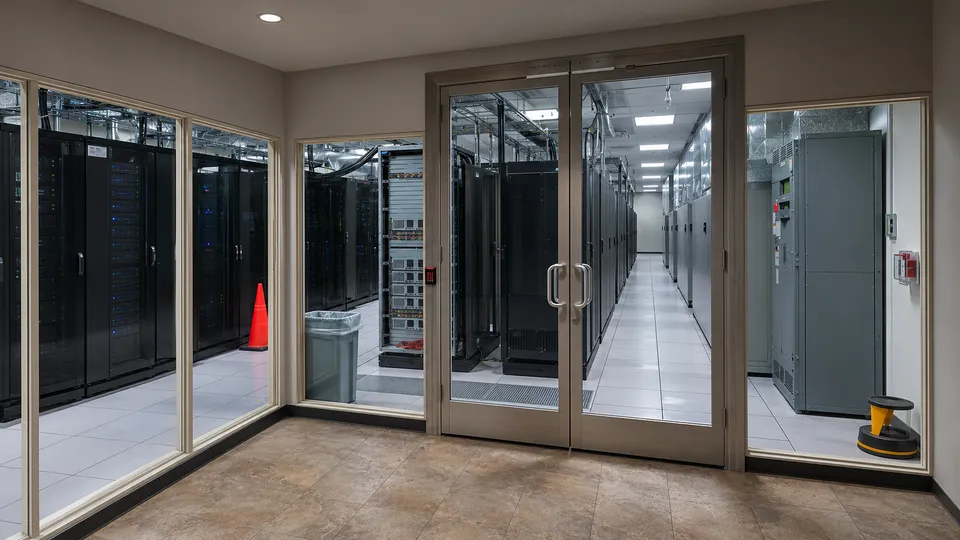
The $21 million doesn’t buy hardware the colleges would own; it buys a connection. It funds a partnership with UC San Diego, the San Diego Supercomputer Center and CENIC, the nonprofit that runs CalREN, California’s research-and-education fiber network, to plug all 116 colleges into the CENIC AI Resource, a shared GPU cluster already serving roughly 20 UC, CSU and community-college campuses. CalMatters put the network’s backbone at roughly 8,000 miles of fiber; CENIC’s own materials count a larger system, more than 54,000 miles of managed fiber in total once leased and shared lines are included, of which about 8,000 miles is the backbone CENIC owns outright. Craig Hayward, a strategic adviser to the community-college chancellor’s office on AI, told CalMatters the case for an in-house system rests on three things: commercial AI tools can cost up to $200 a month per user; an internal platform keeps prompts and data off a vendor’s servers; and a system the colleges control is one they can actually measure the energy footprint of.
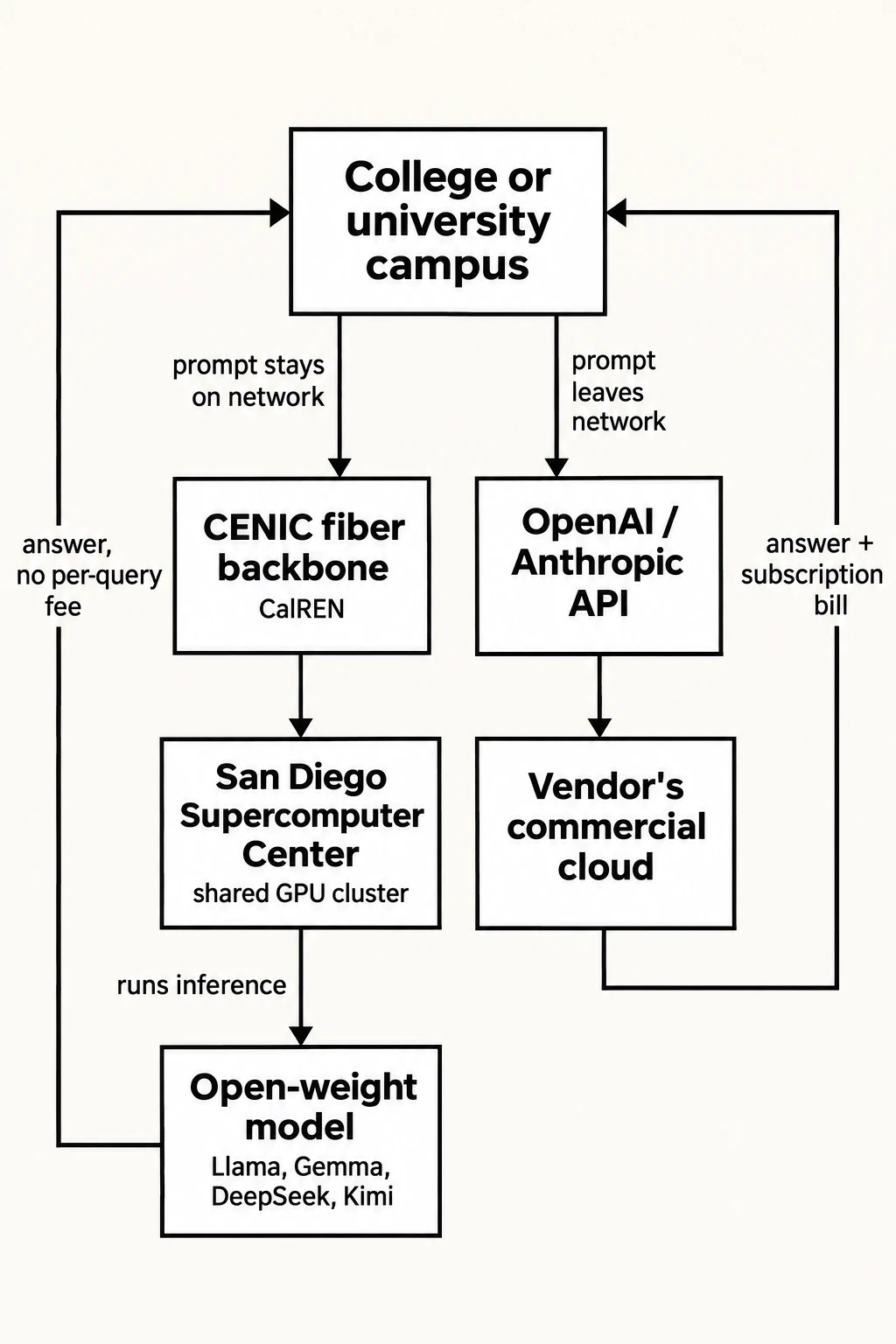
That is one path a prompt can take on a California public-college network now. The other path, the one every campus still defaults to, sends the same prompt off the network entirely, to a vendor’s commercial cloud, and bills the college per seat, per month.
| From | To | How |
|---|---|---|
| College or university campus | CENIC fiber backbone (CalREN) | prompt stays on network |
| CENIC fiber backbone (CalREN) | San Diego Supercomputer Center (shared GPU cluster) | |
| San Diego Supercomputer Center (shared GPU cluster) | Open-weight model (Llama, Gemma, DeepSeek, Kimi) | runs inference |
| Open-weight model (Llama, Gemma, DeepSeek, Kimi) | College or university campus | answer, no per-query fee |
| College or university campus | OpenAI / Anthropic API | prompt leaves network |
| OpenAI / Anthropic API | Vendor's commercial cloud | |
| Vendor's commercial cloud | College or university campus | answer + subscription bill |
Based on CENIC; CalMatters reporting
The diagram traces both. A prompt that stays on CENIC’s backbone reaches a GPU cluster at the San Diego Supercomputer Center running an open-weight model and comes back the same way, at no per-query cost to the campus beyond the shared infrastructure. A prompt sent to OpenAI or Anthropic leaves the campus network, runs on the vendor’s own cloud, and comes back with a subscription fee attached. The community colleges’ $21 million buys more capacity on the first path. California’s other two public university systems just spent real money buying more of the second.
Same week, the opposite bet
On November 19, the University of California’s Office of the President announced it had expanded its systemwide contract with OpenAI: a one-year, $1.2 million agreement running from December 2026 to December 2027, giving free access to ChatGPT Edu and OpenAI’s Codex coding tool to everyone on UC’s 10 campuses — more than 300,000 students and roughly 265,000 faculty and staff, by UC’s own count. The deal excludes UC’s hospitals and clinics and does not require anyone to use the tools.
UC’s prior, narrower OpenAI contract priced ChatGPT Edu licenses at a minimum of $10 per user per month and an advanced tier at $30, figures UC spokesperson Stett Holbrook gave CalMatters — a baseline against which $1.2 million for ten campuses looks cheap mainly because the system pays it once, centrally, rather than per seat. Cal State took the same vendor, at larger scale and longer term: its systemwide OpenAI contracts run through 2029 and total roughly $56 million, according to CalMatters. California’s own consumers have, if anything, been moving the other way: OpenAI leads consumer AI spending in every state but California, where Anthropic wins. The state’s public colleges are buying exactly the product Californians who pay for AI themselves are increasingly skipping.
| System | Commercial AI deal | Shared / in-house infrastructure effort |
|---|---|---|
| UC | $1.2M, 1-year OpenAI contract (Dec 2026–Dec 2027); free ChatGPT Edu + Codex for 10 campuses, 300,000+ students… | President's Office panel recommended building UC's own AI systems (Sept. 2026); UCSD runs TritonGPT/TritonAI in… |
| CSU | OpenAI contracts worth ~$56M, running through 2029, across the 22-campus system | Early-stage talks with UC and community colleges on shared AI infrastructure |
| Community colleges | No systemwide paid AI vendor contract; non-financial agreements with Google, Microsoft, Adobe, IBM | $21M request to join UCSD/SDSC/CENIC's shared GPU network (CENIC AI Resource) |
| Cal Poly San Luis Obispo | None reported | New campus AI data center announced Nov. 2026, built with $3M from the Robert N. Noyce estate |
Source: CalMatters reporting
The table lines up what each system is doing right now. UC pays once, centrally, for free access to a single vendor’s full catalogue. Cal State pays more, over a longer contract, for the same vendor. The community colleges have no systemwide vendor contract at all, only non-financial agreements, and are asking for public money to buy into infrastructure built around the one UC campus that already has a working example of the alternative running in production.
Nobody asked the faculty
UC’s own Academic Senate says it learned of the OpenAI expansion on October 21 and sent a letter five days later raising data-privacy, intellectual-property and pedagogical concerns, before the deal was finalized regardless. Academic Senate chair Susannah Scott, in a statement reported by EdSource, said the university had moved too fast:
The Academic Senate believes it is unwise to provide students with universal access to a tool capable of performing the academic work required to earn a degree without first addressing the concerns of the faculty who are responsible for curriculum, teaching, and academic integrity.
Scott added that the senate’s October 30 letter raised concerns that “remain unresolved.” UC’s chief information officer, Van Williams, wrote in an October email that the university needed to move quickly to “lower costs, strengthen enterprise protections, and broaden access.” UC President James Milliken wrote that the decision had “the full support of all UC Chancellors.” A UC spokesperson told EdSource faculty feedback had been “thoughtful and helpful,” which is one way to describe being overruled.

Cal State has its own version of this fight. A San Francisco State professor, Martha Kenney, is running an independent petition, about 4,000 signatures as of this month, asking Chancellor Mildred García to cancel the system’s OpenAI contract and redirect the money toward jobs at the nine CSU campuses where employees have received layoff notices since 2024. The petition’s complaint is specific: “ChatGPT Edu does not use reliable peer-reviewed sources to answer students’ questions and is indifferent to whether its answers are correct.” CSU’s faculty senate separately passed a resolution asking administrators to confine AI mainly to administrative work, not curriculum.
Sovereignty runs on someone else’s weights
Even the in-house option isn’t sovereign all the way down. UC San Diego’s TritonGPT, the most developed example, running since a student help-desk project roughly three years ago and now folded into a broader TritonAI platform, runs on open-weight models: Meta’s Llama, Google’s Gemma, or Chinese labs’ DeepSeek and Kimi, all cheaper to operate once deployed than a metered call to ChatGPT or Claude, none of them built by the university. Frank Wuerthwein, who directs the San Diego Supercomputer Center, told CalMatters the shared California network is smaller than Texas’s equivalent, and that both trail the computing power of the commercial AI companies the colleges are trying to avoid paying. “CENIC AIR enables California’s colleges to own their AI infrastructure,” Wuerthwein said in a CENIC statement, “with CENIC doing the network planning, engineering, and coordination activities, including critical security functions.” Owning the network is not the same as owning the model running on it.

The scale difference shows up fastest at the edges. Cal Poly San Luis Obispo announced a new campus AI data center this month, built in part with a $3 million donation from the estate of Intel co-founder Robert N. Noyce, meant to serve the whole campus under the direction of Chris Lupo, head of the school of applied computing. $3 million buys a campus cluster. It does not buy a presence in the kind of data-center buildout that is reshaping the Bay Area’s building permits and power grids a few hundred miles north, where the companies the colleges are trying to substitute for operate at a different order of magnitude entirely.
Whether the $21 million survives the legislature is a separate question from whether it should. The LAO’s review of the governor’s 2026-27 budget flags a $5.6 billion Proposition 98 settle-up obligation already built into the same account the community colleges are drawing from for everything, AI included. The number to watch next year isn’t the $21 million the system asked for. It’s how much the legislature actually appropriates, and whether UC and Cal State, having just signed a combined $57.2 million in new OpenAI contracts, ever show up as paying partners in the network the community colleges are trying to build instead.