
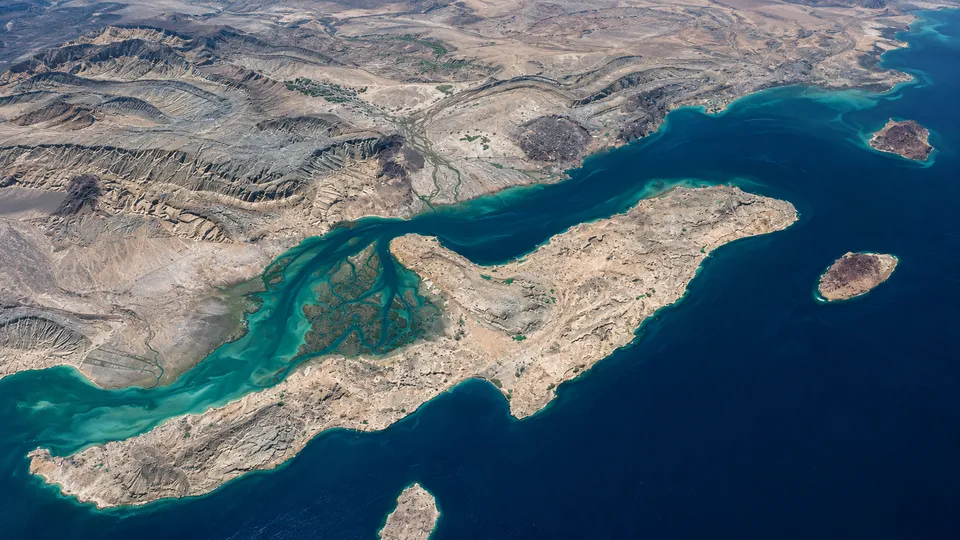
Qeshm is a long, low island lying across the mouth of the Gulf, close to the Iranian shore and to the narrow water every tanker must pass through. Late on Monday, 2 November, the explosions there came one after another, in quick succession, according to Iran’s state news agency IRNA. Witnesses told the agency they had seen two planes over the island. Across the water at Bandar Lengeh, a port on the mainland coast, the semi-official Fars agency said blasts were heard as well, coming “from the direction of the sea.”
That is nearly everything known about what happened on the ground. As Al Jazeera reported, neither Tehran nor Washington commented straight away. No deaths, injuries or damage had been reported. The account of who did it and why came from Washington, from officials who would not give their names.
A careful word
The Wall Street Journal broke the story first, citing US officials who said the American military had carried out the strikes. Some of them called the strikes defensive, aimed at limiting Iran’s ability to attack commercial shipping. One official told the paper that Washington had kept its campaign quiet so that it would not look like a return to major combat operations. A US official told the Associated Press that the targets were Iranians using surface-to-air missiles against US assets. Fox News and Axios reported that the strikes answered fire by the Islamic Revolutionary Guard Corps on a US aircraft over the strait that day. Fox’s Jennifer Griffin, citing an official, said this was not “the start of expanded strikes by the US.”
Two US officials told ABC News that the strikes on Qeshm “do not signal the resumption of major combat operations against Iran,” and described them as limited in scope. US Central Command did not respond to the network’s requests for comment.
Read as reflection, not as fact: a war that has learned to describe itself in the passive voice is a war trying to hide its own size. The bombs fall, but the word “defensive” goes out ahead of them, as though the language were the real target and the island only something in the way.
Drones over the water
Earlier on Monday the Revolutionary Guards made claims of their own. They said they had used electronic warfare to take control of two US reconnaissance drones south of Qeshm, and that they had destroyed an MQ-9 drone east of the strait. ABC News reported that Iran said it had brought down two RQ-170 drones. A US official called that claim “false.” So two versions of the same day go out from the two capitals, and neither offers much proof.
This is a strait Iran has kept shut as its main leverage over Washington. In recent weeks, ABC reported, Iran has stepped up its attacks on commercial ships moving through it. The US has blockaded Iranian ports. Every drone, every missile battery on the coast, every “defensive” strike belongs to that larger contest over the water.
The eve of the vote
The timing could hardly have been worse for a president who wants to look like a peacemaker. On Tuesday Americans vote in midterm elections in which the Republicans are fighting to keep the House and the Senate. Hours before the blasts, Donald Trump stood by the Lincoln Memorial Reflecting Pool in Washington and spoke warmly of a possible agreement with Tehran.
“It looks like that’s coming together very nicely. That’s why I guess the oil prices dropped. People found out about it.”
On Truth Social he wrote that oil had fallen almost $10 a barrel, which he called a record, and added: “Iran wants a settlement, as soon as possible. It could happen!” Asked whether he would strike Iran once Tuesday’s vote was over, he said “no.”
Rulers have always liked to set the price of oil against the price of a war. In this case the two seem to move in the same news cycle, almost hour by hour.
Two days, five conditions
In Tehran, foreign ministry spokesman Esmaeil Baghaei said Iran’s demands had been clearly conveyed and that “the ball is in the US court.” Iran has drawn up a shortened plan to reopen the Strait of Hormuz, and he said it could be carried out within two days if its conditions were met. Those include lifting the US naval blockade of Iranian ports and ending hostilities, which would open the way back to negotiations. As rews has reported, that timetable rests on concessions Washington has not confirmed.
So in a single evening both sides spoke of two days and of a settlement, and both had aircraft and missiles over the same island.
Beijing returns
Far from the strait, another capital moved. After a lull in its activity, China has stepped up its diplomacy in the Middle East, Al Jazeera reported. On Monday Foreign Minister Wang Yi met a senior Iranian security official in Beijing, and the government urged dialogue to end the US-Israeli war on Iran. It is also sending an envoy to the Gulf. On the same day President Xi Jinping hosted Oman’s Sultan Haitham bin Tariq on a state visit, the first by an Omani head of state since 1978.
Forty-eight years between visits. Then, in one week, a sultan in Beijing, an Iranian envoy at the foreign ministry, a Chinese envoy heading for the Gulf. Great powers rarely travel this much when nothing is at stake.
On Qeshm itself, the only accounts so far are the few lines in IRNA’s report: blasts one after another, and two planes overhead in the dark. Whatever the officials in Washington call it, the people who live on the island heard it close up. Nobody has yet said what it cost them.