
On Saturday 17 October, people marched in at least four European Union countries — Belgium, France, Italy and Portugal — in demonstrations called separately, by different unions and student groups, over different immediate grievances, that happened to converge on the same weekend. Al Jazeera reported hundreds of thousands of marchers across the four countries. No single body counted them all, and within every country the national tallies disagree with each other by a factor of two or more — a pattern that recurs through the whole story, and that tells you as much about how European states measure dissent as the protests themselves do.
The backdrop is one number Eurostat publishes every month: euro-area annual inflation, which rose to 3.8% in September 2026, up from 3.2% in August and from 2.2% a year earlier. Energy, at 18.9% year-on-year (up from 14.3% in August), did roughly half the work. Of the 3.8 percentage points of headline inflation, Eurostat attributes 1.71 points to energy, 1.52 to services, 0.29 to non-energy industrial goods and 0.25 to food, alcohol and tobacco; unprocessed food inflation alone jumped to 4.0% from 2.7% in a single month. None of this is specific to Belgium, France, Italy or Portugal — it is a bloc-wide average that hides large country differences — but it is the number every national grievance in this story sits on top of.
Portugal: a new lease now costs more than the minimum wage
In Lisbon, Porto and Coimbra, the CGTP union federation led marches under the slogan “higher wages, better pensions, and public services,” as Euronews reported. Al Jazeera’s reporting put Portuguese property prices at more than double their 2017 level. The number behind the Lisbon marches is more specific: data published by Portugal’s statistics institute, INE, put the median rent on new leases at €10.17 per square metre in the second quarter of 2026, up 10.2% year-on-year and a record. For a standard two-bedroom flat at that median, the monthly rent — about €864 — now exceeds the net minimum wage of €818.80. Signing a new lease, in other words, costs more than a full month’s minimum-wage pay packet before anything else is bought. CGTP general secretary Tiago Oliveira called it a “brutal increase” in housing costs and in the cost of living generally. The Left Bloc’s José Manuel Pureza put it to the Associated Press this way, as carried by Euronews:
Those whose rent is getting ever more expensive, those whose mortgage is increasingly hard to fit into the family budget. That is what we are talking about, that is why people have been protesting, always peacefully, always peacefully.

Portugal’s Parliamentary Affairs Minister, Carlos Abreu Amorim, said ahead of the march that the government would not yield to “shouts from the street,” per Al Jazeera. No serious violence was reported at the Portuguese marches.
Belgium: a tuition bill that more than tripled, a bus pass that rose 32-fold
Belgium’s unrest predates 17 October by weeks. The Wallonia-Brussels Federation’s new fee schedule for 2026-27, reported by the Brussels Times, sorts students into bands of €0, €374, €835 or €1,194 a year by financial circumstance, replacing a flatter, cheaper system; about 60% of students land in the top band, according to the magazine Moustique. One Conservatoire Royal de Bruxelles student, Emilie, told reporters her own fee went from €350 to €1,200. Separately, the Wallonia transport operator TEC confirmed that from 1 February 2027 its near-free €12-a-year youth pass disappears; full network access, Express lines included, rises to €384 a year — a 32-fold increase affecting some 136,000 young riders. TEC’s justification: a 2024 internal evaluation that, it said, found no significant link between the cheap fare and higher ridership. Under pressure, Wallonia’s governing MR and Les Engagés parties have since proposed capping the new youth fare at €180 instead. A 9 October national march in Brussels drew 30,000 people by police count and 50,000 by unions’ count; by 17 October, with cost-of-living protests converging nationwide, police used tear gas and water cannon in both Brussels and Liège, where they said protesters threw projectiles and set fires. Interior Minister Bernard Quintin said “what is unfolding in Brussels is no longer mere protest.”
Italy: a march against war and prices ends at the Duomo
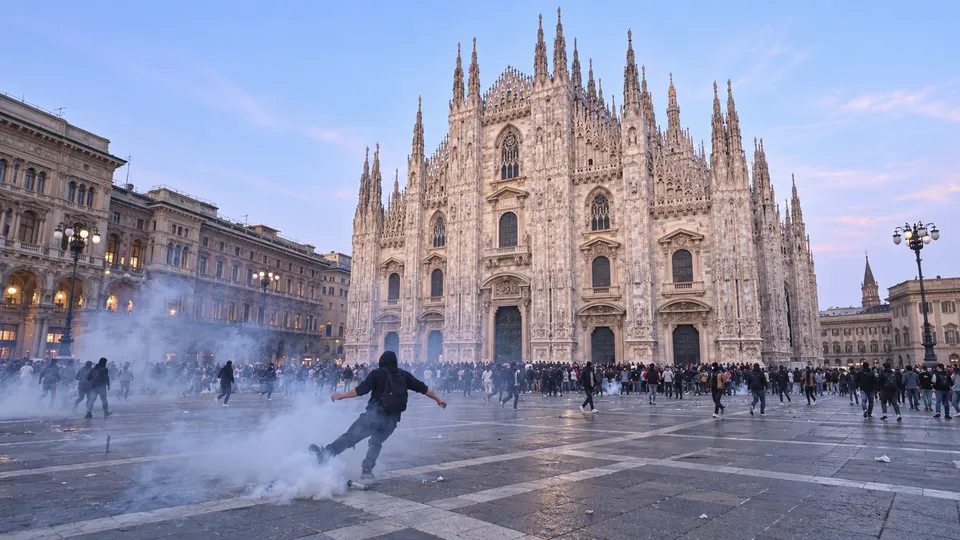
Italy’s 17 October unrest followed a 2 October 24-hour multi-sector strike — covering rail, schools, healthcare, local authorities, metalworking, agriculture and private security — called by a small autonomous union, not by the CGIL confederation whose Gaza-related general strike drew more than two million people into Italian squares in October 2025. The Milan march on 17 October began as a demonstration against war and the cost of living; it ended with masked protesters throwing stones and paving blocks at riot police, burning barricades built from café tables, and looting shops, clearing Piazza del Duomo and a luxury shopping arcade. The Italian news agency LaPresse reported at least two police officers injured and about 50 demonstrators detained, many of them minors. Prime Minister Giorgia Meloni defended the right to peaceful protest while condemning the arson, and accused troublemakers of exploiting the demonstration; Milan’s centre-left mayor, Giuseppe Sala, acknowledged the protesters’ underlying grievances but rejected the attacks on police and property. Police in Bologna reported separate stone-throwing.

France: a budget fight, and a counting fight
France’s 17 October marches folded into school blockades that had already run since September, over education funding and the national budget. On turnout, the French interior ministry and the unions disagree by roughly 250,000 people: CNN reported the ministry’s nationwide count at 550,000, including 110,000 in Paris, while TASS reported the CGT union and the student group L’Union Étudiante putting the national figure at 800,000, across 1,700 separate rallies and marches by the student union’s own count. An independent crowd count for Paris specifically, cited in earlier rews reporting on the same day, put the capital’s crowd at 32,800 — a reminder that French headcounts vary not only by who is counting, but by what, exactly, is being counted: a city or a country, marchers or rally attendees. The violence was not contested. Fire gutted a 140-year-old town hall in Limoges; intruders damaged municipal buildings in Marseille and Lille; Lyon’s tourist office was burned. Prime Minister Sébastien Lecornu said 1,200 people were arrested nationwide and 150 police officers were injured, calling it “a miracle the toll wasn’t higher.” President Emmanuel Macron said on social media that those responsible would be “prosecuted and punished.”

The next twelve months have four elections in them
Alberto Alemanno, an EU law and policy professor at HEC Paris Business School, told Al Jazeera that the four marches were distinct movements rather than one coordinated campaign, but shared concerns over education funding, household costs and graduates’ job prospects. France, he said, was the main centre of unrest, with early signs that it could spread to Greece, Germany and Austria within the following week. He noted that elections are due in Spain, France, Italy and Poland over the next 12 months — which is one reason four separately organised Saturday marches are getting read, by governments and by each other, as a single political fact.
The numbers to watch now are mundane by comparison: Eurostat’s next inflation estimate, due in mid-November, will show whether September’s energy spike was a one-month jump or the start of a run; Wallonia’s parliament still has to vote on whatever youth transport fare replaces the scrapped €12 pass; and France’s unions have not yet said whether there will be another nationwide call before the budget vote. Whether four uncoordinated Saturdays add up to one European movement is a question none of this weekend’s headcounts, however they were taken, actually answered.