
Klopatra, an Android banking trojan, infected more than 3,000 phones between March and October 2025, mostly in Spain and Italy, according to the Milan-based fraud-detection vendor Cleafy, which found it. The trojan doesn’t harvest a password and phone home. It sits inside the phone, waits until the victim’s banking app session is already open and authenticated, and then drives a transfer itself, often at night while the device charges and the owner sleeps, using a hidden VNC connection to control the screen without showing anything on it. Cleafy’s writeup attributes the operation to a Turkish-speaking group and counts more than 40 distinct builds since March, evidence of active, iterative development rather than a one-off tool.
The industry term for this is on-device fraud: the fraudulent transaction originates on the customer’s own hardware, inside the customer’s own authenticated session, so every signal a bank checks — device fingerprint, biometric unlock, one-time code, behavioural pattern — reads as genuine, because mechanically it is. The fraud isn’t in getting past those checks. It’s in not needing to. Luca Collacciani, Cleafy’s chief growth officer, laid out the shift in Cybersecurity Insiders: “the malware is the customer, as far as the bank can tell.” That claim is worth testing against the regulatory data, because it changes what a fraud statistic actually measures.
The EU’s two bank regulators, the European Banking Authority and the European Central Bank, report that payment fraud losses across the European Economic Area rose from €3.5 billion in 2023 to €4.2 billion in 2024, a 20% increase. Credit-transfer fraud accounted for €2.2 billion of that (up 16% year on year); card fraud on EU/EEA-issued cards accounted for €1.329 billion (up 29%); the remaining roughly €0.67 billion, 16% of the total, came from other instruments. Strong customer authentication, the two-factor login EU banks have been legally required to run since 2020, is still working on cards: the EBA/ECB report finds card fraud is 17 times higher when the recipient is outside the EEA, where that requirement doesn’t apply. It is not working, structurally, against authorised-push-payment scams, where the EBA/ECB report finds payment service users bore about 85% of the €2.2 billion in credit-transfer fraud losses themselves — roughly €1.9 billion moved by victims who were tricked into clicking send.
| Total reported fraud losses (€bn) | of which credit transfers (€bn) | of which cards (EU/EEA-issued) (€bn) | |
|---|---|---|---|
| 2023 | 3.5 | 1.897 | 1.03 |
| 2024 | 4.2 | 2.2 | 1.329 |
Source: European Banking Authority / European Central Bank joint report on payment fraud. 2023 instrument split derived by applying the report's stated year-on-year growth rates (+16% credit transfers, +29% cards) back from 2024 figures
None of that total breaks out on-device malware as its own line item. The EBA/ECB categories are credit transfer, card, direct debit and e-money fraud, sorted by how the loss happened procedurally (an authorised transfer, a card-not-present transaction), not by whether a human or a trojan did the authorising. That gap matters, because on-device fraud produces exactly the same transaction record as a legitimate authorised-push-payment scam: a real customer’s device, sending a real authenticated transfer. The only numbers tracking the malware side come from vendors like Cleafy, measured on their own telemetry, not audited by a regulator.
Why the old defences don’t see it
Behavioural biometrics, device fingerprinting and two-factor authentication all share one assumption: that fraud looks different from normal use — an unfamiliar device, a failed login, an odd typing rhythm. A banking app that’s been quietly carrying a remote-access trojan since the owner installed a pirated streaming app doesn’t trip any of those checks, because nothing about the device, the login, or the typing is unfamiliar. The fraud happens after the genuine authentication, inside the genuine session.
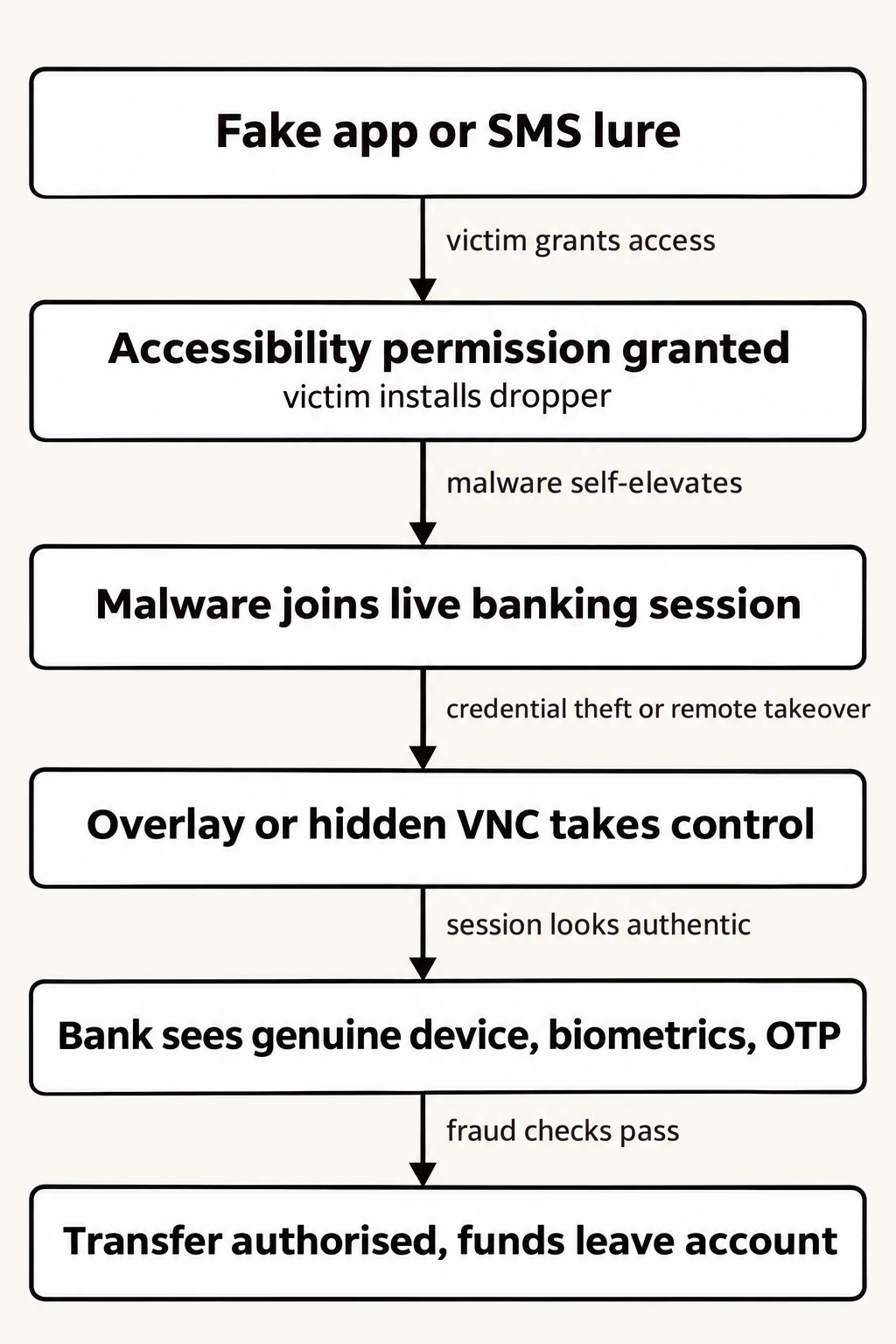
| From | To | How |
|---|---|---|
| Fake app or SMS lure | Accessibility permission granted (victim installs dropper) | victim grants access |
| Accessibility permission granted (victim installs dropper) | Malware joins live banking session | malware self-elevates |
| Malware joins live banking session | Overlay or hidden VNC takes control | credential theft or remote takeover |
| Overlay or hidden VNC takes control | Bank sees genuine device, biometrics, OTP | session looks authentic |
| Bank sees genuine device, biometrics, OTP | Transfer authorised, funds leave account | fraud checks pass |
Based on Cleafy Labs
Cleafy has documented two other families built on the same premise. Mirax, a remote-access trojan sold as malware-as-a-service to a small number of mostly Russian-speaking affiliates, adds a second business model on top of fraud: it turns the infected phone into a SOCKS5 residential proxy, opening WebSocket channels on ports 8444 and 8445 so other criminals can route unrelated traffic through the victim’s genuine home IP address. TheHackerNews reported that Cleafy tracked malicious Meta ads for fake IPTV apps served to more than 200,000 users as the infection vector. The proxy function needs far fewer Android permissions than full device takeover, so a phone stays monetisable to the operators even when the banking-trojan payload fails to install — a hedge against the victim’s own security software.
Albiriox, the third family Cleafy has named, is rented outright: about $650 a month, according to Cleafy’s analysis, for a kit with a hard-coded target list of more than 400 banking, payment and crypto apps, VNC-based remote control, and accessibility-driven automation for overlay attacks. One documented campaign impersonated the Austrian supermarket chain Penny by SMS, routing victims to a spoofed site that collected their phone numbers, fed a WhatsApp download link through a Telegram bot, and delivered the payload disguised as a file manager. Pricing a banking trojan as a $650 monthly subscription, rather than selling it once, is itself a tell: the economics only work if a rented copy can be pointed at new victims faster than banks can blacklist its infrastructure.

What’s measured and what’s marketed
Mobile banking’s growth is real and well measured: Febelfin’s survey of 1,000 Belgians found 89% now use a banking app, overtaking PC banking’s 85% for the first time, with two in three using the app at least weekly. That’s the attack surface growing, independent of any vendor’s framing of it. What’s harder to verify is Cleafy’s claim that its own detection platform, called Nyx, is already running in production at “one of Europe’s largest banks,” protecting more than two million customers since December 2025. That figure, and the accompanying claim of under five minutes per fraud assessment with no analyst hours required, comes from Cleafy’s own product page and press release, not from the unnamed bank or any regulator. No bank is identified, no dollar amount of fraud stopped is given, and no false-positive rate is disclosed — the three numbers an engineer would actually want before trusting a vendor’s detection claim.
The EU’s incoming third Payment Services Directive is expected to push more fraud liability onto banks rather than customers, which is the commercial reason fusion platforms like Cleafy’s exist: a bank that eats the loss has a much sharper incentive to buy detection than one that can point at a customer who clicked a phishing link. An earlier piece on the economics of connecting two billion new mobile users covered the supply side of that incentive. The EBA/ECB figures, revised annually, are the only independently audited measure of how much of this is actually moving money at EEA scale. The next edition, covering 2025, is the number to watch: whether on-device malware shows up as a visible bend in the credit-transfer fraud line, or whether it stays invisible inside a category built for a different kind of theft.