
On Friday evening Volodymyr Zelensky gave his nightly video address and told Ukrainians what was coming. Russia, he warned, was preparing new strikes on energy facilities, on bridges and on the rest of the infrastructure a capital needs to stay alive through a winter. It was less a prophecy than a reading of the timetable. Within hours the timetable was kept.
The Ukrainian Air Force reported waves of ballistic missiles aimed at Kyiv and the towns around it, from the evening of 6 November and on through the night. The mayor, Vitali Klitschko, wrote on Telegram in the clipped language of a man who has written such messages many times, as Al Jazeera reported:
Explosions in the Kyiv suburbs. The enemy is hitting infrastructure with ballistic missiles.
The count
At first the city’s military administration said two people had been hurt. Then the number rose, the way such numbers rise through a night: three, then five. By Saturday Klitschko was reporting on Facebook that five people had been injured, according to Ukrinform, among them a 14-year-old. Two were taken to hospital.

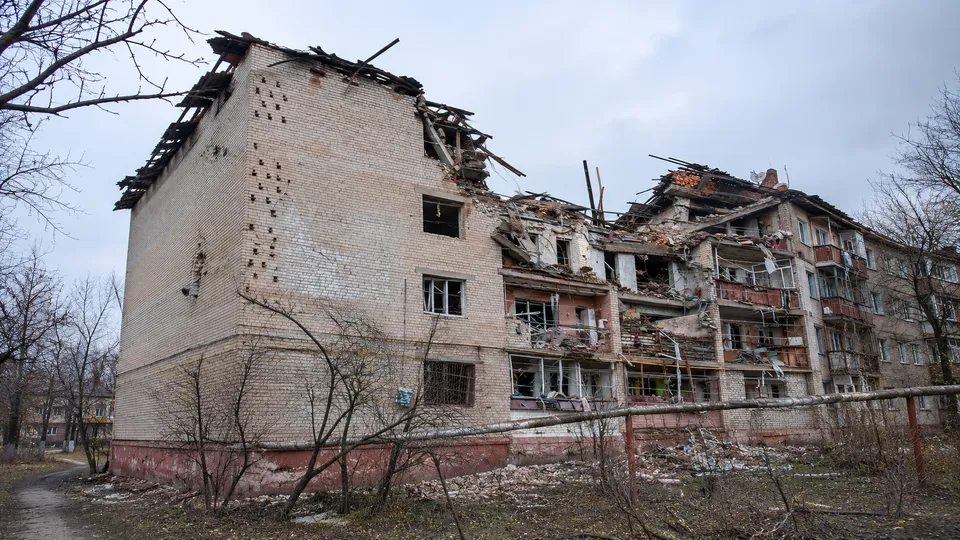
Falling debris struck a five-storey apartment block in the Solomianskyi district in the west of the capital. The facade and windows of another residential building were damaged. So was a building that houses a kindergarten. Russia says it fires at infrastructure. The fragments come down wherever they come down, and in Kyiv that means on the places where people sleep and where their children are looked after.
The river
Kyiv is a city split by the Dnipro, and its bridges are the stitches holding the two halves together. After the strikes, traffic was halted on one of them, the Associated Press reported, along with damage to homes and commercial buildings and fresh outages of electricity and water. Liga.net identified the closed crossing as the Northern Bridge. Zelensky had named bridges in his warning; a month earlier, Russia hit a Kyiv bridge while Germany’s chancellor was visiting the city.
Then there was the grid. “As a result of the enemy’s night attack, energy facilities in the Kyiv and … Zhytomyr regions were damaged,” Klitschko said, calling the capital’s energy situation “extremely difficult” and saying it was disrupting heating and water. This is the slow part of the war, the one that does not show up in casualty figures: a campaign against the wires and the substations before the cold settles in, aimed at the radiator and the tap rather than the soldier.

Hours after the attack, officials were still warning residents that more strikes could follow.
The table
None of this happened in a diplomatic vacuum. Negotiators from Russia, Ukraine and the United States are due to meet on Tuesday in Abu Dhabi, in the United Arab Emirates. It would be the fourth round mediated by the Trump administration; the AP said the previous one was held in Geneva in February. Territory and security remain unsettled, and Ukraine’s Western backers are looking for a new approach.
On Thursday, Donald Trump said a deal might be “imminent” after receiving Kirill Dmitriev, Vladimir Putin’s envoy, at the White House. Trump said he had not met the Ukrainian delegation that day. Also on Thursday, Melania Trump hosted Russian and Ukrainian representatives, hoping to build on a local truce she had helped broker in Oleshky in October.
That truce ended last Sunday. On Monday, Russian guided bombs struck an aid distribution point set up in a former school in Komyshuvakha, in the Zaporizhzhia region, and a shelter nearby. Al Jazeera reported that Ukraine’s State Emergency Service had raised the death toll to 50 by Friday; the AP put it at 55, including two bodies recovered on Saturday, with dozens still missing. It is one of the deadliest attacks on civilians this year.

Meanwhile in Brussels, Ukraine’s allies spent two days on reconstruction after the war, on next year’s funding and on security guarantees. Rustem Umerov, Kyiv’s lead negotiator, said the participants included the United States, Britain, France, Germany, the European Union, the World Bank and BlackRock. In an interview broadcast late on Thursday, Zelensky said Kyiv wants Western partners to spell out concretely how security support would work once the fighting stops.
Two calendars
A reflection, not a finding: wars that are heading towards negotiations tend to run on two calendars. One is kept in hotel conference rooms and on the White House lawn, where the word “imminent” circulates. The other is kept in apartment stairwells in Solomianskyi and at a closed bridge over the Dnipro, and it is measured in missiles. Those in power read the first calendar. Ordinary people have to live by the second.
Some time this weekend a 14-year-old in Kyiv will be counted among the wounded of a night that the country’s president had announced in advance. On Tuesday, in Abu Dhabi, the delegations will sit down.