
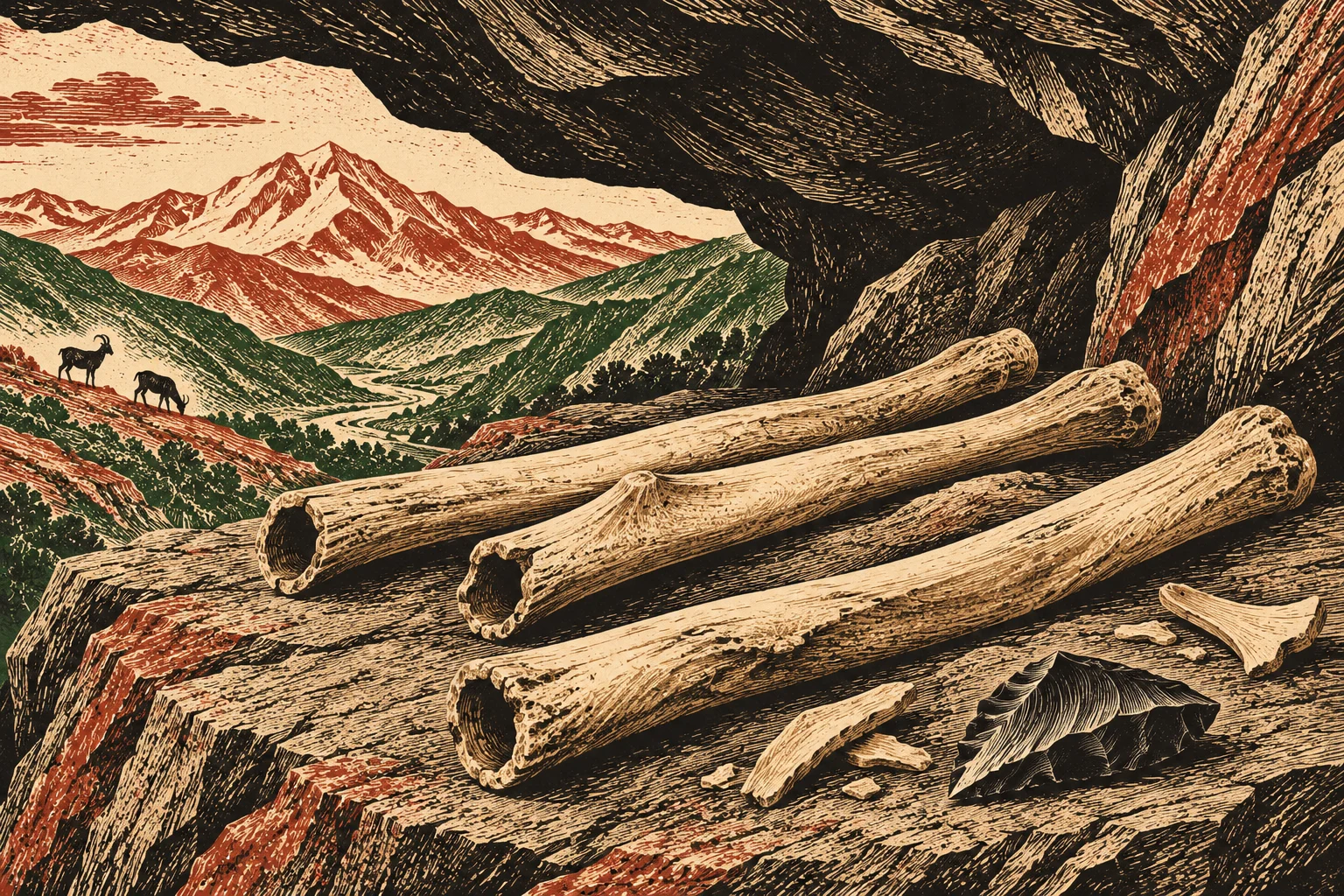
If you keep goats, you have goats for the milk and the meat, obviously. Then the goat dies and you are left with the bones, and the bones are free raw material. Somewhere in southern Armenia about 6,000 years ago, people seem to have done that sum: they herded sheep and goats, ate them, and then made tools out of what was left. And some of those tools were long narrow tubes, cut and finished to a common pattern, and nobody today can say what they were for.
The finds come from Yeghegis-1, a rock shelter in the Yeghegis River valley in Armenia’s Vayots Dzor region, at about 1,500 meters above sea level. As Leman Altuntaş reported for Arkeonews, an international team that includes Marina Évora and Mariya Antonosyan has published an analysis of 40 bone artifacts from the site in the journal Archaeological Research in Asia. Radiocarbon dates put human occupation of the shelter between 4100 and 3500 BCE, roughly half a millennium of the Chalcolithic, the period when copper was coming into use but stone still did most of the work. The site was found in 2020, according to the team’s earlier project report in Antiquity, and the bone artifacts were dug up between 2021 and 2024.
Asking the bone what it was
The first problem with a worked bone tool is that working it destroys the evidence. Once you have sawn, scraped and polished a chunk of bone into a point, it no longer looks much like the part of the animal it came from, and most of these 40 pieces had lost the anatomical features that would let a specialist name the species by eye.
So the team used ZooMS, short for Zooarchaeology by Mass Spectrometry. Different animals have slightly different collagen, and collagen survives in bone a long time, so you take a tiny sample, read its protein signature and match it to a species. The researchers say their sampling was minimal enough to leave no visible damage on the surfaces. It worked on 39 of the 40 pieces.
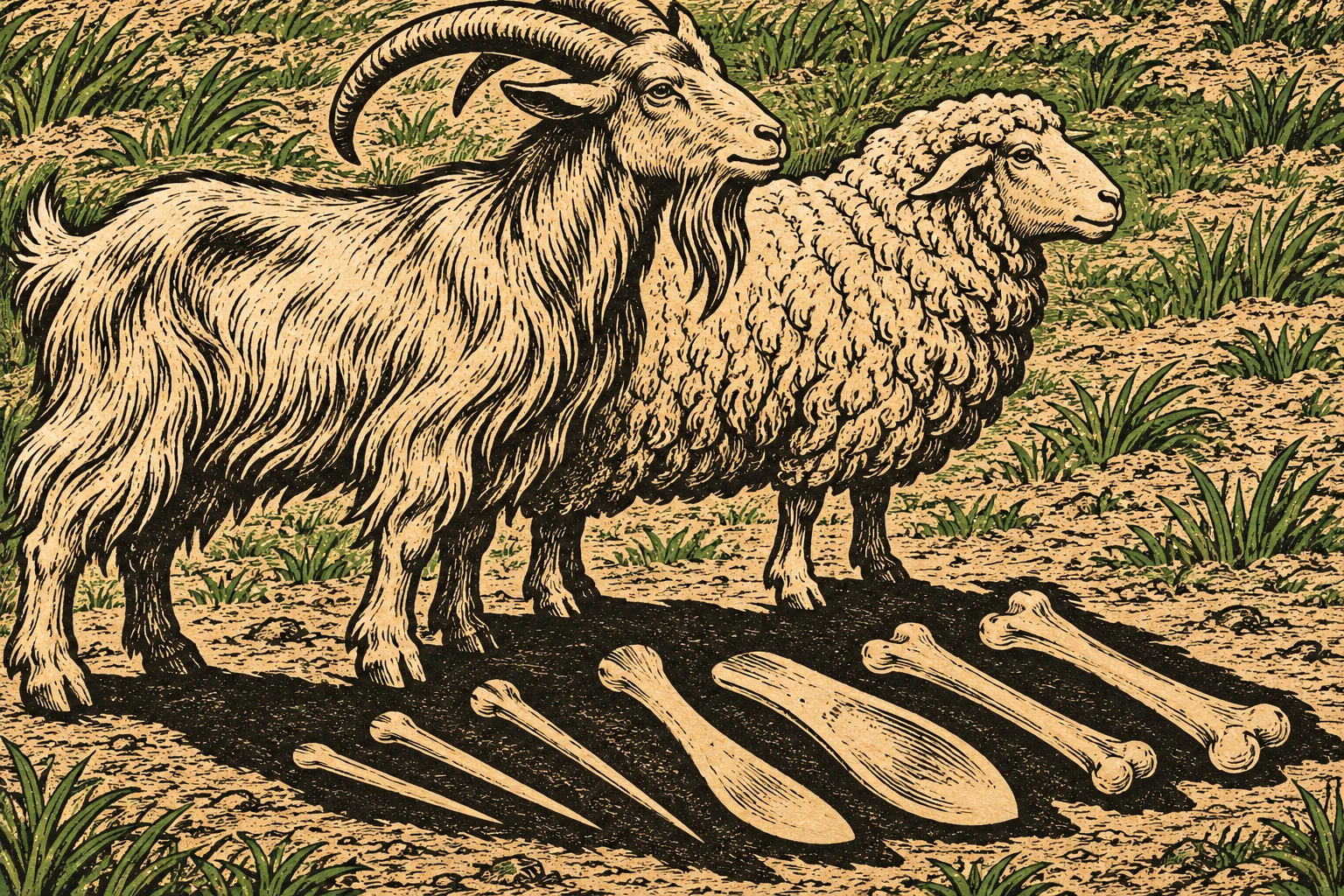
The breakdown: 16 goat, 11 sheep, six rabbit, one gazelle, and two pig or wild boar, plus three more that could be placed only in a broader animal group. That adds up to 39. Goats and sheep together make 27 of them, a bit more than two-thirds. (Arkeonews says “rabbit”; the team’s earlier preprint on bioRxiv describes the wild component as gazelle and hare, which is the more natural reading for the Caucasus.)
This lines up with what was already known about the place. Earlier animal-bone and isotope work at Yeghegis-1 had found that herding sheep and goats was central to how its people lived. The new result fills in the rest: the same flocks that fed them also supplied the material for their tools. The wild animals were hunted now and then. The herd did most of the work, alive and dead.
A workshop with a lot of work in progress
Here is the part I find most fun. Of the 40 artifacts, 23 are unfinished, 10 are finished tools, four are production scraps and three are raw or barely worked bone. If this were a factory you would say it carried a lot of work-in-progress inventory: well over half the stock was partly made, and only a quarter was finished goods. The archaeologists draw the sober conclusion that having every stage of production in one place means at least some of the bone-working happened inside the shelter itself.
And 19 of the 40 pieces are the tubes. They are long and narrow and look alike, and some of them are unfinished. Their surfaces show marks from sawing, twisting and abrasion, and the researchers think they were made by a set procedure. What the procedure was for is the open question.
Earlier work on bone tubes from other sites has offered the usual suspects: musical instruments, containers, amulets, personal ornaments. The Yeghegis-1 study doesn’t confirm any of them. Because so many of the tubes were never finished, it’s hard to work backward from the object to its purpose. You are looking at the half-built thing and guessing what the finished one would have done. The researchers suggest that the matching shapes may reflect a particular way of making things, perhaps tied to a specialized activity. They leave three possibilities open: the tubes were used locally, traded away, or abandoned partway through.
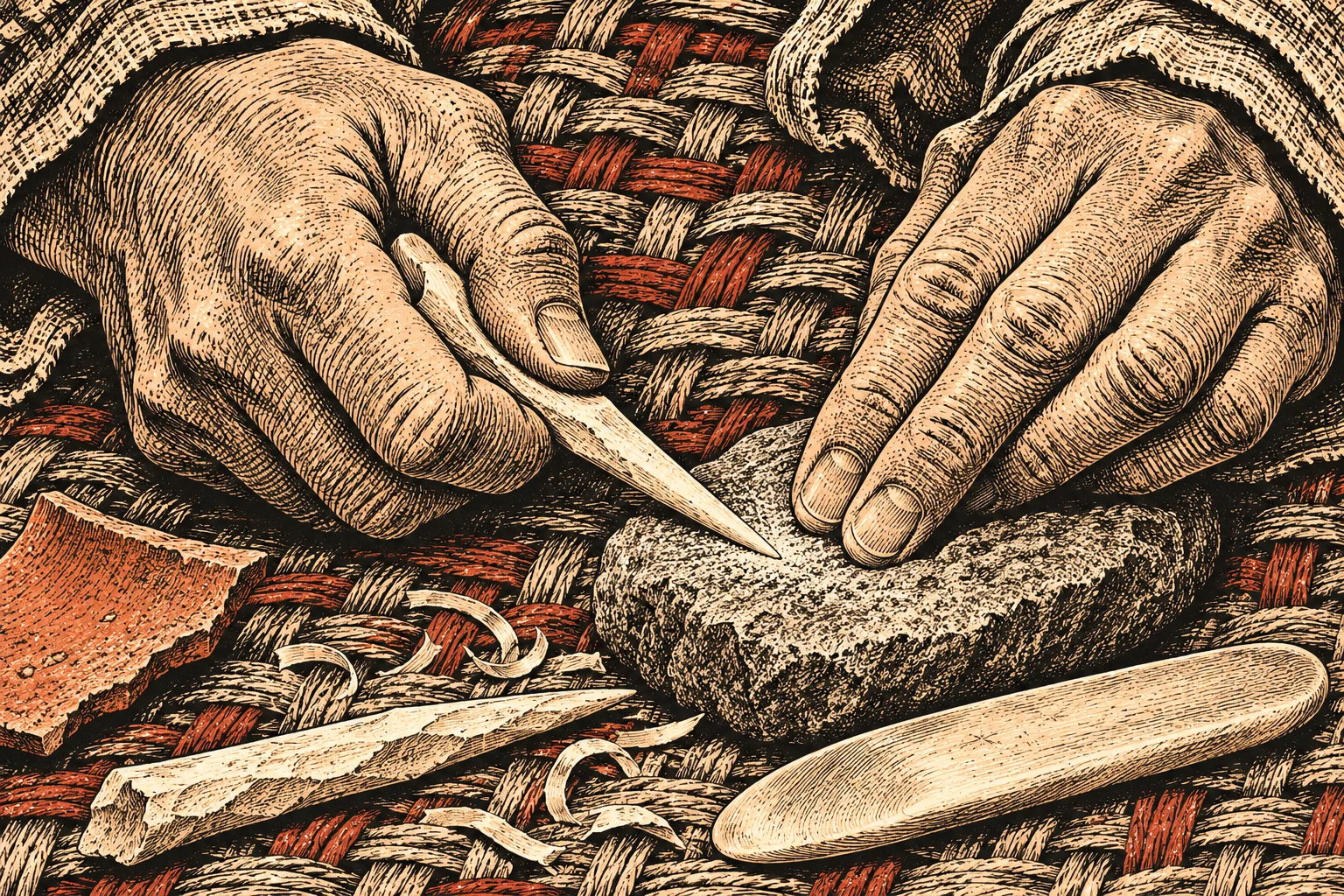
The other tools are easier to picture: pointed tools, smoothers, and pieces that may have been used to work different surfaces. The pointed ones could have served for leatherworking, weaving, basketry or decorating pottery, though the team says experiments are needed to check those uses.
Stone, not metal
One more detail. The marks on the bone point to shaping with stone tools, and the team found no clear traces of metal tools on any of the pieces. Metalworking was developing in the region during this period, but at Yeghegis-1, on this evidence, the bone-workers kept using stone. That makes sense if you think about what was cheap. The stone in question was very likely obsidian: a 2024 study in Scientific Reports found that 92.1 percent of the shelter’s stone artifacts were obsidian, drawn from a widening range of sources, some about 40 to 55 kilometers away in a straight line and others as far as 220 kilometers. Volcanic glass gives a very sharp edge. Copper was new and scarce. If you only need to saw a goat bone, you use the glass you already have.
The authors are careful about how far 40 artifacts can take them. That isn’t enough, they say, to draw firm conclusions about how large production was or how the shelter connected to regional trade. The study’s value is as comparison data on what raw materials South Caucasian communities chose in the Chalcolithic, and it adds to a run of finds from the region, including a 2,700-year-old Armenian grave covered here last month. The full paper is listed on the Max Planck Society’s publication repository.
So the state of knowledge is this: 6,000 years ago, people high in a valley in Vayots Dzor ate their goats, kept the bones, carefully made 19 matching tubes, didn’t finish many of them, and left no indication of what they were for. Future experiments may answer that. Until then the tubes keep their purpose to themselves, which, for an amulet, may have been the point.