
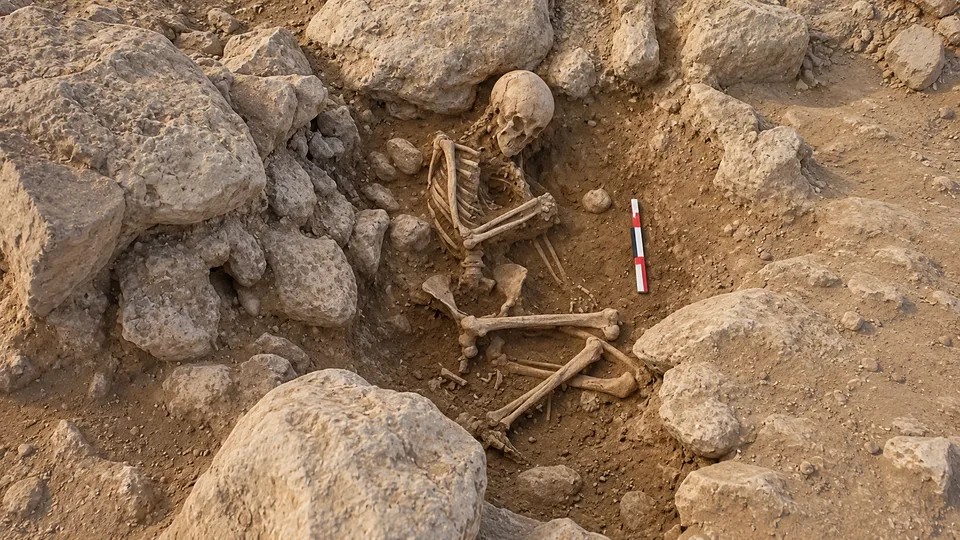
0.70740. That is the strontium isotope ratio (⁸⁷Sr/⁸⁶Sr) measured in the tooth enamel of a woman buried about 2,700 years ago at Metsamor, in Armenia’s Ararat Valley, and it is the single most informative number in a new study of her grave, because the local range at Metsamor runs from roughly 0.70689 to 0.70736. Her value falls just outside it. The gap is small — about 0.00004 — but tooth enamel forms in childhood and does not remodel afterward, so the ratio she carries is a fixed record of the geology under the food and water of her early years. Whoever buried her in the courtyard of an occupied house, with a Urartian-style cylinder seal among her grave goods, was likely not born where she died.
The finding comes from archaeologists Krzysztof Jakubiak and Arkadiusz Sołtysiak, whose study of the grave — designated Burial 11, in a structure called House II — was published in the Journal of Archaeological Science: Reports (vol. 74, article 105927) and reported by Arkeonews. The paper itself asks a narrow question: is this grave an isolated oddity, or one instance of a broader Iron Age funerary pattern in the South Caucasus? The honest answer so far is that it is unusual without being unique.
A grave cut into a living household
Metsamor sits about 30 kilometers west of Yerevan. It was occupied from prehistoric times and became a fortified metalworking center in the Bronze and Iron Ages, with a citadel behind massive stone walls and a Lower Town of residential buildings on an organized street grid. Most burials excavated in the Lower Town date to later periods, when abandoned buildings were reused as convenient places to put the dead. Burial 11 is different: the stratigraphy indicates the pit was cut through the courtyard floor of House II while the house was still in use, in the late eighth or early seventh century BC. Someone dug a grave into the floor of a functioning household and domestic life continued around it.
The pit measured approximately 2.56 by 1.96 meters, oriented north to south. The woman lay on her left side, tightly flexed. Early field descriptions called the position sitting or crouching; re-examination of the remains indicates a contracted lateral position instead, which matters because body position is one of the few variables archaeologists can compare across sites. The grave had been looted in antiquity, so the surviving assemblage — the seal plus several bronze objects — is a fraction of what went in.
What one cylinder seal can and cannot establish
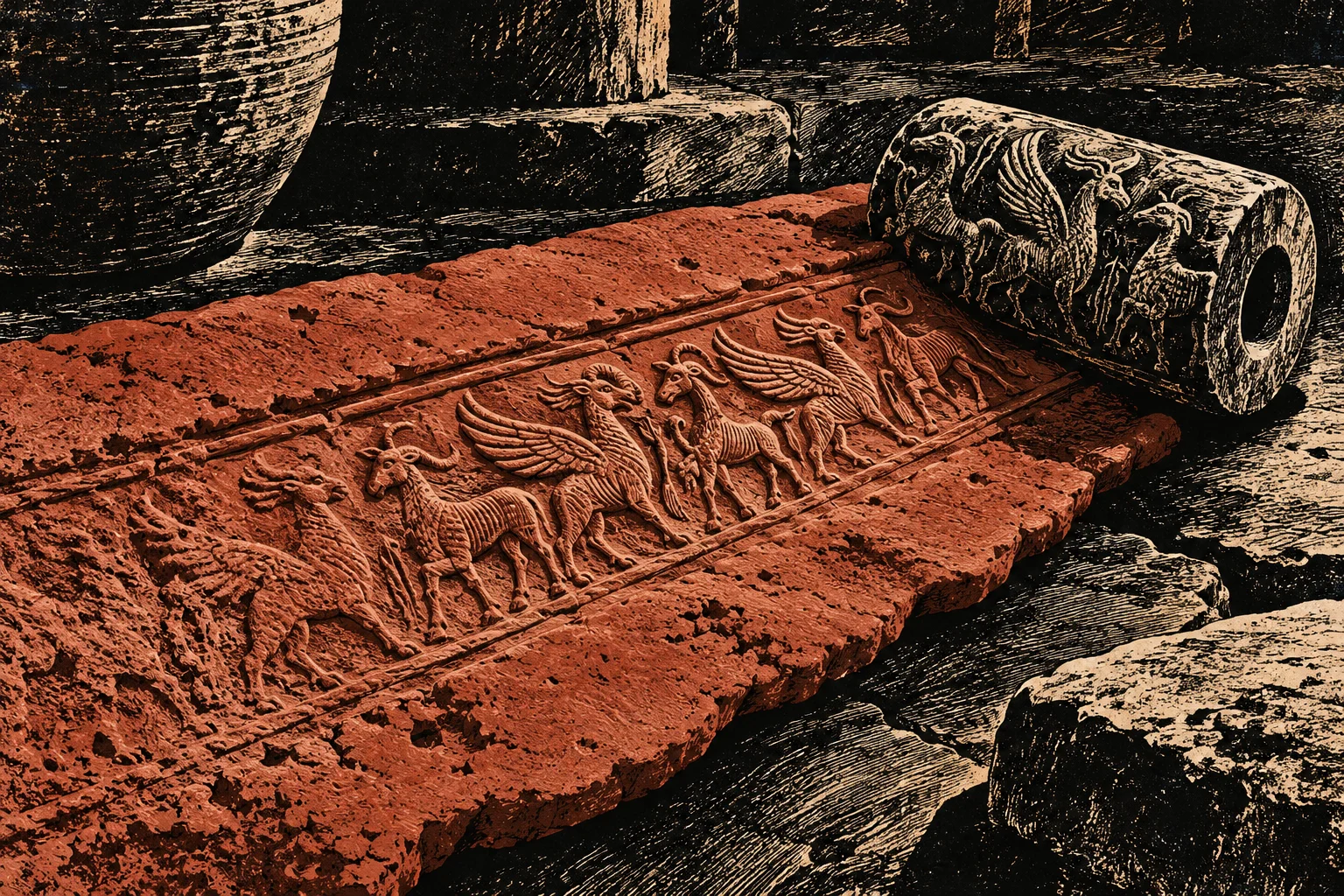
In the ancient Near East, cylinder seals were working objects: rolled across clay to mark ownership, authenticate goods, and run administration. They also carried symbolic weight and were sometimes worn on the body. The Metsamor seal is decorated with stylized animals, possibly fantastic creatures, though the surviving detail is too poor for a definitive reading. Comparable seals are known from Armavir, Karmir Blur, Iğdır, and Noratus, which places this one within the Urartian-influenced material culture of the Iron Age Armenian Highlands.
The temptation with a seal in a woman’s grave is to give her a title: priestess, administrator, elite. The researchers explicitly refuse. The object shows she held a socially distinctive position — ordinary dead at Metsamor do not get courtyard graves with seals — but it cannot say which position. The seal’s presence tells you about the community’s treatment of her, not her job description.
An over-40 skeleton with a childhood written in enamel
The skeleton is poorly preserved, but it still yields data. The woman was probably over 40 at death — an age many at Metsamor did not reach. Degenerative changes in her knee joints point to long-term mechanical strain, habitual activity, or age itself; the analysis cannot separate those. Her teeth showed advanced decay. More informative are defects in the enamel of her upper canines: enamel hypoplasia, horizontal bands that form when growth is interrupted in childhood by illness or nutritional stress. The enamel records episodes it cannot identify. She had a hard childhood by some measure, and a distinctive burial by any measure — the two facts coexist without explanation.
Strontium isotope analysis works on a simple mechanism. Bedrock weathering puts a locally characteristic ⁸⁷Sr/⁸⁶Sr ratio into soil, water, and plants; the ratio passes unchanged up the food chain and is locked into enamel as it mineralizes in childhood. Compare the enamel value against the local range and you get a verdict on origin, not on travel. Her 0.70740 falls just above the Metsamor baseline of 0.70689–0.70736. The researchers are careful about the limits: geology can shift over short distances, and the comparative isotope dataset for Metsamor is small. The result suggests she grew up elsewhere; it cannot say where, or how far, or why. Marriage, family relocation, and wider social ties all fit, and none can be demonstrated.
Why the date is a 345-year window
The archaeological context says late eighth to early seventh century BC. The calibrated radiocarbon result says roughly 775–430 BC — a window spanning 345 years. This is not sloppy measurement; it is the Hallstatt plateau, a stretch of the calibration curve between about 800 and 400 BC where atmospheric radiocarbon fluctuated enough that very different calendar ages produce nearly identical ¹⁴C readings. Almost any Iron Age sample from this era calibrates into the same smear. For Burial 11, the radiocarbon range is consistent with the context but adds no precision to it. The stratigraphy, not the ¹⁴C, is what dates this grave.
Comparable, but not a pattern
Jakubiak and Sołtysiak checked the grave against regional parallels rather than assuming one. At Oshakan, north of Metsamor, a woman was buried in a possibly contracted or seated position, but preservation is too poor to confirm. Estark, in northern Iran, produced a female burial with some similar traits. The strongest comparisons come from the Van region of eastern Türkiye, where several female burials combine strongly contracted positions with seals or small metal objects in Urartian tradition — but their dates and interpretations remain disputed, which blocks any claim of a single widespread custom.
What Burial 11 establishes, then, is a conjunction rather than a category: a grave cut into an occupied house, a deliberately arranged body, a status object that refuses to name a status, and an isotope ratio 0.00004 above the local ceiling. Each element alone has parallels. Together they describe a woman a community chose to keep inside its walls after death, and who by the chemistry of her own teeth had not always been there. The open numbers are the baseline ones: the Metsamor local strontium range rests on limited comparative data, and a few more sampled individuals — local and otherwise — would say whether 0.70740 is an anomaly or the first data point of a migration nobody has measured yet.