
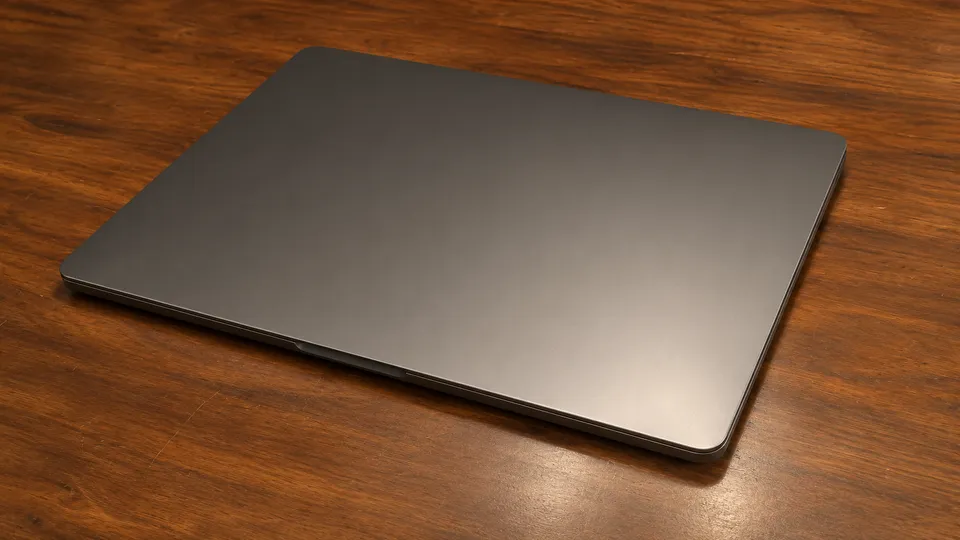
Some machines arrive at the end of an era and some at the start of one. Now and then a company builds one that has to stand in the doorway between them. On October 28 Apple announced a MacBook Pro with what it calls a PROLED XDR display. It is the company’s first laptop with an OLED screen and the first Mac you can touch, and it went on sale on November 6 after a week of preorders.
The price comes first, because for many buyers it will also be the last thing they consider. Gizmodo reported a starting price of $2,899 for the 14-inch model and $3,399 for the 16-inch. A 14-inch with the M5 Max chip starts at $4,499. Engadget called the base price the highest launch price it has seen for a MacBook Pro. By its count, a fully loaded 16-inch with an M5 Max and 128GB of memory costs $14,549. Apple also sells a non-touch model with the newer M6 chip for $1,999.
In his review for Ars Technica, Samuel Axon didn’t soften it. The laptop, he wrote, is “expensive as hell.” He also argued that the money buys real quality, and that whether it is worth paying is harder to answer in 2026 than in most years.
The screen
Apple calls the panel a tandem OLED: one screen with two light-emitting layers. Stacking the layers raises peak brightness. It may also lower the risk of burn-in, because the two layers seldom need to run at full power together and can share the work at reduced current, which should extend the panel’s life. Apple rates it at up to 2,000 nits for HDR highlights and 1,000 nits sustained. Each pixel lights or goes dark on its own, which gives true black and a contrast the old MiniLED screen, good as it was for an LCD, could not match. The screen covers the P3 and Adobe RGB colour spaces and refreshes at anywhere from 10 to 120 Hz. The 14-inch model has 3,024×1,986 pixels and the 16-inch has 3,472×2,226. A nano-texture anti-glare glass option costs $150 more.
Axon’s verdict was unusually plain. It is the best screen he has used on a laptop and one of the best he has used on any device, closer to an ultra-high-end television or a reference monitor than a computer display. He found the uniformity essentially flawless and said only time would tell how long the panel lasts. His one complaint was about the name. He called the “PROLED XDR” branding “silly and eye-roll-inducing.”
The screen is the reason to pay extra for this model. In his view, it is the main one.
The island and the touch
With the lid closed, the new machine looks like the old one. Ars found it only slightly thinner, a difference you would notice on the spec sheet or holding the two side by side. Engadget, by contrast, called it noticeably thinner. Both agree it is lighter: about half a pound less, Axon reports, partly because a light OLED panel is easier to build than a light MiniLED one. The Apple logo on the lid lights up again, as it did on older MacBooks, which Axon found “arguably a little tacky” and also nostalgic. The notch at the top of the screen has been replaced by a camera cutout like the iPhone’s Dynamic Island. Because OLED can make the surrounding pixels as black as the camera hole, live activities and the volume bar look as if they grow out of the cutout and shrink back into it.
Then there is the touch, which Axon says would never have happened in an earlier Apple era. For years the company argued that laptop screens should not be touched, and that argument now has a second life as a critique of exactly this kind of change. The company has changed its mind, and it is charging for the change.
The chip that stayed behind
Inside, almost nothing is new. The chips are the same M5 Pro and M5 Max as in the previous model, and Ars’s synthetic benchmarks found no meaningful difference between the two machines. Apple still promises 24 hours of battery life, which Axon says takes careful use to reach. The ports are unchanged: three Thunderbolt, one HDMI, one SDXC and MagSafe. The N1 chip provides Wi-Fi 7 and Bluetooth 6. The chips are fast enough for everyday work and most 3D work for the foreseeable future. Axon’s doubt is about AI inference, a field moving fast enough that today’s silicon may not keep up.
In late June, Bloomberg’s Mark Gurman reported that Apple would skip Pro and Max versions of the M6 and move straight to a rework of its next chip family. “The M7 line is designed primarily around major advancements to on-device AI processing,” he wrote. The emphasis would be on memory bandwidth, which drives fast and efficient AI inference. Macworld summarised the reported timeline: M7 Pro and M7 Max in late 2027 and an M7 Ultra in 2028. If the reports are right, it would be the first time since the M1 that a generation of Apple silicon has gone without Pro and Max versions. Apple has not confirmed any of it.
Axon points to another sign. The A20 Pro, which appeared in Apple’s latest iPhones a few weeks earlier, brought a much better Neural Engine, a large increase in memory bandwidth and, in some of Ars’s tests, better 3D graphics. If Macs get similar gains, he suggests that buyers focused on AI or even 3D work might be better off waiting a year. Rivals are already selling the idea of laptops that can run large language models locally.
The buyer in the doorway
Axon describes a market full of unease. Computer prices are at levels not seen in recent history and may keep rising. Apple’s leadership is changing hands, which raises questions about where its ecosystem goes next. The laptop is sold as a consumer product, yet configuring it with enough memory and storage to feel future-proof pushes the price into territory mostly only well-funded businesses can afford.
It is a pattern older than computers. A company decides when one era ends and the next begins, and it decides what the customer pays to cross between them. The customer pays without being told the date. On the reported timeline, the chip Gurman described would arrive about a year from now.