
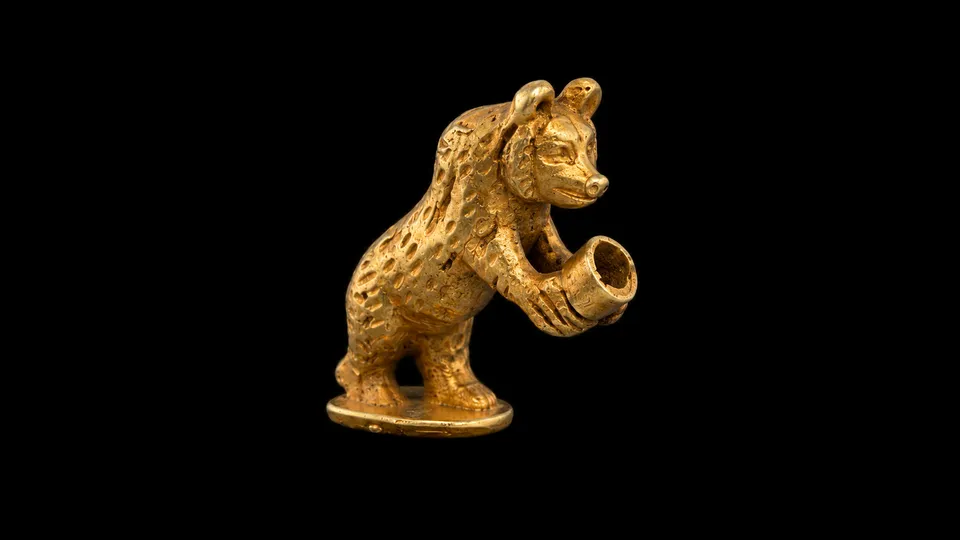
Here is a burial mound on the edge of Almaty, Kazakhstan. It sits in the Karagayly cemetery in the city’s Nauryzbay district, it is about 25 to 26 metres across and 2.5 metres high, and it dates to the 4th–3rd centuries BCE, which puts it in the Saka period of the Early Iron Age. At some point in antiquity, somebody dug straight down through the middle of it, took what they wanted and left. About 2,300 years later the Almaty Museum Union excavated it and found, among the mess, a small gold bear. Arkeonews reported the find, and the bear is, according to the museum union’s director, the first of its kind found in the country.
I want to spend a minute on the looters, because grave robbing is a business, and as businesses go it has an odd cost structure. You do almost all of the work before you know what you’ve got. The pit at the centre of the Karagayly kurgan goes down roughly three metres. (The History Blog describes it as a crater three metres wide; the museum’s account, as relayed by Kazakhstan’s state news agency, says about three metres deep. Either way, a lot of digging.) Imagine, purely as a hypothetical, that you are the person holding the shovel: you have put in the labour, you are working in a hole, it is presumably not well lit, and you want to be gone before anyone notices. You grab what’s obvious. What’s obvious is not necessarily what’s valuable, and it is certainly not what’s small. The grave goods ended up scattered, and the one thing the excavators now call the most significant find of the dig was apparently too little to catch anyone’s eye.
Sure, that’s how archaeology works much of the time. Looters have bad due diligence, and science gets the leftovers.
The bear
The figurine was cast in gold, and it has small holes that suggest it was sewn onto a headdress. The History Blog’s write-up gives a bit more description: the bear stands on its hind legs holding a vessel in its front paws, and it sits on a plate with perforations at each corner. Lyazzat Sagyndykova, who directs the Almaty Museum Union, told Kazinform that “the sculptural bear figurine is unique to Kazakhstan. No similar discoveries have been made here before.” She also said it lets researchers trace cultural links across Eurasia, from the Black Sea region to the Altai Mountains.
That is a big claim to hang on a small bear, but it fits a known pattern. Saka communities, who spread across large stretches of the Central Asian steppe in the 1st millennium BCE, are famous for gold work and for what scholars call the “animal style”: deer, big cats, mountain sheep and birds, put on jewellery, weapons, horse harness and ceremonial clothing. Animal figures on headdresses specifically have turned up before in Kazakhstan. The famous Golden Man wore a gold mountain-sheep ornament on his headdress, and a leopard figure found in 2014 at the Kok-Kaynar cemetery is also thought to have been a headdress decoration. According to 24.kz, that Kok-Kaynar dig in Almaty’s Alatau district also yielded an ornament showing a bird of prey. The bear is a new animal in an old lineup. (The steppe keeps producing these; rews covered a Saka deer carving relocated from 1856 drawings just last month.)
What the bear meant to whoever wore it, nobody can yet say. For now the researchers are studying its form, how it was made and how it compares with other Saka pieces, which is the responsible answer and also the only one available.
Seven people
The second finding is quieter and, I think, more puzzling. A first look at the bones suggests the mound may hold four adults and three children. Marat Nurpeisov, a senior researcher at the museum union, said mounds of this size in Kazakhstan were generally built for one or two people, and told Kazinform that “such collective burials are uncommon in Kazakhstan.” Seven where you would expect one or two is between three and a half and seven times the usual number.
The count is not final, and the looting is why. Disturbed bones are hard to tally, and the robbers also moved the finds around, including fragments of Saka-period pottery, so the excavators cannot yet tell whether these people were buried together or at different times. Anthropologists will now examine the remains to establish how many individuals there were and the circumstances of their burial, and to work out why this kurgan departs from the usual arrangement.
Who pays for the digging
This was a rescue excavation, carried out with support from the Almaty Municipality as part of an effort to protect Saka heritage around a growing city. The Almaty Museum Union has been running its own archaeological research in the area since 2022; The History Blog notes that it got a special licence to excavate that year. Its first season paid off well: in 2022 it found an unlooted Saka warrior’s grave dating to the 5th–2nd centuries BCE in a kurgan in the Alatau district, with pieces of a sword with gold inlay, animal-style gold decorations and silver objects.
Work at Karagayly is not finished. Once the scientific studies are done, the museum union plans to put the most valuable finds on display at the Almaty Museum.
So the tomb’s gold has two destinations, a few thousand years apart. Whatever the looters carried out went wherever looted gold goes, and nobody has seen it since. What they missed is headed for a museum case and a press release. Leaving the small stuff behind was a poor way to run a looting operation.