
Archaeologists used a Russian explorer’s 1856 drawings to locate a deer carving associated with early Saka culture in southeastern Kazakhstan, Arkeonews reported on Oct. 22.
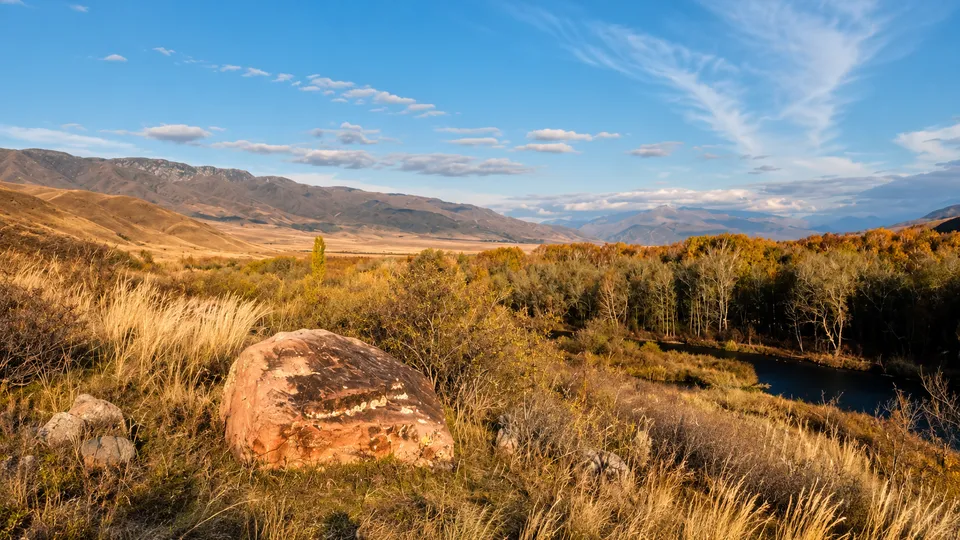
The joint Russian-Kazakh expedition identified the carvings on a large boulder in the Koksu River valley and documented their location and condition, according to the Institute of Archaeology of the Russian Academy of Sciences. The animal figures date from different periods, from the Early Iron Age to the Middle Ages.
The deer has tall, branching antlers. Elena Levanova, head of the institute’s Paleoart Center, said its form resembles Saka animal imagery found in Kazakhstan and Tuva, including motifs on ornamental metalwork from the Zhalauly treasure.
Researchers suggested that the boulder, because of its size, may have been a place of veneration for Saka nomads. That interpretation remains unproven. The expedition did not establish a precise date for the deer carving.
Pyotr Semyonov-Tyan-Shansky, the Russian geographer, recorded the figures during a journey through the valley in August 1856. After hearing about unusual markings on stone, he left his main route to investigate and drew the animals he found, without knowing their age or cultural significance.
His diary described the narrowing valley and granite rocks near the river. Those details helped the modern team find the site, whose exact location had been lost.
Alexey Rogozhinsky, an archaeologist at Kazakhstan’s Tanbaly Museum-Reserve, said the explorer’s drawings closely matched the surviving carvings. Alongside the deer, the figures include wild goats and sheep. Their differing dates indicate that people carved the rock over centuries, rather than in one episode.
Specialists from the museum-reserve and the Russian institute retraced sections of Mr. Semyonov-Tyan-Shansky’s travels with support from the Russian Geographical Society. They covered nearly 600 kilometers, visiting archaeological sites and natural landmarks he had described.
The route also took them to Tamgaly-Tas, a Buddhist sanctuary beside the Ili River whose religious images and inscriptions are generally dated to the 17th and 18th centuries. There, the team compared surviving carvings with illustrations by Pavel Kosharov, an artist who accompanied the explorer in 1857.
The sanctuary and the Koksu carvings are separate sites, distant from each other in both geography and date. The expedition connected them through the explorer’s route, not through evidence of a shared religious complex.
The team used geodetic mapping, aerial photography and three-dimensional documentation to record the monuments. With fieldwork complete, specialists are processing the material to create digital models of selected carvings and inscriptions. They also plan an interactive map of Mr. Semyonov-Tyan-Shansky’s route through southeastern Kazakhstan.