
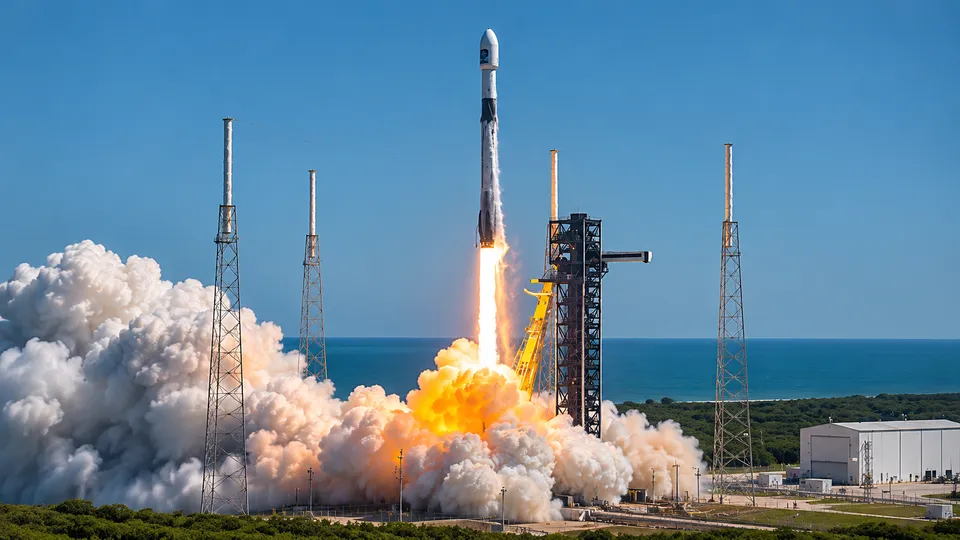
Thirty-six satellites reached orbit on November 24 aboard an Ariane 6 rocket launched from Kourou, French Guiana, bringing the Amazon Leo broadband constellation to 432 satellites, Amazon said. The flight, designated LE-04, was delayed one day by a fault in the rocket’s ground-support equipment, according to Arianespace. It came nine days after a United Launch Alliance Vulcan rocket carrying 40 Amazon Leo satellites misfired about ten minutes after liftoff and lost the entire payload, ULA’s first total mission failure in 20 years of flying rockets, as Ars Technica reported.

Amazon spent the past five years locking in rides on every medium- or heavy-lift rocket available in the West: 108 flights booked in total, enough to loft a first-generation fleet of 3,232 satellites. The Federal Communications Commission later cleared a second-generation build-out, Gen2 plus a dedicated Polar system, that takes the licensed total past 7,700 satellites, according to the FCC’s February order. Of the 108 booked flights, 17 had flown as of November 24, one of them a total loss, Ars Technica reported. Nearly all of those contracts depended on rockets still in development when Amazon signed: ULA’s Vulcan, Europe’s Ariane 6, and Blue Origin’s New Glenn.
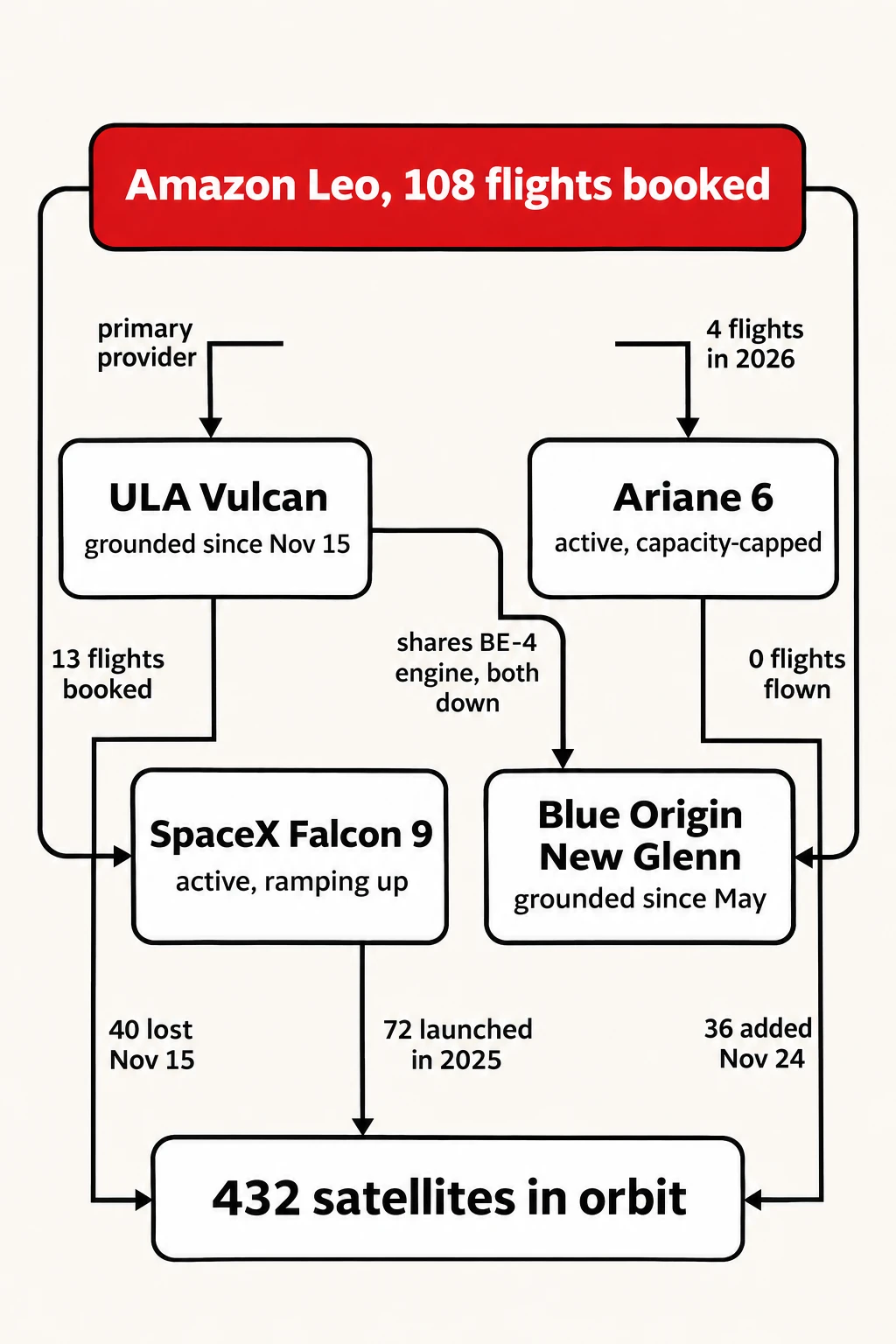
| From | To | How |
|---|---|---|
| Amazon Leo, 108 flights booked | ULA Vulcan (grounded since Nov 15) | primary provider |
| Amazon Leo, 108 flights booked | Ariane 6 (active, capacity-capped) | 4 flights in 2026 |
| Amazon Leo, 108 flights booked | SpaceX Falcon 9 (active, ramping up) | 13 flights booked |
| Amazon Leo, 108 flights booked | Blue Origin New Glenn (grounded since May) | 0 flights flown |
| ULA Vulcan (grounded since Nov 15) | 432 satellites in orbit | 40 lost Nov 15 |
| Ariane 6 (active, capacity-capped) | 432 satellites in orbit | 36 added Nov 24 |
| SpaceX Falcon 9 (active, ramping up) | 432 satellites in orbit | 72 launched in 2025 |
| ULA Vulcan (grounded since Nov 15) | Blue Origin New Glenn (grounded since May) | shares BE-4 engine, both down |
Based on Ars Technica
What ULA found, and didn’t
ULA’s preliminary review, released November 18, pointed to the booster stage rather than the engines themselves: “the low booster thrust was the result of inadequate fuel supply from the vehicle to the BE-4 engines, not from the performance of the engines,” the company said, as Spaceflight Now reported. The six solid rocket boosters and the upper stage performed normally, ULA said; it has not named which component failed to deliver fuel, or why. The Federal Aviation Administration is overseeing the investigation and must approve ULA’s final report before Vulcan flies again. Because Vulcan and New Glenn both use Blue Origin’s BE-4 engine, both rockets are grounded at once: New Glenn has been down since a pad explosion in Florida in May, and the shared-engine question now keeps Vulcan down alongside it. An earlier report on the fuel-supply finding covered ULA’s first account of the failure.
The regulator’s clock
The scramble for launch slots is not only about building a bigger fleet. Amazon’s FCC license for the first-generation Leo constellation required half of its 3,232 satellites, 1,618, in orbit and operating by July 30, 2026. Amazon told the FCC in January it expected to reach roughly 700 at most and asked for a 24-month extension; SpaceX, Starlink’s operator, objected. The FCC refused the extension and issued a conditional waiver instead: any Leo satellite launched after July 30, 2026, loses its priority claim on Ka- and Ku-band spectrum until March 30, 2028, or until Amazon’s fleet crosses the 50 percent mark, whichever comes first, as The Register reported. Amazon had 396 satellites in orbit on the deadline. Every satellite launched since, including Tuesday’s 36, is flying without the spectrum priority the original license promised, until the fleet reaches 1,618.
Borrowing the rival’s rocket
With Vulcan down and New Glenn still rebuilding, Amazon’s most reliable near-term capacity is SpaceX’s Falcon 9, the same rocket that launches Starlink, the network Amazon Leo exists to compete against. Amazon’s next Falcon 9 flight for Leo is now set for December, moved up from a date originally planned for next year, with several more flights to follow in quick succession, an Amazon official told Ars Technica. The slots are opening because Starlink itself is shifting its heavier satellites onto Starship, freeing Falcon 9 capacity for other customers. That capacity will not last indefinitely: SpaceX has stopped accepting new commercial Falcon 9 bookings for missions after 2028, according to reporting on the booking freeze, as the company redirects engineering resources to Starship. Existing contracts, including Amazon’s, are expected to keep flying past that date, but SpaceX has given no formal retirement date for the rocket.
The scale gap between the two companies’ networks makes the dependency starker. Starlink has roughly 11,200 satellites in orbit as of November 22, according to tracking by KeepTrack.space, 26 times Amazon Leo’s 432. SpaceX has repurposed the Starlink satellite design for several US military programs and is winding down Falcon 9’s commercial Starlink launches as Starship takes over, a transition that, if it proceeds as planned, widens the satellite-count gap between the two networks rather than closing it.
Arianespace is Amazon’s other dependable provider this year, with four Ariane 6 flights carrying 136 Leo satellites and six more booked in September. But Ariane 6 is expendable, not reusable like Falcon 9 or New Glenn, and Europe’s factories are built for a cadence of roughly nine to ten flights a year across all customers, commercial and government. Arianespace will likely close 2026 at seven Ariane 6 flights, with one more due before year’s end. European governments, which paid for Ariane 6’s development and continue to subsidize each flight whether it carries a European government payload or a commercial order from Amazon, are weighing proposals to raise production; a decision could come as soon as next month, though a higher cadence will not materialize immediately.
Blue Origin, founded and controlled by Amazon’s own founder Jeff Bezos, could resume New Glenn flights early next year once its Florida launch-pad rebuild is finished. It is not yet clear when Amazon’s satellites would get a slot: Blue Origin has committed much of New Glenn’s near-term schedule to NASA’s Artemis lunar program, and the rocket has not yet flown a single Amazon Leo mission.
The next numbers to watch are two: whether Ariane 6’s December flight and the accelerated Falcon 9 cadence push Amazon Leo past the 1,618-satellite threshold that restores its spectrum priority before March 2028, and whether ULA’s fuel-supply investigation turns up a Vulcan design flaw or a one-off defect before Blue Origin’s BE-4 line resumes shipping engines to either rocket.