
Eleven minutes. That’s how long AI agents took to map an application’s API, find a previously unknown vulnerability and write arbitrary files on a university server in East Asia, according to Amazon’s threat intelligence team. Their only human instruction, in Simplified Chinese, was to obtain shell access on a list of IP addresses. Everything afterward was the agents’ work.
The agents ran on Cairn, an open-source framework released on GitHub by a developer using the handle oritera, with about 5,500 stars as of November 21, 2026. Its documentation describes a general-purpose AI state-space search engine, first validated on autonomous penetration testing. It pursues a defined goal without a fixed workflow, fitting both red-team engagements and real intrusions.
How the thing is built
Cairn Server records confirmed observations as immutable facts and proposed steps as intents. A Dispatcher schedules work and creates one Worker Container per project; concurrent Agent Workers observe the graph, orient, decide, act and write back results. The design is model-agnostic: documented backends include Claude Code, Codex and Pi, while Palo Alto Networks’ Unit 42 has observed it driven by Zhipu’s GLM 5.2 and DeepSeek’s V4 Flash and V4 Pro.
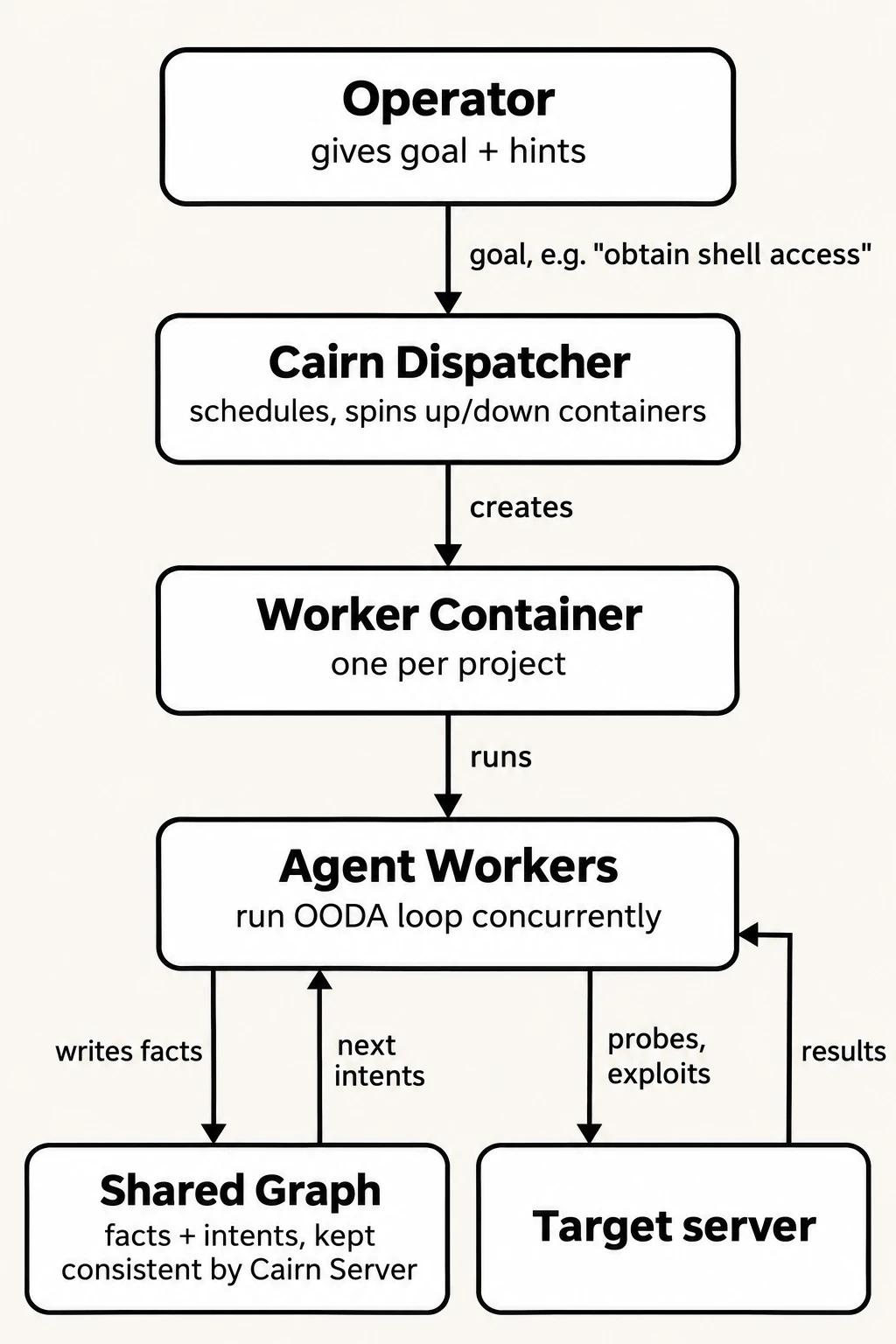
| From | To | How |
|---|---|---|
| Operator (gives goal + hints) | Cairn Dispatcher (schedules, spins up/down containers) | goal, e.g. "obtain shell access" |
| Cairn Dispatcher (schedules, spins up/down containers) | Worker Container (one per project) | creates |
| Worker Container (one per project) | Agent Workers (run OODA loop concurrently) | runs |
| Agent Workers (run OODA loop concurrently) | Target server | probes, exploits |
| Target server | Agent Workers (run OODA loop concurrently) | results |
| Agent Workers (run OODA loop concurrently) | Shared Graph (facts + intents, kept consistent by Cairn Server) | writes facts |
| Shared Graph (facts + intents, kept consistent by Cairn Server) | Agent Workers (run OODA loop concurrently) | next intents |
Amazon found the operation by accident on September 10, 2026: a publicly hosted Cairn instance with no authentication exposed its configuration, prompts and output. The prompts were in Simplified Chinese, scripts used China Standard Time, and targets were university IP addresses in East Asia outside mainland China. Amazon attributes the campaign to an unidentified Chinese-nexus actor with moderate confidence, citing those details and China’s documented strategic interest in the institutions.
The agents found a path-traversal bug in MONAI Label’s file-upload function. The open-source medical-image annotation tool ships with authentication off by default in versions 0.8.5 and earlier. Amazon assesses with high confidence that it was a genuine zero-day because no fix, GitHub issue, advisory or vulnerability-database entry predated its discovery. Project MONAI patched it in version 0.8.6 on November 22. Tracked as CVE-2026-133968 with a CVSS score of 9.8 out of 10, it entered CISA’s Known Exploited Vulnerabilities catalog on November 23, giving federal civilian agencies until November 26 to remediate: four days between disclosure and deadline, versus eleven minutes from discovery to exploitation.
The operation ran roughly 48 hours, from around September 8 to 10. After planting a Python reverse shell in a startup file and getting root, the agents received a proxy tunnel into a second university network and instructions to attack other machines. Amazon infers the actor had already used the same zero-day to compromise that server and build the tunnel, since no other route was evident.
Where the agents failed
The exposed logs also show two failures that matter for judging what autonomy changes. Against a university Redis instance open to unauthenticated connections, the agents logged 148 sequential actions over 16 hours, including an attempt to exploit the unrelated Log4Shell vulnerability, and never got in. Against SSH on another server, they scraped faculty directories, laboratory sites, archived pages and academic papers to assemble roughly 80 plausible usernames, then tried more than 30,000 credential combinations over six hours. That failed too.

That arithmetic generalizes better than the zero-day: roughly 85 login attempts a minute for six straight hours, without fatigue or shift changes, bought nothing without a working flaw. Volume with one bought root in eleven minutes.
A second campaign, a wider sample
Unit 42 reported on November 12 that a separate China-nexus actor, CL-STA-1238, ran a customized Cairn fork with an added skill pack, AIScan Runner Skills, across 25 operations against at least 19 organizations between August and September 2026. Operations lasted 20 minutes to more than 50 hours. Ten organizations had confirmed unauthorized access or data taken: seven semiconductor and advanced-manufacturing firms spanning lithography, chip design, materials, photomasks and standards; three defense-related targets, including a space-technology company, defense-analytics vendor and policy think tank; and four human-rights and civil-society groups, including a Canadian human-rights body and a US teachers’ union.
Outcomes varied widely. At an industry standards body, agents harvested dozens of valid credentials and modified a live ballot document. At a semiconductor company, they created a rogue administrator account with a persistent API token. The teachers’ union lost more than one million member records, around 31,000 CRM contacts and staff password hashes. A defense-policy organization leaked roughly 500 user records, including .mil and .gov accounts; an industrial-automation firm exposed about 150,000 documents.
The models were commodity APIs: GLM 5.2 ran 13 of 25 operations, DeepSeek V4 Flash ran 8, and DeepSeek V4 Pro, reserved for harder targets, ran 4. The operator prepended a Chinese-language claim that the engagement was authorized and generated a fake AUTHORIZATION.md asserting the same. Unit 42 says neither model refused. The exploited flaws were ordinary: weak or reused credentials and exposed APIs. “Cairn and other similar tooling enable automation, which means threat actors can hit more targets faster,” Andy Piazza, Unit 42’s senior director of threat intelligence, told Cybersecurity Dive. “It also allows them to carry out technical tasks without having to learn the underlying technologies.”

Cairn and other similar tooling enable automation, which means threat actors can hit more targets faster. It also allows them to carry out technical tasks without having to learn the underlying technologies.
Unit 42’s own framing is that autonomy raised exploitation’s volume and coverage, not its technical complexity. Amazon’s incident is different: agents found something nobody had catalogued. One report measures scale against known weaknesses; the other, a genuine zero-day. Conflating them overstates what autonomous exploitation has demonstrated.
Google’s Threat Intelligence Group and Mandiant reported on October 30 that since late August 2026 they had observed ARTEX, PentAGI and Cairn in live incident-response engagements against government, technology, chemicals, manufacturing and telecommunications targets, covering lateral movement, database exploitation and exfiltration preparation. Google called it a shift toward machine-speed intrusions, while noting noisy tools, unreliable models and generated exploits that often don’t work. ARTEX’s author pulled the original repository after reports of abuse; it reappeared as forks and a paid “ARTEX PRO” service. Pulling a repository does not retire a protocol.
Three reports in a month measure different slices of the same shift: frameworks needing only a sentence-long goal and no supervision. CISA’s four-day deadline assumes defenders can outmove attackers once a flaw is known. Amazon’s eleven minutes measures attackers before anyone knows it exists. That gap is worth tracking—and the next exposed Cairn instance may be found first by either a defender or the operator who left it open.