
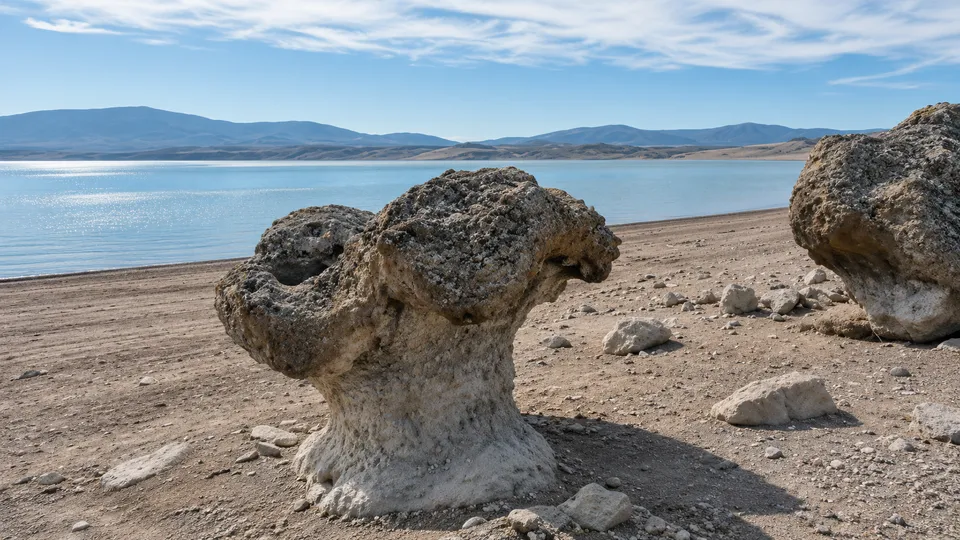
The Zamantı River runs through the Develi district of Kayseri, at the southern edge of Cappadocia. Near the Gümüşören Dam, between the settlements of Hüseyinli and Yenice, stands a rock shaped like a mushroom. It rises about five metres above the ground around it, on a narrow stem under a broad cap. On top of the cap, perhaps two thousand years ago, someone cut a grave.
The man who noticed it is not an archaeologist. Nezir Ötegen is a local history researcher who lives in Develi, and he came across the rock while working through the valley’s old remains. At the summit he found a rectangular grave with its lid pushed aside, the type of rock-cut burial specialists call a chamosorion, as Leman Altuntaş reported for Arkeonews. The Turkish press, following a report by the DHA news agency, calls it a tekne mezar, a trough grave. Preliminary assessments place it in the Roman period. Nobody yet knows exactly when it was cut, who was buried in it, or why there.
A grave meant to be seen
The rock sits at roughly 1,297 metres above sea level. Ötegen, quoted by Sabah, puts it about a kilometre uphill from the river. The Romans, he says, liked to bury their dead beside rivers and on high ground where everyone could see them, and this rock stood among settlements, in plain view. That is his explanation for the choice. It is a plausible one, but so far it is only his.
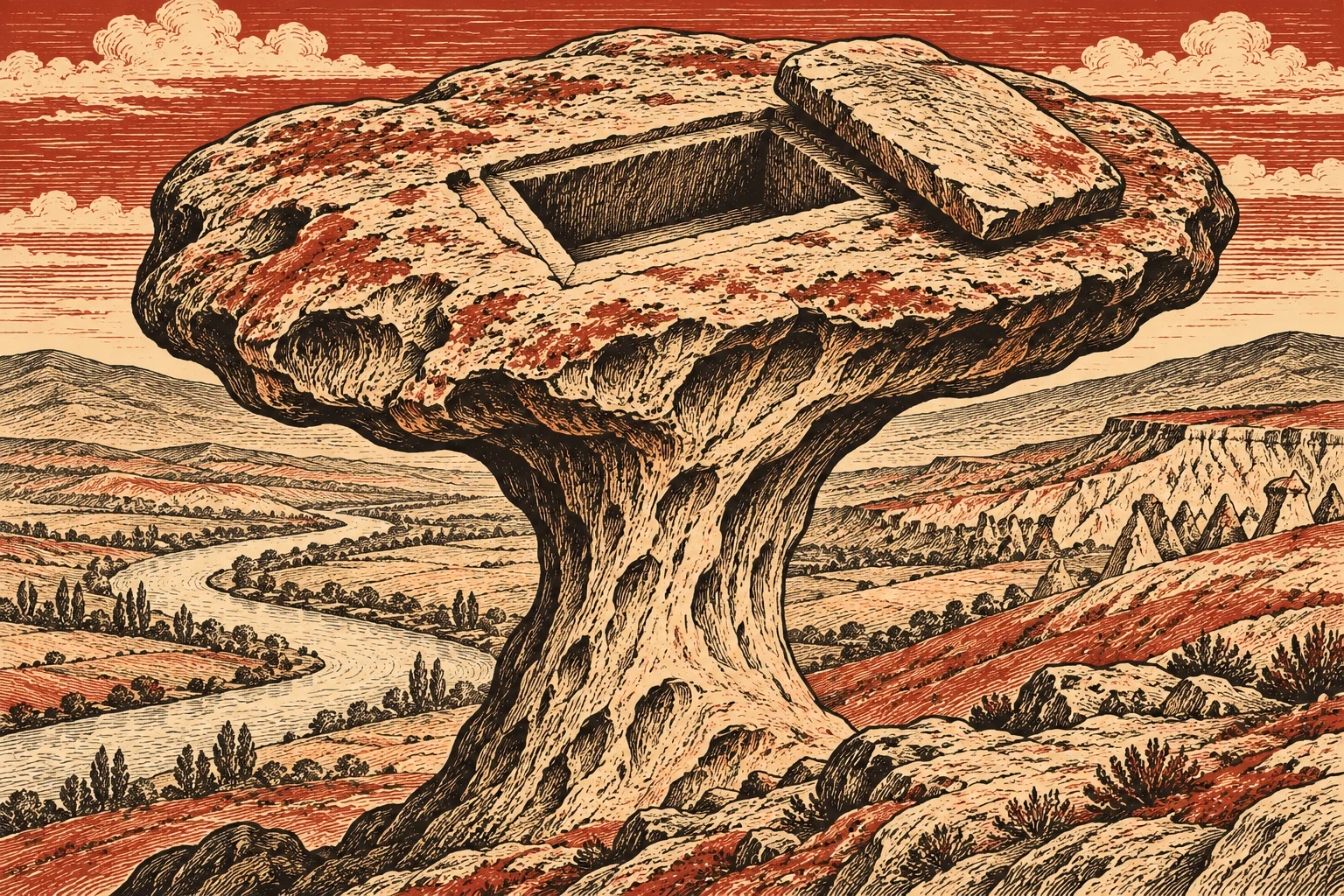
One might read a very old wish into it: to be laid where the living cannot help looking. The powerful carve their names into cliffs. Someone else, whose name no one has reported finding, took the top of a strange stone and let the stone do the speaking.
Kings across the valley
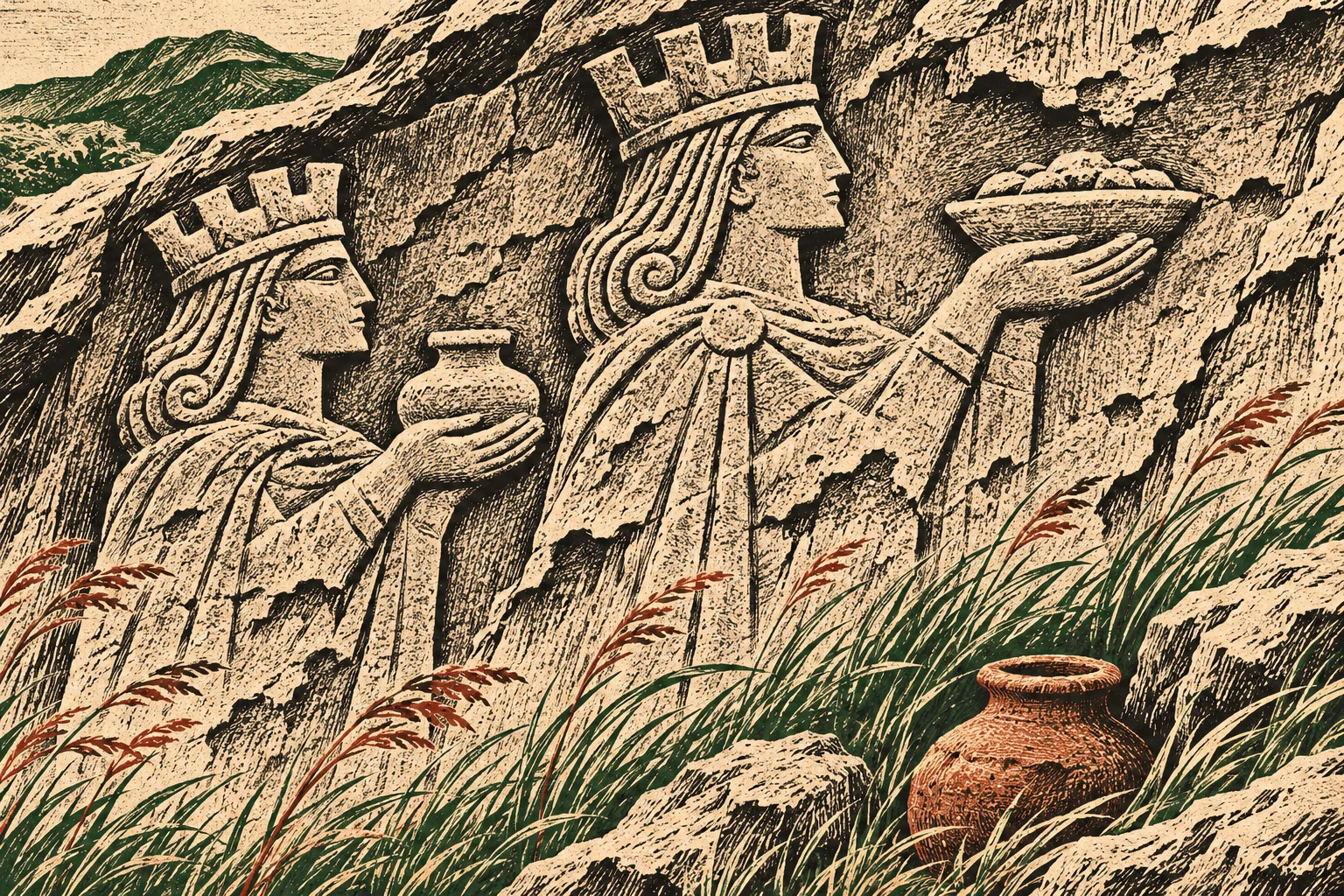
The rock does not stand alone. This stretch of the Zamantı holds the Fraktin rock relief from the 13th century BCE, the Çinçin Caves, Direkli Cave and, on the far side of the valley, the Çukuryurt Rock Tombs, which Ötegen points to as part of the same landscape of the dead. At Fraktin, according to the Hittite Monuments survey, the Hittite king Hattusili III pours a libation to a male god, and Queen Puduhepa, in a scene that was never finished, pours one to the goddess Hebat. Luwian hieroglyphs name them: Great King, Great Queen.
The dead of later centuries left their own marks nearby. A 2021 inventory by Türkiye’s Ministry of Culture and Tourism recorded five rock-cut chamber tombs and four rectangular rock-cut graves at the Çakmaktepe necropolis, together with road remains attributed to the Roman period. Future work may show whether the mushroom-rock grave belonged to that burial ground or stood apart from it for reasons still unknown.
The titles of the king and queen survived three thousand years in stone. The person on the mushroom rock has so far left no name at all. Anatolia has a long habit of burying the powerful in the record and leaving everyone else to the weather, as another tomb, a clay coffin at Attouda, showed this autumn.
Two rocks in the Rhodopes
The nearest parallels lie far to the west, in Bulgaria’s Eastern Rhodope Mountains, the Thracian country where another rock city’s ancient name is still argued over. In his 2015 study Dolmens and Rock-Cut Monuments, the archaeologist Georgi Nekhrizov describes a grave near the village of Bashtino, at a place called Alla Kaya. It was cut into the summit of a naturally pyramid-shaped volcanic rock, possibly making use of a hollow already in the surface, and its outer walls were shaped so that the monument looks something like a dolmen.
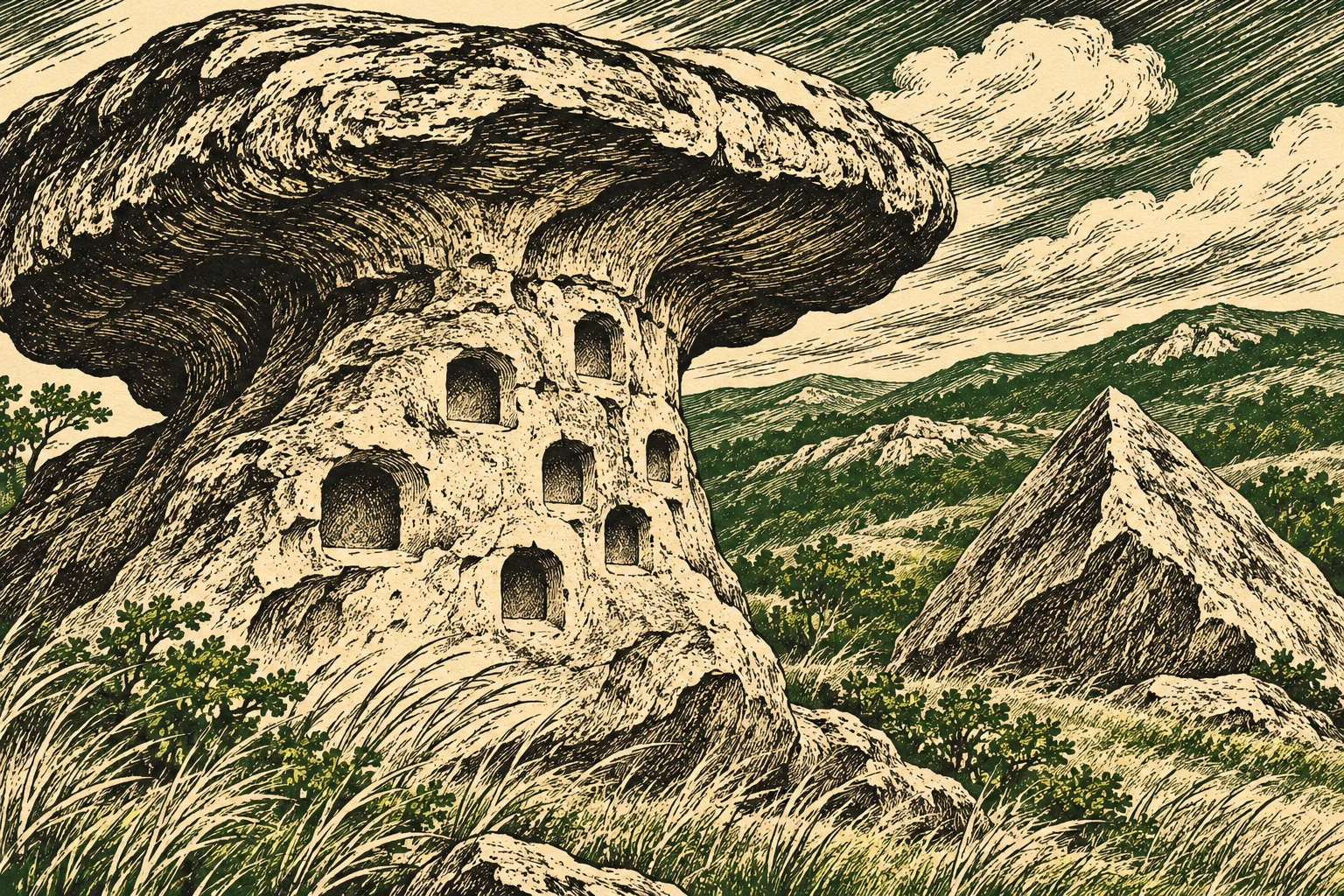
Between the villages of Zhenda and Sokolite stands a natural mushroom-shaped rock with eight niches carved into its sides. Some scholars link such niches to Thracian funerary rites. Others disagree, and their purpose is still argued over.
Neither is quite the Develi stone. Bashtino has a grave on its summit, but the rock is a pyramid. Zhenda is a mushroom, but its carving is on the sides. Nothing connects any of them in culture or in time. A limited review has found no exact equivalent to a grave cut into the cap of a mushroom rock, which is why some now suggest it may be the first documented example of its kind. That claim will hold only if a fuller search of the world’s archaeological records fails to find another.
What the wind did, and when
Mushroom rocks are made by differential erosion: wind, water and time wear some parts of a stone away faster than others, until a slim base holds up a wider top. In the Turkish reports Ötegen describes sand and gravel blown by the wind eating away at the foot of this rock. “The trough tomb dates to the Roman period, about 2,000 years ago, but the rock itself formed much earlier,” he said.
Geologists have not yet tested that. No one has worked out how much the formation has changed since the grave was cut. Its builders may have picked a stone that was already a mushroom, or the centuries after them may have shaped it. The answer would show whether the rock’s odd form drew the burial to it at all. Ötegen wants experts to study the tomb first and then the rock.
A petition to the state
He has reported the find to the authorities and asked for the site to be officially registered, protected and investigated by academics. Turkish reports say officials are expected to inspect it. “We believe we have made a new contribution to geological heritage literature,” he said. Mushroom rocks are common enough around the world. In his view, what sets this one apart is the grave on top, which makes it both a natural landmark and an ancient monument.
Until the inspectors and geologists arrive, the grave stays as he found it, with its lid displaced and its occupant unnamed, five metres above the valley floor.