
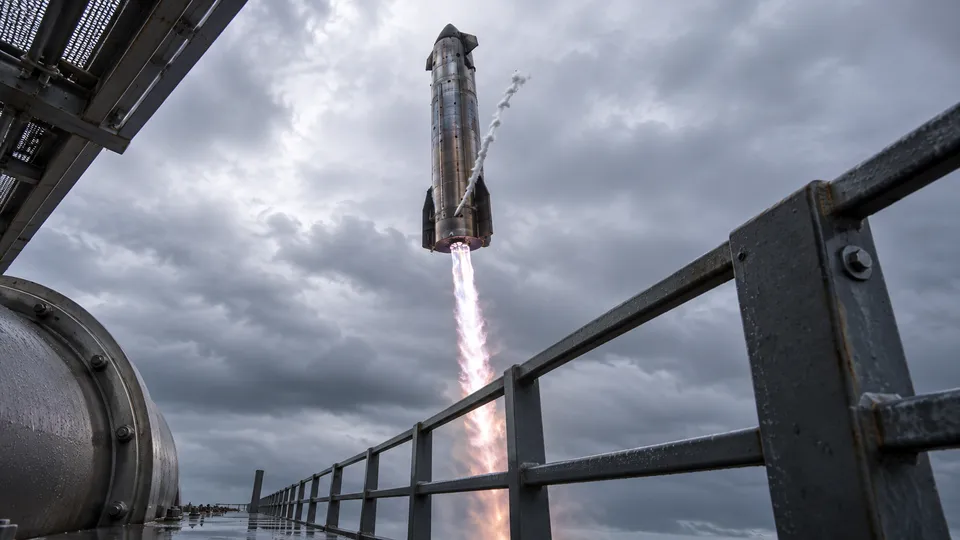
On Saturday, November 14, 2026, at Starbase on the Texas coast, the arms of a launch tower closed around a Starship coming home. It had left the same site the day before on top of a Super Heavy booster. SpacePolicyOnline reported that the flight lifted off at 5:47 pm Eastern time on November 13, and that Ship 42 became the first spacecraft to come back from orbit and be caught where it had launched.
For SpaceX, the aim is to fly the same ship again soon, and to deploy its newest generation of Starlink satellites faster. NASA wants something else from it. As Stephen Clark reported for Ars Technica, the agency believes more launches will mean faster learning while SpaceX builds the deep-space Starship that is supposed to carry astronauts down to the lunar surface. The company had promised on an earnings call to catch both halves of the rocket. On Saturday it caught the upper half.
Then there is the refueling demonstration. Since late 2024 it has slipped two years, more or less a day lost for every day that passed, while engineers worked through the vehicle’s problems. Without it, Starship cannot reach the Moon with a crew. The catch may mean SpaceX has turned a corner. Nobody can say yet.
The pieces for the next step are being laid out in Florida. Early next year SpaceX plans to open a second Starship launch site at Kennedy Space Center, where a second Starship factory is also being built to work alongside the production line at Starbase. Two lander tests are due next year as well. First comes NASA’s Artemis III mission, which needs no orbital refueling. After it comes an uncrewed Starship landing on the Moon, which needs a great deal of it.

Two landers, two lessons
Earlier this year NASA rewrote Artemis III, turning a lunar mission into one that never leaves low Earth orbit. The first crewed landing of the program moved to Artemis IV, which is targeted to launch before the end of 2028. Artemis III itself is aimed at summer 2027, according to Aerospace America, and Scientific American has described the agency’s 14-day schedule for it. Four astronauts will ride the Space Launch System and Orion into orbit. Orion will dock first with Blue Origin’s Blue Moon lander, launched on a New Glenn rocket, for two days of tests. The crew will open the hatches and go into its pressurized cabin to try out its environmental control and life support systems. Then Orion will undock and drop to a slightly lower orbit, mostly beneath the Starlink constellation, to dock with Starship for two hours. Nobody will go inside the SpaceX vehicle. The plan, as an earlier rews account put it, packs work on two landers into a single flight.
Why does Blue Origin get so much more of the testing? Steve Creech, who manages NASA’s Human Landing System contracts with both companies, gave two reasons. NASA wants SpaceX concentrating on refueling, which Blue Origin no longer needs for its landing missions. And SpaceX already has years of life support experience from its Dragon capsule, while Blue Origin has little. Its New Shepard tourist flights were short hops that never needed systems built to keep people alive for long.
“The bigger challenges for [SpaceX] were the prop transfer and getting to the uncrewed landing demo.”

With Starship, Creech said, the lesson will be in control: once Orion is docked, Starship will command the attitude of the whole stack. “So, with that huge of a vehicle, I think we’re going to learn more on that.” On the Blue Moon test, Orion will steer instead, to reduce risk. On a later mission, a fully fueled Blue lander will have to do it.
The Starship flying on Artemis III will carry a full set of Raptor engines and a docking port on its nose. The Blue Moon will carry no main engines at all, only small thrusters for pointing and minor maneuvers. “With Blue, you don’t have a BE-7 engine, you don’t have the cryo tanks,” Creech said. “They’re representing the mass of the lander when it comes back from the surface because we think that’s the most critical case. But it does have the crew cabin.”
NASA has given both companies more to do. SpaceX must build a prototype crew compartment, called Cabin One, for ground tests at Starbase. Blue Origin plans to launch its first Blue Moon test mission, the Mark 1, early next year, months late after a rocket exploded on its launch pad in May. The Mark 1 has a single hydrogen-fueled BE-7 engine. The landers meant for crews will have three, and NASA has added a hotfire of that three-engine unit inside a vacuum chamber at its In-Space Propulsion Facility in Ohio.
The ninety days
The old plan made both landers wait. “Our previous architecture for both these landers required a 90-day loiter in lunar orbit for Orion to arrive,” Creech said, adding that this “made the lander job really hard.” That requirement is gone. SpaceX proposed meeting Orion near Earth and carrying it to the Moon. The first surface stays for both landers have been cut from six and a half days to four.

The six and a half days had a long chain of causes behind them. Orion could not reach an orbit close to the Moon. So Gateway, the lunar station, was to sit in a long, looping near-rectilinear halo orbit, and the landing schedule was built around that orbit. Gateway has since been canceled. It is an old habit of large institutions to keep building around a structure that no longer exists, and to call the leftover constraints requirements.
Under the new plan, Orion will meet Starship in high Earth orbit, and Starship will push it toward the Moon. What remains unsettled is whether Starship will need to refuel above low Earth orbit first. Last month Jeremy Parsons, NASA’s Artemis program manager, showed a graphic with a “final tanking orbit” before the docking with Orion.
“We’re still working that out,” Creech said. “We’re making progress, but where we actually rendezvous with Orion is still in trade, so that’s why you saw a little bit of fuzziness there.”
Blue Moon will meet Orion in lunar orbit instead. It no longer needs refueling in space, but each mission will still take four New Glenn launches: one for the lander and three carrying transfer stages to push it out of Earth orbit. To get Orion down to low lunar orbit, NASA is counting on a stretched Centaur upper stage for the Space Launch System. It has not decided whether that stage will be ready for Artemis IV. If it is not, Artemis IV could fly on the last SLS upper stage NASA has in stock.