
The universe contains about 1.6 billion photons for every leftover baryon — a proton or neutron with no antimatter partner to annihilate it. That ratio, η ≈ 6.1×10⁻¹⁰, is measured two independent ways: from the pattern of the cosmic microwave background and from the primordial abundances of hydrogen and helium left over from Big Bang nucleosynthesis. The two methods agree to within a few percent, which is why cosmologists treat the number as settled. What isn’t settled is where it came from.
The textbook expectation is zero. The early universe, hot enough to pair-produce particles and antiparticles freely, should have made matter and antimatter in equal amounts; equal amounts should have annihilated down to almost nothing but light. That they didn’t, by one part in 1.6 billion, is the asymmetry problem, and it has no confirmed solution. A pair of theoretical particle physicists — Rishav Roshan at the University of Southampton and Sudipta Show at the Indian Institute of Technology Kanpur — argue in a paper in Physical Review Letters that a piece of the standard toolkit for solving it has been sitting unused for decades, as 404 Media reported.
The seesaw’s third neutrino
The relevant toolkit is the minimal type-I seesaw model, the standard way theorists explain why the neutrinos we observe are absurdly light — under 0.1 eV, roughly a billion times lighter than an electron. The seesaw posits three heavy right-handed neutrinos (N1, N2, N3, lightest to heaviest) that pair up with the three known neutrino flavors. Their masses and the ordinary neutrinos’ masses are related inversely: the heavier the hidden partner, the lighter the observed neutrino. Push N3’s mass up, in other words, and you get the tiny neutrino masses measured here without needing N3 to do much else.
That’s the rationale for ignoring it. Most seesaw calculations keep N1 and N2, which drive leptogenesis — the process by which an excess of leptons (electrons, muons, their neutrinos and antiparticles) is thought to have been converted, via a Standard Model process called sphaleron transitions, into the baryon excess measured today. N3 is assumed heavy enough and weakly coupled enough that it decays away before it matters, so papers drop it. Roshan and Show’s calculation says that assumption doesn’t generally hold.

“This thing was present in the literature for a very long time, and for some reason people did not pay that much attention to this particular point,” Roshan told 404 Media’s Becky Ferreira. The particle’s coupling to ordinary matter is feeble enough that it drops out of thermal equilibrium with everything else early on — it “decouples” — and then survives, cooling along with the expanding universe, until it is non-relativistic enough to decay on its own schedule rather than everyone else’s.
A delay that moves the asymmetry
The mechanism in the Physical Review Letters paper, titled “Delayed Charged Lepton Yukawa Equilibration in Minimal Seesaw” and published in the journal’s 11 September 2026 issue (volume 137, issue 11), turns on a quantity called the Yukawa equilibration temperature: the point in the cooling universe at which interactions involving the charged leptons — electron, muon, tau — become fast enough to treat the three flavors as interchangeable rather than tracked separately. Where that temperature sits determines which of several standard leptogenesis bookkeeping regimes — “flavoured” or “unflavoured” — applies to a given calculation, and the size of the resulting asymmetry depends on which regime you’re in.
Roshan and Show find that when N3 is long-lived, its late decay pushes that equilibration temperature around, shifting the boundary between regimes. The practical effect: a lighter N1 can generate the lepton asymmetry in the unflavoured regime under conditions where standard bookkeeping would have assigned it to a different, differently-weighted regime. A follow-up preprint posted to arXiv on 13 October 2026, “Cosmological Consequences of a Highly Decoupled Right-handed Neutrino”, adds a third author, Stephen F. King, and extends the idea inside a concrete gauge model (a broken U(1)_B−L symmetry). There, the decoupled N3 first dominates the universe’s energy density outright — an early matter-dominated era — before decaying and diluting whatever asymmetry N1 had already made, with the final observed value of η constraining N1’s lifetime and, through the seesaw relation, the mass of the lightest ordinary neutrino.
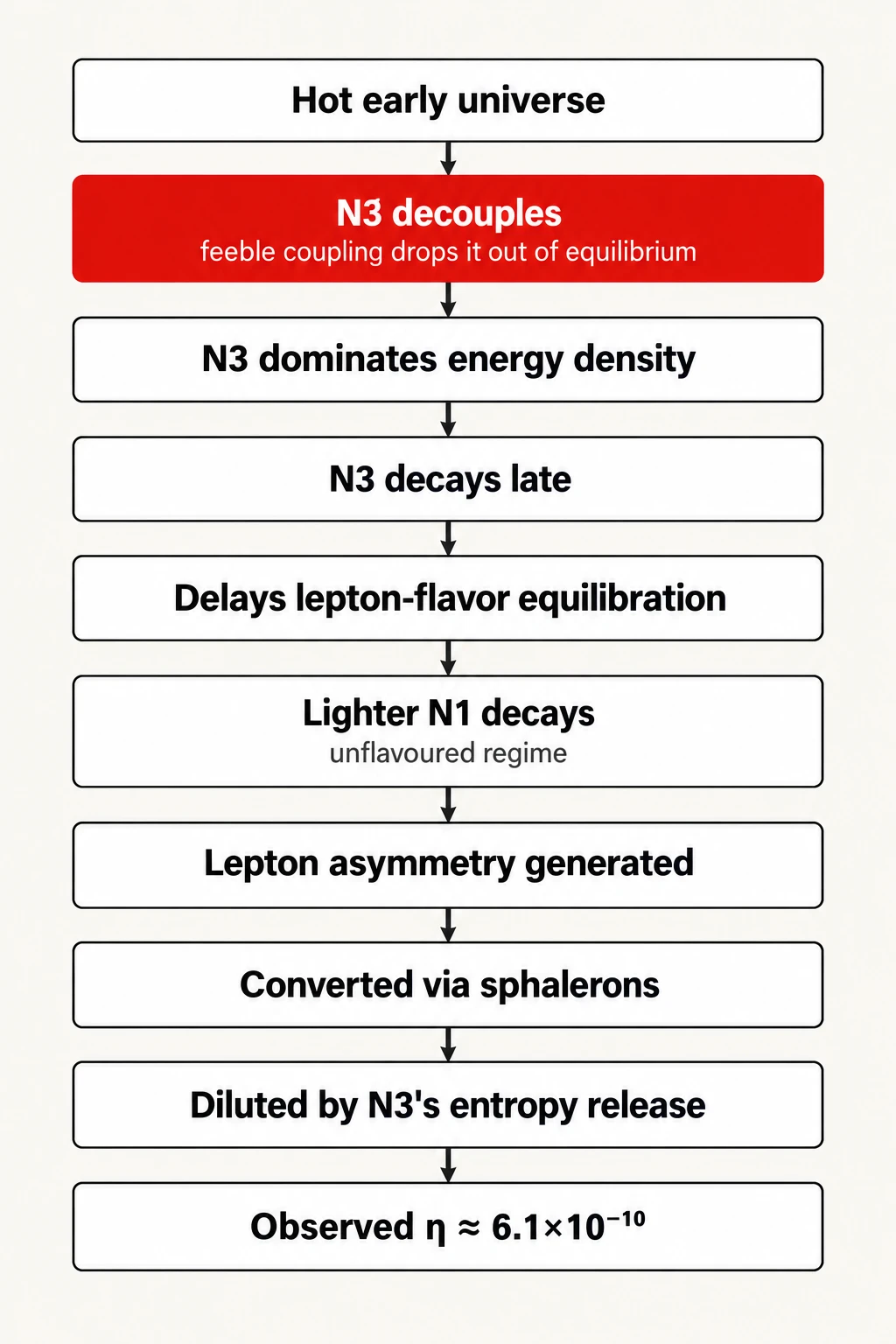
| From | To | How |
|---|---|---|
| Hot early universe | N3 decouples (feeble coupling drops it out of equilibrium) | |
| N3 decouples (feeble coupling drops it out of equilibrium) | N3 dominates energy density | |
| N3 dominates energy density | N3 decays late | |
| N3 decays late | Delays lepton-flavor equilibration | |
| Delays lepton-flavor equilibration | Lighter N1 decays (unflavoured regime) | |
| Lighter N1 decays (unflavoured regime) | Lepton asymmetry generated | |
| Lepton asymmetry generated | Converted via sphalerons | |
| Converted via sphalerons | Diluted by N3's entropy release | |
| Diluted by N3's entropy release | Observed η ≈ 6.1×10⁻¹⁰ |
Based on Roshan, Show and King
Neither paper puts a hard number on N3’s mass. The generic seesaw relation — light-neutrino mass roughly equal to (Dirac mass)² divided by heavy-neutrino mass — only lands near the mass scale usually quoted for these particles, about 10¹⁴ GeV, if the underlying Yukawa couplings are assumed to be of order one, the same rough size as the top quark’s coupling to the Higgs. That figure is a modeling choice, not a measurement: nothing in current data fixes it, and 10¹⁴ GeV is roughly seven billion times the 13.6 TeV collision energy of the LHC’s current run — which is the sense in which Roshan’s “nearly invisible to current experiments” is not an exaggeration.
Testing a particle no collider can reach
With no accelerator in reach, the arXiv paper proposes two indirect tests. One is precision neutrino-oscillation data, which constrains the seesaw parameters N3 feeds into. The other is gravitational waves: breaking the U(1)_B−L symmetry in the model produces cosmic strings, and the stochastic gravitational-wave background those strings leave behind should carry a spectral break — a kink in the power spectrum at a frequency set jointly by N3’s mass and the lightest neutrino’s mass — dating to the matter-dominated era the decoupled neutrino caused. Roshan and Show’s paper names current and near-term detectors that might see such a break: SKA, THEIA, LISA, μARES, DECIGO and the Einstein Telescope.
| Detector | What it measures | Status |
|---|---|---|
| SKA Observatory | Pulsar timing, nanohertz–microhertz gravitational waves | Under construction in South Africa and Australia; full array ("AA4") expected online 2028–2038 |
| LISA | Space-based laser interferometer, millihertz band | ESA/NASA mission adopted 2024; construction under way; launch set for 2035, science data in the late 2030s |
| Einstein Telescope | Ground-based triangular interferometer, sub-Hz to kHz | Final site choice (Sardinia, Meuse-Rhine or Saxony) due 2027; precursor underground lab construction began 23 September… |
| DECIGO | Space-based interferometer, deci-hertz band | Proposed Japanese mission; precursor B-DECIGO targeted for the 2030s, DECIGO itself has no funded launch date |
Source: ESA, SKA Observatory, Einstein Telescope Italia, published mission documents
The table is worth sitting with before taking the 404 Media framing — that these detectors are “due to come online in the 2030s and 2040s” — at face value. LISA won’t launch before 2035 and won’t deliver science data until some years after that, by ESA’s own schedule. The Einstein Telescope hasn’t picked a site yet; the decision is due in 2027, and what’s under construction right now in Sardinia is a precursor laboratory, not the detector itself. DECIGO is a proposal with no appropriated launch date at all. “Due to come online” covers a real range from under-construction to unfunded concept, and a signal this specific — a break in a gravitational-wave spectrum tied to two unmeasured masses — would need more than one of these instruments working, and working at a sensitivity none has yet demonstrated.
The caution applies to the physics claim too. No experiment has detected a right-handed neutrino, decoupled or otherwise; the entire argument is that a term theorists have been zeroing out in their equations shouldn’t always be zero. That’s a legitimate correction to a calculation, not evidence of a new particle, and Roshan’s own framing to 404 Media — that solving the asymmetry “could transform our understanding of cosmic evolution,” if it holds up — carries the conditional for a reason. Detecting astrophysical neutrinos that already exist is hard enough: IceCube, the cubic-kilometre detector buried under the South Pole that won this year’s Nobel Prize in Physics, has spent a decade finding cosmic neutrinos everywhere and tracing almost none of them to a specific source. A neutrino seven billion times further out of collider reach, that may not even exist, sets a higher bar.
The number to watch isn’t a mass. It’s a frequency: if a spectral break shows up in the stochastic gravitational-wave background at the value the model predicts once N3’s mass and the lightest neutrino’s mass are pinned down by oscillation data, the seesaw’s forgotten third neutrino gets a second life. If the Einstein Telescope’s site, LISA’s 2035 launch and the SKA’s full array all come through on schedule and no break appears, the paper’s correction to the equations stands, but its claim on the asymmetry problem doesn’t.