
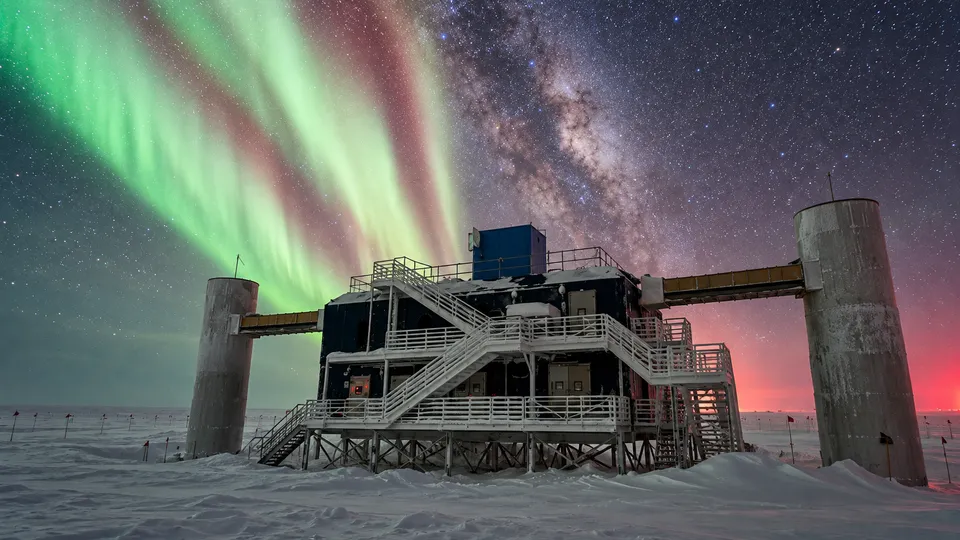
At the bottom of the world, in a glacier that belongs to no nation, someone built a telescope out of ice. IceCube covers a cubic kilometre of it, threaded with thousands of light sensors, and on October 6 the Royal Swedish Academy of Sciences decided that the man who dreamed the thing up had earned the 2026 Nobel Prize in Physics. Francis Halzen, principal investigator of the IceCube Neutrino Observatory and professor at the University of Wisconsin-Madison, was cited “for decisive contributions to the IceCube Neutrino Observatory and the discovery of high-energy neutrinos of astrophysical origin.” From Salt Lake City came the news that the prize belonged, in no small part, to work done there too: as the University of Utah reported, its Department of Physics & Astronomy is one of the largest academic groups in the international collaboration.
Neutrinos are nearly massless particles that almost never interact with matter; trillions pass through a person unnoticed at any moment. But when one does collide with an atomic nucleus in the ice, it gives off a faint flash, and IceCube’s sensors are waiting. Because these particles travel from extreme cosmic environments without being deflected or absorbed, each one that is caught points back along a straight line to its source — toward the unknown engines of the universe’s most violent events. Cosmic neutrinos of extremely high energy are exceedingly rare; hence the cubic kilometre. The observatory was completed in 2011, and after years of painstaking effort the collaboration detected the first high-energy astrophysical neutrinos, signals that had travelled to Earth from far beyond our solar system. A new window had been opened on the universe; what stands on the other side of it remains a young science.
The idea, born in 1988
Halzen first presented his vision of detecting neutrinos at the South Pole in 1988, long before it gained momentum among physicists. What he proposed — and proved — was that glacial ice could serve as the detection medium. “It’s a great relief for me to finally deliver the recognition that this great collaboration deserves,” he said in a press release issued by the University of Wisconsin. “This was a great surprise and is a celebration of a very unusual project. The success of this project involved the diligence and hard work of the many wonderful collaborators I’ve had the pleasure to work with.”
The drillers have not stopped. In March of this year, postdoctoral researcher Vedant Basu of the University of Utah joined an international team that bored six holes, each a mile and a half deep, into the ice — part of IceCube’s most significant upgrade in 15 years.
Salt Lake City at the pole
Carsten Rott, chair of Utah’s Department of Physics & Astronomy, brought the project with him when he was recruited as Keuffel Memorial Chair in 2021, though he has been part of IceCube since its construction began in 2005. In 2025 the university hosted the IceCube Collaboration Meeting in the new L. S. Skaggs Applied Science Building. “Being part of the IceCube Neutrino Observatory has been an extraordinary privilege,” Rott said. “Beyond the breakthrough discovery of high-energy astrophysical neutrinos, IceCube has created an entirely new platform for exploring a remarkably diverse range of scientific questions.”
Utah professor Dennis Soldin, a member of the collaboration since 2011, now serves as IceCube’s analysis coordinator, overseeing all physics working groups and coordinating the organisation and review of physics analyses across the collaboration. His own research chases cosmic rays and the physics of extensive air showers. “High-energy cosmic rays have been studied for more than a century, yet we still do not fully understand where the most energetic cosmic rays in the universe come from,” he said. The neutrinos, produced in astrophysical processes that involve those very rays, open, as he put it, a new path to one of the oldest questions in the field: where are the most energetic particles in the universe produced? Elsewhere in the department, Paolo Gondolo’s work has been critical for IceCube’s dark matter searches.
There is a quiet justice in such a prize. No army dug those holes, no minister dictated the findings. Men and women from many laboratories, in a year when much of the world’s machinery is devoted to destruction, lowered sensors into the dark ice to listen for messengers from colliding stars. The interactions IceCube records, continuously, will go on feeding that listening — among others, the physicists in Salt Lake City, whose share of the glory is not a metaphor but a working group, a drilled hole, a meeting all last year in a new glass building a long way from the South Pole.