
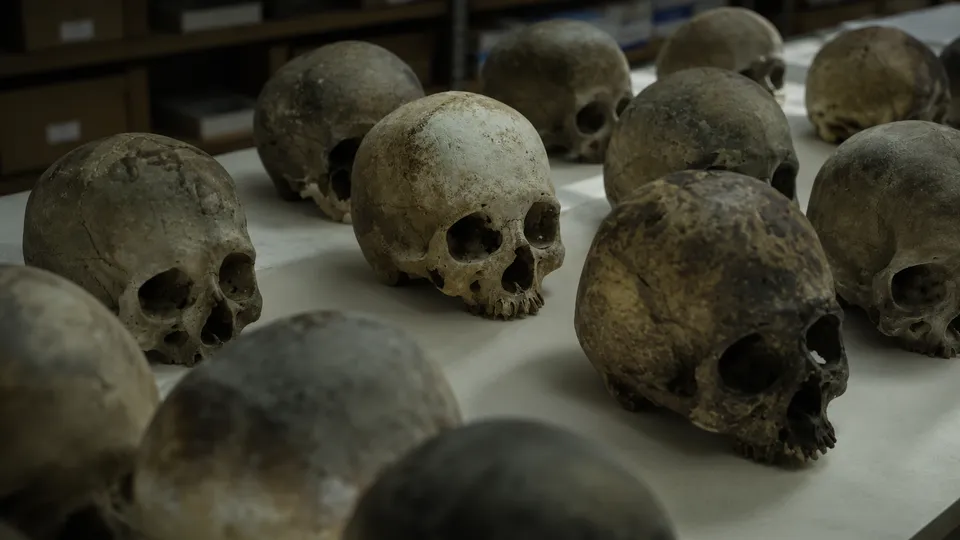
In 2012, people went into a cave in Frontera Comalapa, in the Mexican state of Chiapas near the Guatemalan border, and found human skulls. A lot of them. Archaeologists later identified the collection as a tzompantli, the Mesoamerican practice of gathering and displaying human skulls, and dated the site to roughly 900 to 1200 AD, which makes the remains about a thousand years old. Mexico’s National Institute of Anthropology and History (INAH) has now announced the results of a fuller analysis, and as Arkeonews reported, the count is 165 skulls: 83 identified as female, 79 as male, and three too fragmented to call.
Do the arithmetic. 83 plus 79 plus 3 is 165. Of the 162 skulls that could be sexed, 83 is about 51%. So the headline version is “female majority,” which is technically true, by four skulls. Josuhé Lozada Toledo, the INAH archaeologist at the Centro INAH Chiapas who is the public face of the work, is more careful. He describes the sample as showing “an apparent balance between both sexes,” and says that “the osteological analysis allows us to re-evaluate the role of women in ancient rituals.”
The reason a 51/49 split counts as news is that it runs into a prior. The standard story about ceremonial skull collections in Mesoamerica is that they are mostly about male war captives: you fight a neighbour, you take prisoners, and the prisoners end up on the rack. The most famous examples, the great skull arrays of Tenochtitlan, the Aztec capital, fit that story comfortably. A cave where women are at least as numerous as men, and where 15 of the 165 skulls belonged to children, does not. If your model of who ends up in a tzompantli is “enemy soldiers,” this cave is a data point your model did not predict.
How do you tell a woman’s skull from a man’s without the rest of her? Usually you would want the pelvis, which is the best indicator of biological sex, but there were no pelvic bones here. So the team fell back on the skull itself, which according to Infobae is the second most commonly used method: chiefly the angle of the lower jaw and how far the ridge above the eye sockets sticks out. Physical anthropologist Javier Montes de Paz did the first phase of the research. The sex estimates came from Cristell Delesma Pérez and Abigail Reyes López. “Estimates” is the right word: these are probabilistic judgments from anatomy, and a split this close is the sort of result where a few calls going the other way would flip the headline.
The ages are more lopsided. Among the adults the biggest group were people aged 25 to 35 when they died. Two were around 55 to 70, which Lozada Toledo notes is well beyond the roughly 40-year average lifespan in the Maya area during the Early Postclassic. So the cave holds women and men, children, young adults and a couple of people who were old by the standards of their time. Whatever selected people for this cave, it was not just age or sex.
Torches, knives and heat
Three individuals have cut marks on their remains. Some bones show signs of heat exposure, and Infobae’s account goes further and describes signs of cooking. Archive photos show soot on the cave ceiling. Lozada Toledo’s reading is that “the ancient Maya entered with torches and, perhaps, performed various rituals there,” and that nearby communities may have used the cave “for rain petitions or other ceremonies,” making it a site of pilgrimage. Note the “perhaps.” Cut marks and burning do not by themselves prove human sacrifice, and the researchers say the archaeological context needs closer study before anyone can say what caused the marks or how the ceremonies worked.
What is clearer is that the dead were handled, more than once, long after they died. Most of the skulls have no lower jaw. The teeth in most of the upper jaws had been removed. Lozada Toledo describes these as post-mortem changes, pointing to complicated practices in which people came back to the cave, took bones out, and moved or replaced them for ritual purposes. Some skulls also show intentional cranial shaping done in childhood, the head bound with small wooden boards while it grew, a style the researchers call tabular erect modelling. That part was done to the living, years before any of this.
The collection is now held at the Physical Anthropology Laboratory of the Centro INAH Chiapas: the 165 skulls plus 51 long bones. Delesma says the remains are generally in good condition, good enough that one person’s malleus, the hammer bone of the middle ear at about 8 to 9 millimetres, survived. Those rarely make it through a thousand years.
Why skulls
The Comalapa site also differs from the Aztec model in timing and engineering. It comes before the big central Mexican skull racks of the Late Postclassic (1200 to 1521 AD), and the skulls lack the holes seen in some Aztec examples, which is why INAH researchers have previously suggested a different wooden mechanism held them up. As for why the head mattered, Lozada Toledo points to Mesoamerican beliefs that placed different spiritual entities in different organs: teyolía in the heart, ihíyotl in the liver, and tonalli, a person’s essence, in the head. On that reading, a cave full of skulls was less a display of death than a large collection of essences offered to the gods in a sacred place. (Ideas about where souls go, and how builders accommodated them, turn up elsewhere in the region too, as at Zapotec Mitla.)
Mexico’s Culture Secretary, Claudia Curiel de Icaza, said the cave may have been a concentration point for Maya ritual practice, and stressed the duty to preserve and share Chiapas’s archaeological heritage, which is what culture secretaries say.
There is one more detail I like. Lozada Toledo suggests that Tenochtitlan’s great Huei Tzompantli may have worked as political advertising as well as religion: a public statement of power, put where everyone could see it. The Comalapa skulls were in a cave that you could only see by torchlight. Whoever arranged them, it seems they were not trying to impress the neighbours.