
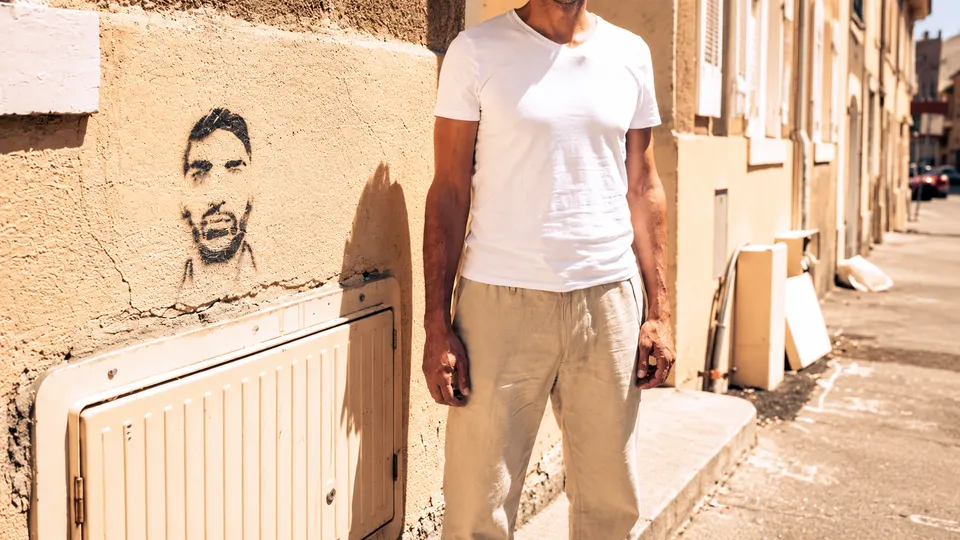
Belle de Mai is a working-class district of Marseille, behind the railway station. On 4 August 2021, at around six in the evening, police stopped a car at the corner of rue Bonnardel and rue Fortuné-Jourdan. The officers said they thought they recognised it as a car that had fled a check the day before. The driver was Souhail El Khalfaoui (the French press usually spells it Souheil). According to the police account, he reversed and struck an officer in the leg. A trainee officer drew his service weapon and fired one shot, which hit him in the chest. He died of the wound. French accounts give his age as 19. He worked as a waiter.
Five years later his father is still trying to get the facts established. Issam El Khalfaoui told Al Jazeera’s Sophie Stuber what the family learned after the shooting:
“When my son was killed during a police traffic stop, we realised how difficult it was to bring the truth to light. The police and the justice system took different actions to cover up the evidence. We realised that this was a deeply systemic issue.”
He says he is now speaking out against a bill that would tell French courts to start from the assumption that every police bullet was fired lawfully.
The file that disappeared
His list of what went wrong is short and exact. “The IGPN [National Police] lost the video that captured my son’s murder. The witnesses were not interviewed, and the case file completely disappeared from the court. That is the reality.”
The French record bears much of this out. In December 2021 the IGPN, the internal inspectorate of the national police, found the shot lawful under article L.435-1 of the Internal Security Code, and a few months later the prosecutor closed the case without charges. The family’s lawyer, Arié Alimi, then filed a complaint for obstructing the truth. He argued that footage from a surveillance camera at the exact spot of the stop had been lost because nobody ever placed it under seal, and that the inspectorate had finished its report on the officers’ account without waiting for the ballistics. The investigation was reopened.
Then, almost four years after the shooting, came the episode the father calls the disappearance of the file. France 3 reported that all the sealed evidence had vanished from the Marseille courthouse. Nine items were reportedly missing, among them the bullet that killed the young man, surveillance footage, recordings of emergency calls and the filmed interview of the officer who fired. In late June 2025 the court announced that the items had been found again, in the office of the investigating judge who first had the case.
So the evidence came back. Nobody could say where it had been.
The police side has its own account. According to Al Jazeera, Bruno Bartocetti, a regional representative of a police union, told BFMTV that the shooting was clearly self-defence and that the young driver had been looking for a fight. Several witnesses dispute the self-defence version.
The text that goes to the Senate
The bill began in January as a proposal from Éric Pauget, a deputy of the Droite républicaine, who wanted to give police and gendarmes a presumption of self-defence. A government amendment changed the wording. According to LCP, the Assembly’s own channel, the adopted text says that when national police officers and gendarmes use their weapons, they “are presumed to have acted” in one of the cases the law allows, under the conditions of absolute necessity and strict proportionality. One sentence was added as a safeguard: “This presumption may, at any time, be overturned by any contrary evidence.”
On 7 July 2026 the National Assembly passed it at first reading by 313 votes to 199. The government’s camp and the Rassemblement national’s alliance voted for it, and every left-wing group voted against. Interior Minister Laurent Nuñez wrote that day: “Let us stop the fantasies. This text does not organise any criminal irresponsibility for police officers and gendarmes.” In the chamber he said that “any prosecutor” could overturn the presumption if the conditions were not met. Manuel Bompard of La France Insoumise, who had earlier raised the Marseille case with the government, answered: “It will be too late to gather the elements needed to establish the truth.”

That exchange is the whole argument. The minister says a prosecutor can reverse the presumption with evidence. The father, speaking from experience, says the evidence is exactly what goes missing. In his case the camera footage was never sealed, the witnesses were never interviewed, and the seals were lost and then found in a judge’s office. According to Al Jazeera, he warns that the new text would make the presumption all but impossible to overturn.
Outside Parliament
Opponents call it a “licence to kill”, and franceinfo reported that the objections come from well beyond the left. Amnesty International France, the Ligue des droits de l’Homme and the Syndicat de la magistrature, a judges’ union, have opposed it. A petition on the Assembly’s own website had passed 300,000 signatures on the day of the vote. On 20 September, France 24 reported, thousands marched in Paris and other cities against it. All this comes while the country is already in the streets, with high schools blockaded for weeks and police out to clear them.
The text has gone to the Senate. Its fate will be decided there and, very likely, before the Constitutional Council.
States do not often write their trust in their own armed agents into law. When they do, the reasoning is usually that officers must not hesitate. The cost of that reasoning falls on families like the one in Belle de Mai, who learn how much a case depends on a sealed video, a canvass of the street, and a box of evidence that stays where it was put.