
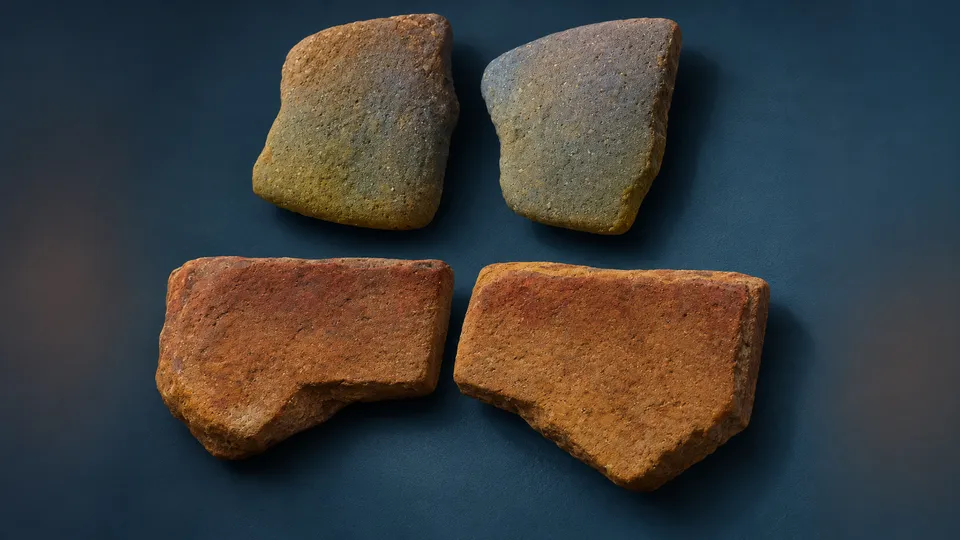
The fragment is about 1.3 centimetres tall — a little over half an inch, by the University of Missouri–St. Louis’s own description — and carries one syllable sign plus what look like number signs on each of its two faces. That is the entire legible content of the find that archaeologist Michael Cosmopoulos presented on November 12, 2026 at the National Archaeological Museum in Athens, in a lecture called “Rewriting the History of Mycenaean Messenia: Iklaina and the Creation of the Kingdom of Pylos.” The piece, dug up during the 2025 excavation season at the site of Iklaina in southwestern Greece and reported first by arkeonews.net, is written in Linear B, the syllabic script Mycenaean palace scribes used between roughly 1400 and 1200 BC to track grain, textiles, land grants and labour obligations — bookkeeping, not literature.
Clay tablets like this one were not meant to last. Mycenaean scribes used unfired clay for current-year accounts and recycled it once a transaction cycle closed; what survives in the archaeological record is almost always clay that happened to be baked hard by the fire that destroyed the building holding it. So a tablet is also, incidentally, evidence that a fire happened near it. That is the main reason this fragment is news at all: its size tells you almost nothing, but its presence, for a second time, in the same settlement tells you something about how that settlement was run.
Iklaina sits in Messenia, the region containing the Palace of Nestor, the best-known Mycenaean palatial site on the Greek mainland. Arkeonews put the distance between the two at about 14 kilometres; Iklaina’s standard reference entry on Wikipedia gives roughly 10 kilometres from the modern town of Pylos — the difference is probably just which point each measurement takes as the palace’s location, not a disputed fact, but it is worth flagging rather than picking one number and pretending it is more precise than it is.
The case for Iklaina as something more than a satellite village rests on what is in the ground, not just what is in the clay. Excavators have uncovered a monumental complex known as the Cyclopean Terrace Building — a terrace 23 by 8 metres, built from massive dressed stones in the construction technique later Greeks called Cyclopean, supporting a megaron-type structure of possibly two or three storeys arranged in three wings around a courtyard. More than 2,500 wall-painting fragments recovered in 2009 depict ships, rowers and dolphins, iconography associated elsewhere with Mycenaean elite self-presentation. There are paved streets, water channels, and an open-air sanctuary identified in the 2012 season. None of that is the output of a hamlet administered from fourteen kilometres away.
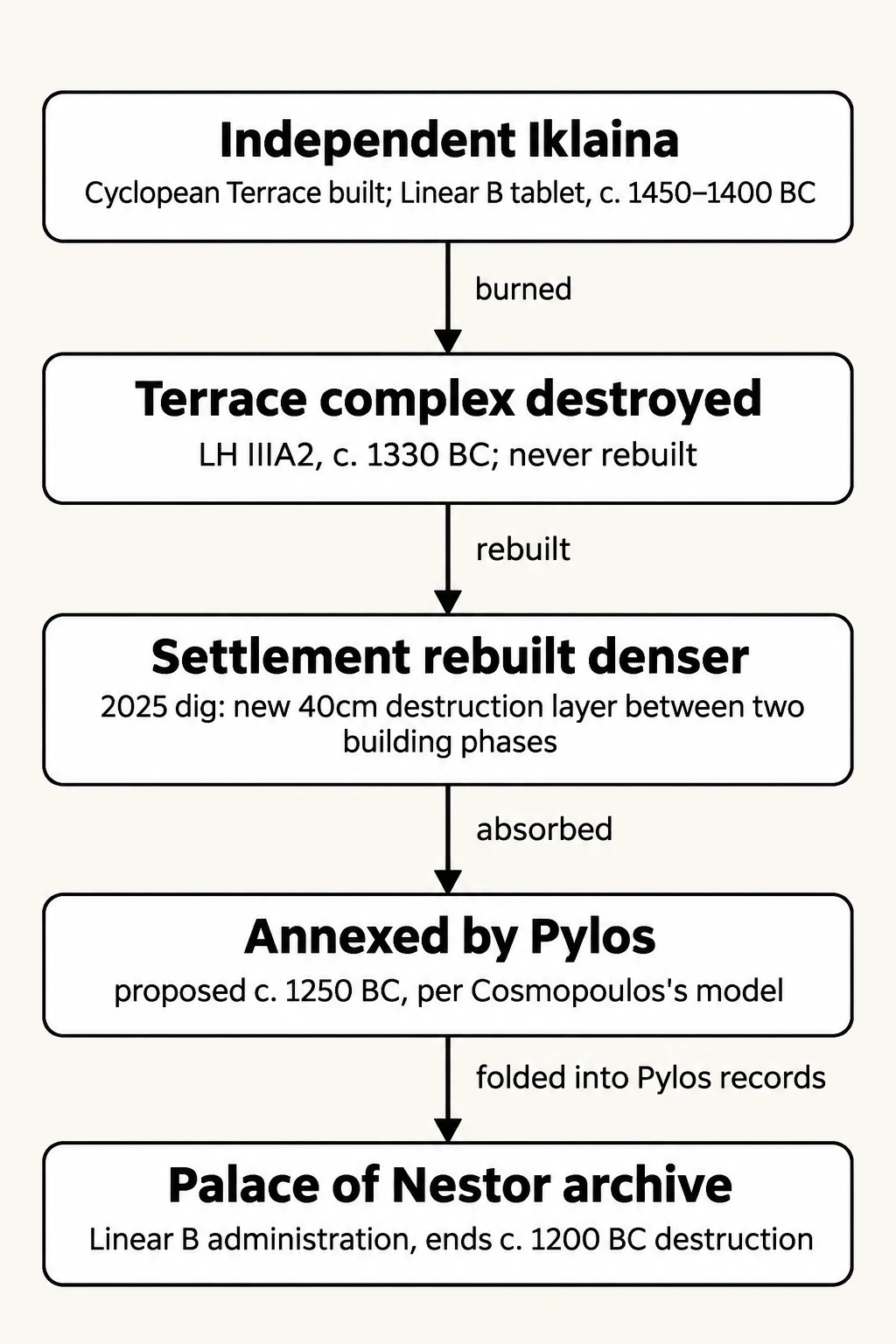
| From | To | How |
|---|---|---|
| Independent Iklaina (Cyclopean Terrace built; Linear B tablet, c. 1450–1400 BC) | Terrace complex destroyed (LH IIIA2, c. 1330 BC; never rebuilt) | burned |
| Terrace complex destroyed (LH IIIA2, c. 1330 BC; never rebuilt) | Settlement rebuilt denser (2025 dig: new 40cm destruction layer between two building phases) | rebuilt |
| Settlement rebuilt denser (2025 dig: new 40cm destruction layer between two building phases) | Annexed by Pylos (proposed c. 1250 BC, per Cosmopoulos's model) | absorbed |
| Annexed by Pylos (proposed c. 1250 BC, per Cosmopoulos's model) | Palace of Nestor archive (Linear B administration, ends c. 1200 BC destruction) | folded into Pylos records |
Based on University of Missouri–St. Louis / M. Cosmopoulos excavation reports
The dates are the part worth checking rather than quoting. The first Linear B tablet found at Iklaina, back in 2010, is assigned to the LH IIB–IIIA1 pottery phase, roughly 1450 to 1400 BC, making it, by the site’s own account, the earliest Mycenaean tablet yet found on the Greek mainland. The Cyclopean Terrace Building’s last construction phase dates to LH IIIA2, around 1330 BC, after which it was destroyed and not rebuilt. The great Linear B archive at the Palace of Nestor, by contrast, is a product of the kingdom’s final destruction, usually placed around 1200 BC. University of Missouri–St. Louis’s statement describes Iklaina’s writing as roughly 150 years older than the Pylos archive. Run the calendar brackets as given — 1450–1400 BC against 1200 BC — and the gap comes out closer to 200 to 250 years, depending which end of each range you pick. Both figures support the same underlying point; they are not the same number, and nobody has published the methodology that would let you choose between them.
A city destroyed, then rebuilt denser
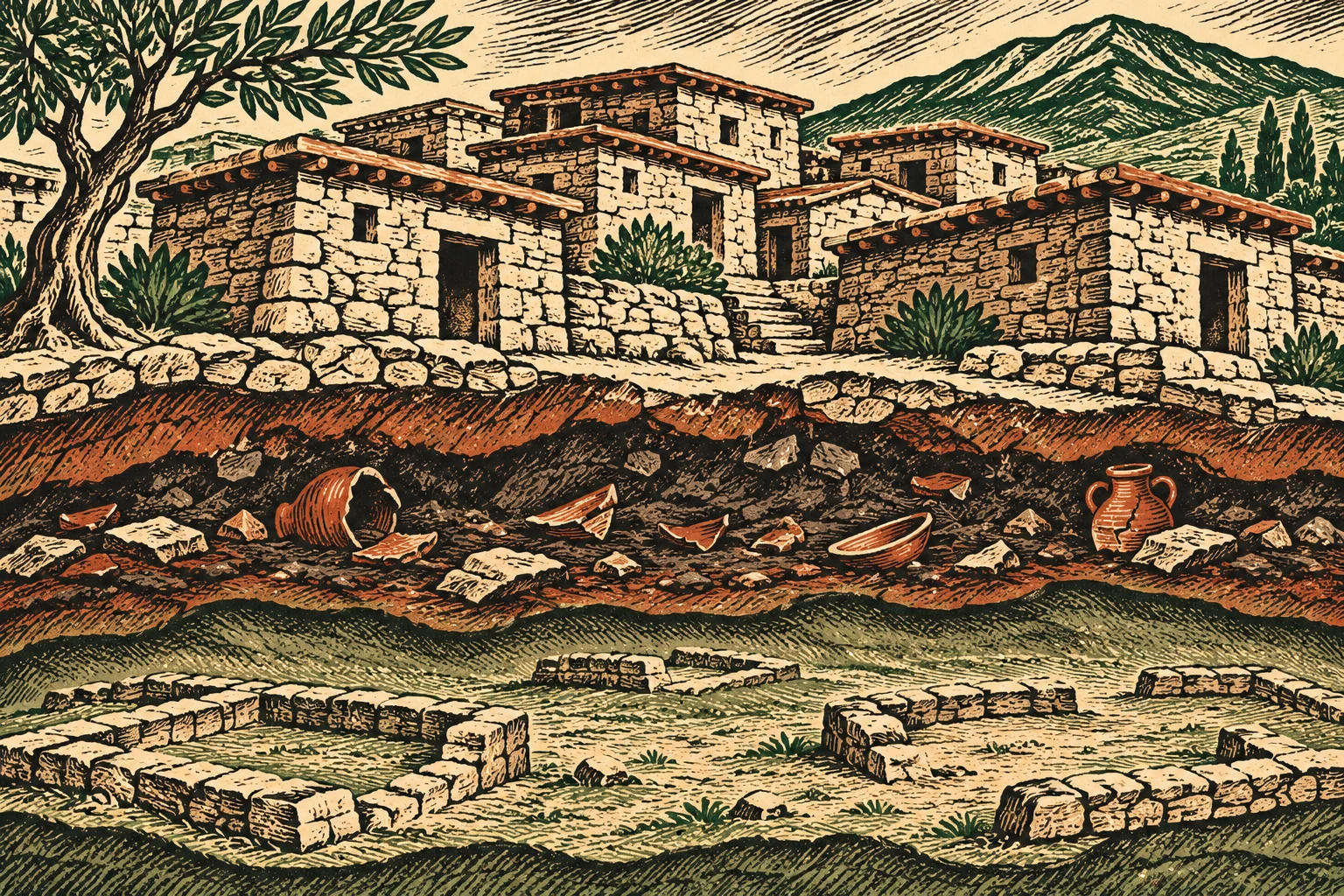
The 2025 season’s clearest new result has nothing to do with the tablet itself. South of a structure the team calls Megaron Gamma, excavators identified two distinct building phases separated by a destruction layer about 40 centimetres thick — burnt earth, broken pottery, charred construction material and animal bone. In the earlier phase, buildings stood relatively far apart; in the later one, the settlement packed in more densely. Cosmopoulos’s team thinks this destruction may coincide with the damage already documented at the Cyclopean Terrace complex, but the excavation record does not establish what caused it. A fire is not a battle. Nothing published so far demonstrates that Pylos, rather than an earthquake, an accident, or an unrelated raid, is what ended Iklaina’s independence.
Merger, not one founding palace
What the new fragment buys Cosmopoulos’s argument is not proof but repetition: a second administrative document, in a city with monumental architecture and its own apparent bureaucracy, that predates the Pylos archive by roughly a century and a half to two and a half centuries on the dating above. His model has Iklaina operating as an independent political centre through the 15th and 14th centuries BC, then absorbed into an expanding Kingdom of Pylos around the middle of the 13th century BC — roughly 1250 BC, a date derived from the architectural destruction sequence rather than from any text that names a conqueror. That reframes Pylos’s famous palatial bureaucracy, the one whose archive survived because the palace burned around 1200 BC, as the product of consolidation among several literate centres rather than a single state that was always dominant. It is a plausible model built from architecture and stratigraphy; it is still a model, and the tablet fragment itself contributes one syllable and some numerals, not a narrative.
Cosmopoulos has also floated, more speculatively, that Iklaina’s name survives in Homer’s catalogue of ships in the Iliad — a proposed identification with the Bronze Age toponym Aipy, a connection that rests on name correspondence across thirteen centuries. “What makes Iklaina especially fascinating,” according to UMSL’s account of the lecture, “is that its importance may have been remembered for centuries.” That is possible. It is also unfalsifiable at the level of a single toponym, since the Iliad was composed roughly 400 to 500 years after the Mycenaean collapse by a tradition with no obvious access to 13th-century BC administrative records.
The broader pattern this find feeds into has shown up elsewhere in the Bronze Age Aegean this year: a Mycenaean town in Greece was recently found to have been walled immediately after an earlier fire, the same destruction-then-rebuild sequence now documented south of Megaron Gamma at Iklaina. What would settle the Iklaina question is not more architecture but more text: a third tablet, or a cache large enough to name an official, a commodity, or a place — something that lets a philologist read an administrative act rather than infer one from a burn layer. Cosmopoulos’s excavation has run since the early 2000s and produced one legible tablet every fifteen years so far. The next one is the number to watch.