
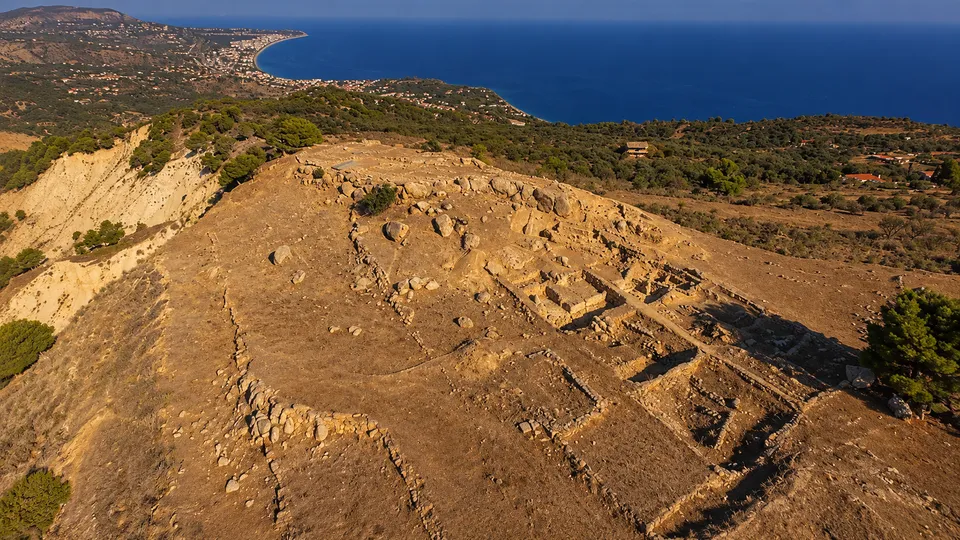
A Mycenaean town in southern Greece that burned around the middle of the 12th century BC was rebuilt almost at once and ringed with a massive wall, archaeologists say, Arkeonews reported on Monday.
The town, Aigeira, sits high above the Gulf of Corinth in Achaia, on the northern Peloponnese. According to the Austrian Archaeological Institute, which has excavated there for decades, it is so far the only site in the Peloponnese known to have been [newly fortified in that late phase](<https://www.oeaw.ac.at/en/oeai/research/prehistory-wana-archaeology/mediterranean-economies/the-mycenaean-settlement-on-the-acropolis-of-aigeira-in-achaia>) of the Bronze Age.
The fire was bigger than anyone first thought. Digs on the acropolis in the 1970s and 1980s, led by Wilhelm Alzinger, found a thick layer of burned debris that closed out an early phase of the settlement. Excavations from 2011 to 2016 then turned up a Bronze Age lower town on the plateau south and east of the hilltop, and the same burn layer ran through it. Together the two parts may have covered as much as 12,000 square meters, and archaeologists think much or possibly all of the town went up in a single fire.
Nobody left. According to the institute, a successor settlement was built directly on top of the ruins, the acropolis was enclosed by the new wall and at least parts of the lower town may have been fortified as well.
The institute reads the wall as a sign that the town’s social order survived the disaster. A project that size took planning, a large workforce and some authority able to organize it, and the decision to build it points to residents who now wanted more protection. It all happened in the unsettled years after the Mycenaean palace system collapsed.
Earlier digs give a picture of who lived behind the wall. Archaeologists found houses, storage areas and places where goods were made and used, along with pottery, terracotta figurines, bronze knives and spindle whorls. The fire layer itself preserved many vessels where they had stood, according to the institute. There’s evidence of pottery production and probably bronze working.
One phase had a large building with many rooms inside the fortification. Archaeologists also identified a cult room. Taken with the signs of storage, production and feasting, that suggests at least some residents held relatively high status.
The current work on the site’s transition from late Mycenaean settlement to Archaic sanctuary has been [led by Walter Gauss since 2011](<https://www.oeaw.ac.at/en/oeai/research/historical-archaeology/early-greece/aigeira-achaia-from-late-mycenaean-settlement-to-archaic-sanctuary>), with support from the Institute for Aegean Prehistory and the Mediterranean Archaeological Trust. Research in the lower town is now yielding information on how people used animals, ran their households and made a living.
The rebuilt town didn’t last. Its Mycenaean occupation ran through several phases and appears to have ended around 1100 BC, according to the Arkeonews account. The institute’s own summary puts the founding at around 1200 BC and says the settlement lasted more than 150 years, which would carry it somewhat past that date.
Archaeologists have found nothing from the Submycenaean, Protogeometric or Early Geometric periods, which raises the possibility that the hill stood empty in the early first millennium BC. Researchers have been cautious about treating the missing finds as proof of abandonment.
Austrian archaeologists have worked at Aigeira [since 1916](<https://www.oeaw.ac.at/en/oeai/institute/branches/athens/excavations-projects/aigeira>). Pottery on the acropolis increases sharply from the second half of the eighth century BC, when an early Greek sanctuary grew up there, and geophysical surveys suggest a settlement tied to it may have spread across the same plateau where the Bronze Age lower town once stood.