
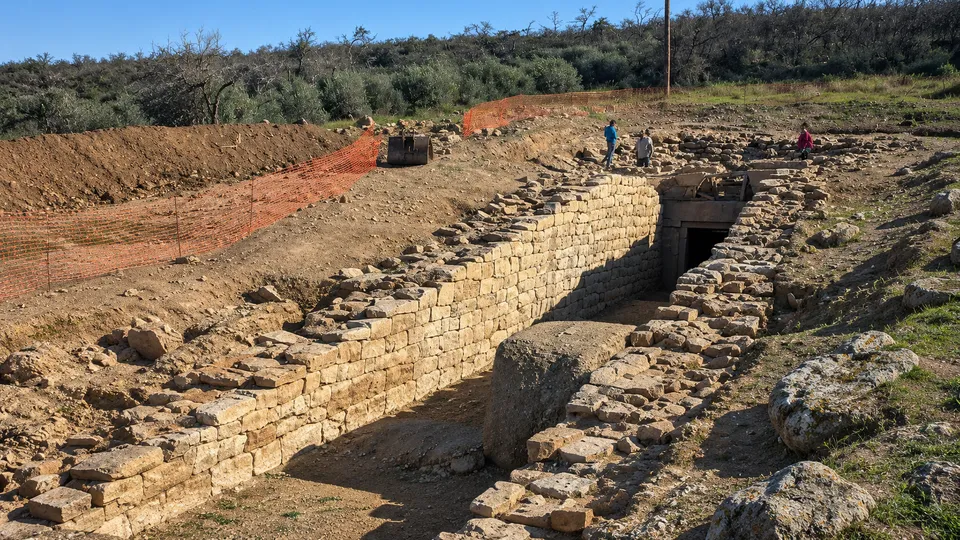
If you build roads in Greece, you are also excavating, whether you meant to or not. The latest example: crews working on the Chalkida–Psachna bypass on the island of Euboea have uncovered a Mycenaean tholos tomb more than 3,200 years old, near the town of Psachna. As Arkeonews reported, early assessments put it among the 20 largest Mycenaean tholos tombs known in Greece. That points to a burial built for a person, or a family, with a lot of wealth and influence.
Citing CNN Greece and the regional site e-sterea, Arkeonews says the tomb is the 126th Mycenaean tholos identified in Greece. Here’s some simple arithmetic. If it really is in the top 20 out of 126, it sits in roughly the top 16 percent of the most monumental tomb type the Mycenaeans built. This is not some farmer’s grave. The English edition of Proto Thema, also drawing on e-sterea, says the early evidence suggests the occupant had great social prestige and political power. It also says that who this person was remains unknown.
That last point matters, because the Greek press has been fairly free with the word “royal.” Some headlines, Lifo’s among them, call it a royal Mycenaean tomb. But CNN Greece’s own write-up is careful to say the label reflects an estimate based on size. It does not prove the tomb belonged to any particular king. Archaeologists haven’t identified the occupants or tied them to a ruling dynasty. They don’t yet know whether the tomb held one burial or several, or whether it was reused. Keep Talking Greece went further. It dated the tomb to around 1200 BC and floated the idea that it belonged to a leader of the Abantes, the people ancient tradition places on Euboea. That is a guess, and it should be read as one.
What you are buying with a tholos
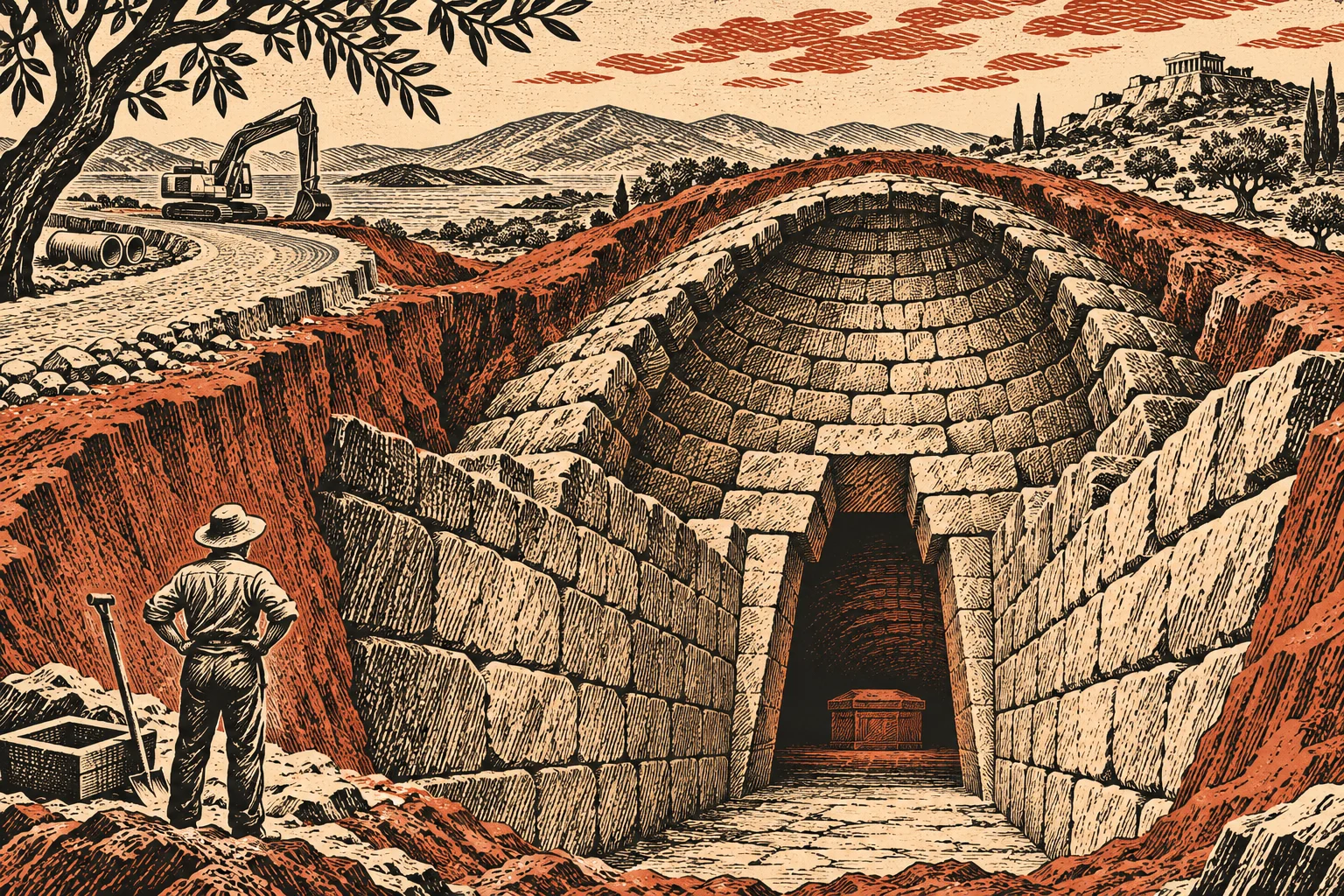
A word on why size is the headline. The Mycenaean world ran from about 1600 to 1100 BCE, with fortified centres, palaces and record-keeping bureaucracies that linked mainland Greece to the wider Mediterranean. Tombs were one of the ways elites showed off their status, and the tholos was the most expensive kind. It has three parts. There is a long entrance corridor called the dromos, a monumental doorway called the stomion, and a round, beehive-shaped chamber. The roof isn’t a true arch. Builders used corbelling, setting each ring of stones a little further inward than the one below until the walls met. The whole thing was then usually buried under earth and stone, so it became a mound in the landscape. The famous examples are the Treasury of Atreus and the Tomb of Clytemnestra at Mycenae.
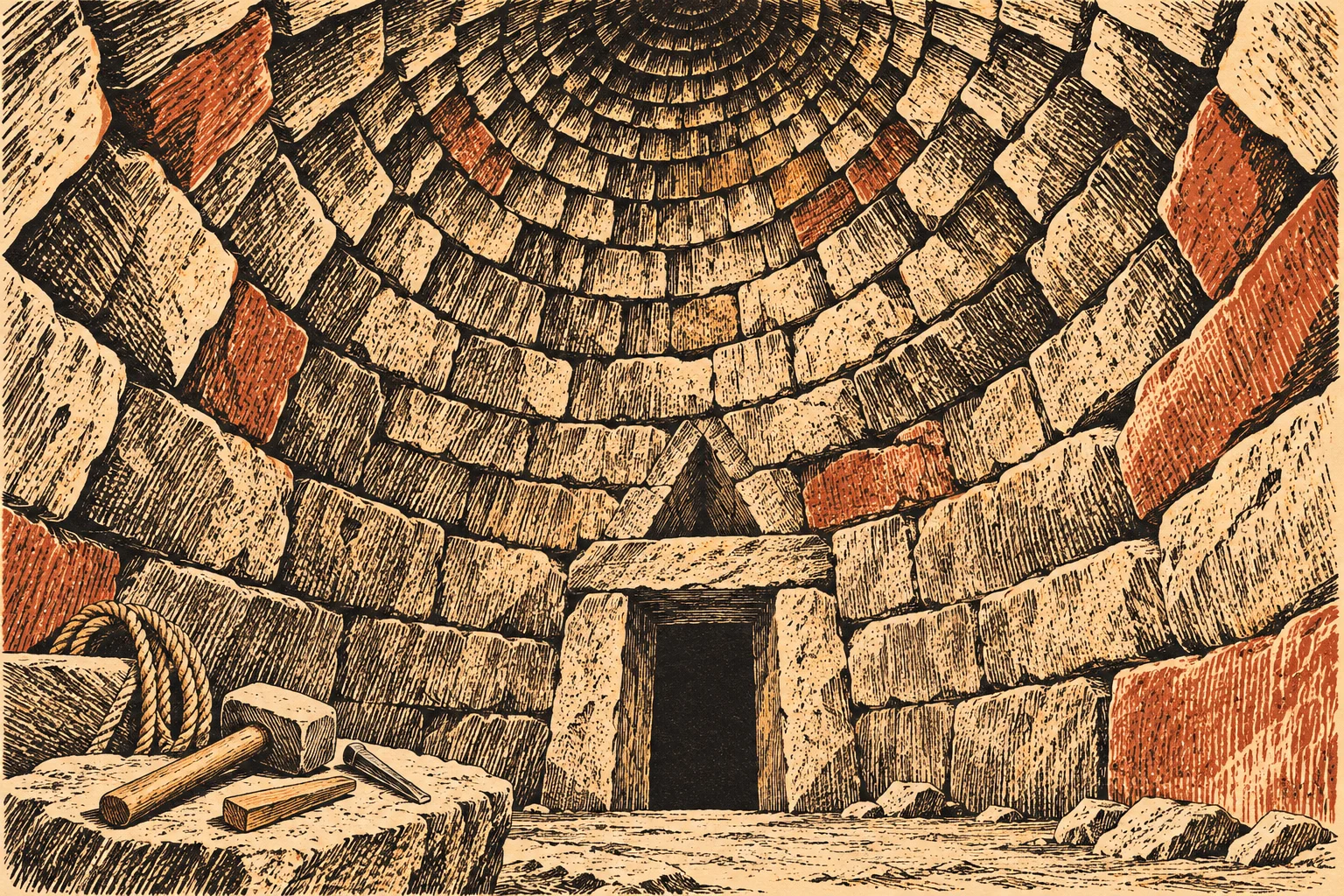
So one way to read a big tholos is as a receipt. Somebody in central Euboea could command skilled masons, a large workforce and a lot of stone, all to build a hole in a hill for the dead. The bigger the tomb, the bigger the claim on other people’s labour. That makes it evidence about who held power on the island, and how much. It also bears on a longer-running question: how much Euboea had its own centres of power, as opposed to just orbiting the big palaces on the mainland. Some tholoi held generation after generation of the same family, which turned the building into an argument about inherited authority. Whether this one did is still an open question. (Rews has written before about the argument that Mycenaean graves were composed as works of art. A tholos is the most expensive version of that idea.)
The location makes sense. Euboea is Greece’s second-largest island, sitting between the mainland, the Cyclades and the northern Aegean, which is a good place to be if you trade by sea. Excavations around Chalkida, Manika and the Psachna–Kastella area had already turned up evidence of prehistoric activity. This find adds a big, expensive piece to that record.
The road problem
Then there’s the modern problem, which is that the tomb sits in the path of a road. On November 23, Thanasis Zempilis, a member of parliament for Euboea, visited the excavation and raised the idea of building a bridge over the archaeological area. That way the tomb could stay where it is and the bypass could still be finished. There are also proposals to secure money for further excavation, restoration and eventually putting the monument on display. CNN Greece says that would come through a dedicated sub-project under the EU-backed 2021–2027 development programme known in Greece as ESPA. It also notes that final decisions rest with the archaeological services and the Central Archaeological Council.
I like the bridge, partly because it’s an honest solution to an incentive problem. A road contractor wants the road finished. The state, by law and by sentiment, wants the antiquities kept. Some outlets have been describing the plans as now favouring a bridge, but it remains a proposal, not an approved design. The bridge lets everyone get what they want, at the cost of a bridge. Who pays for that, and whether a Late Bronze Age mound can justify a redesigned bypass, is the kind of thing that will now be argued over in budgets rather than in burial chambers.
For now, the tomb’s exact dimensions, its contents and its condition haven’t been set out in any public report. We know it’s big, it’s old, it’s in the way, and it was built for somebody important. More than 3,200 years later, that somebody is apparently still able to get a highway rerouted.