
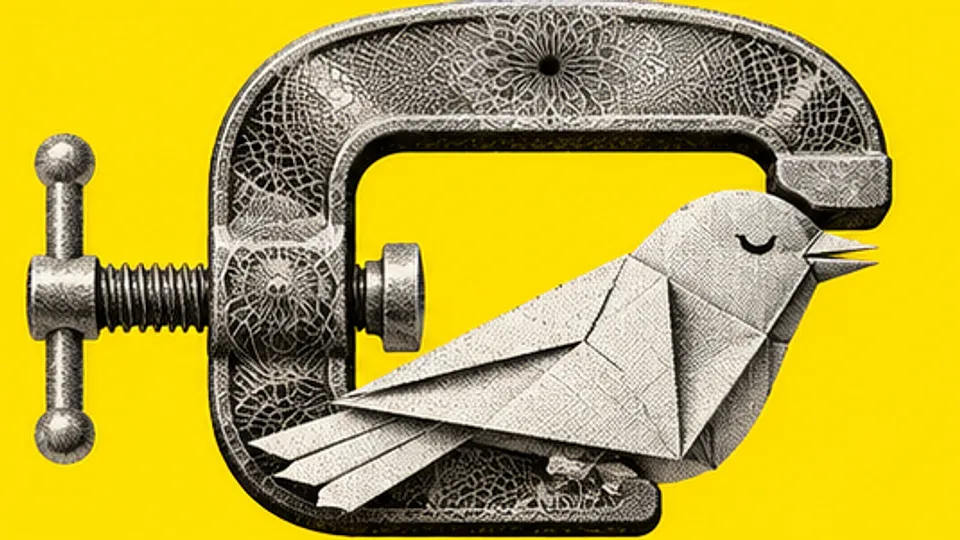
Exploit’s four issues shipped over sixteen weeks, from March 4 to June 24, 2026, then sat unbound for four more months before the collected edition landed October 27, 2026: 114 pages for $17.99 in print, $12.99 as a PDF, from the independent publisher Mad Cave Studios. That works out to just under 16 cents a page. The arithmetic is the least interesting number here. What the book is selling is a mechanism: how a sufficiently capitalized person ends a newsroom, and what’s left to fight back with once they have.
The premise, reviewed for 404 Media by Dave Maass, who by day teaches investigative-reporting technique at the University of Nevada, Reno’s Reynolds School of Journalism and researches surveillance at the Electronic Frontier Foundation, follows Kirby Kuo, an editorial intern at a print magazine called RIOT!, trying to land her first byline before her own newsroom gets bought out from under her. Her target is Cole Saxon, a tech-industrialist whom the publisher’s own synopsis describes as “really good at treason.” Saxon is assassinated on a livestream mid-investigation; Kirby takes the blame and goes on the run with an agoraphobic hacker named Lenox and a Cold War-era cybermercenary named Ipsum, while a second Datum Capital executive, Clark Kincaid, moves into Saxon’s chair and turns what was fear into policy. The finale, issue four, ends with a heist on Datum Tower staged live for a global audience, per a Mad Cave solicitation.
The writers, Laura Hudson and Tim Leong, both edited at WIRED (Hudson as senior editor, Leong as director of digital design) before that, and both have bylines or editorial stints that run through The Verge, Fortune, Entertainment Weekly, The New York Times, The Guardian and Slate. They first worked together in the 2000s running Comic Foundry, a magazine ComicsBeat credited with changing comics journalism. Leong also co-created the Super Graphic infographic books on Marvel and Star Wars; the art on Exploit is by Emiliana Pinna, with colors by Rebecca Good and letters by Frank Cvetkovic.
The two accounts of how the project started don’t match, which is itself a small lesson in reading a launch quote against a direct interview. Hudson told Maass the idea came together at a diner in Los Angeles in 2019, before the pandemic. Mad Cave’s own launch materials, quoting Leong, place the project’s start “back in 2020 at the beginning of the pandemic,” a year later than Hudson’s version. Neither account comes with a dated document to settle it; a comic’s origin story, like most origin stories, gets rounded to whichever year makes the better line in a press kit.
They’re the round, cakey-looking blocks in the game that start shaking when you step on them, and then fall down. So if you’re going to walk across them, you better run, or you’re gonna die. If you stop, you’re gonna die. So, you can’t stop. Ever.

That’s Hudson, in the 404 Media interview, describing the Super Mario Bros. 3 donut block as her model for what it feels like to work in journalism now, and it’s the clearest piece of mechanism in either interview: the job doesn’t get safer by standing still, it gets more dangerous. Her broader argument about the book’s billionaire antagonists is blunter and less testable: that tech leaders, in her words, “struggle to understand human beings socially even as they run social networks,” and that some “would be willing to accept the deaths of millions or even billions of people” for their own vision of progress. That’s a writer’s claim about motive, not a measured fact, and the book doesn’t name which real executive it’s describing; 404 Media’s own framing of the villain as “Alex Karp-flavored” is the reviewer’s gloss, not a quote from the creators.
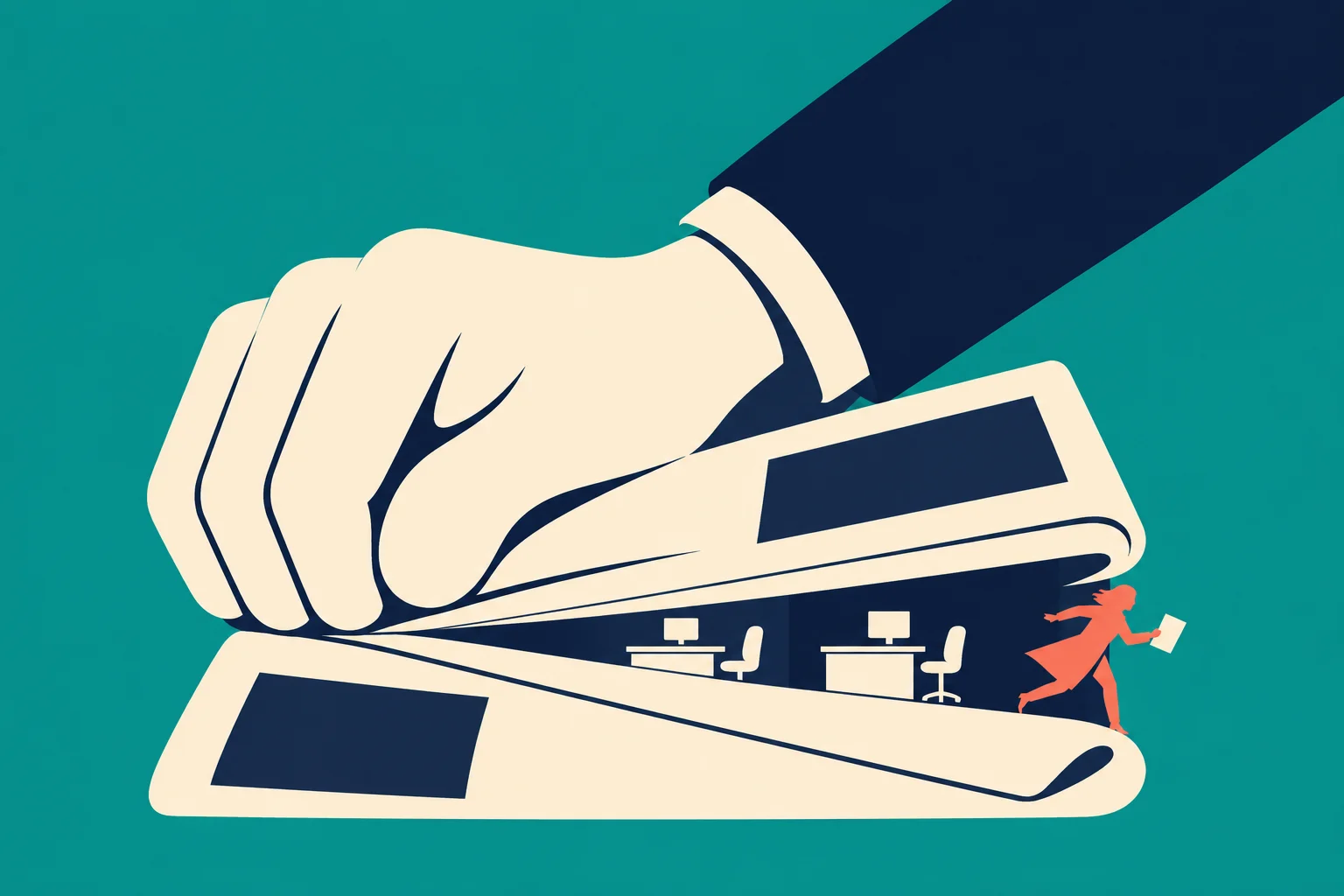
The two real cases the plot most resembles both have paper trails. Peter Thiel secretly paid roughly $10 million to fund Hulk Hogan’s invasion-of-privacy suit against Gawker, a fact Forbes first reported in May 2016; the case produced a $140 million jury verdict, a $31 million settlement and Gawker’s bankruptcy that August. Jeff Bezos didn’t need a lawsuit: he simply bought the Washington Post outright for $250 million in October 2013, a deal the paper reported on itself. Different mechanisms, same result available to anyone with nine or ten figures of spare capital: sue a newsroom to death, or buy it and decide what’s left to publish.

Exploit’s cybermercenary subplot has a less storied but more current real-world match. Earlier reporting has covered an Israeli ad-tech firm whose ads carried spyware onto Al Jazeera’s staff without a click being required, the kind of infrastructure-level surveillance a fictional “Ipsum” would recognize as standard kit rather than exotic tradecraft.
The comic’s tagline describes a world “ruled by algorithms and billionaires,” and two unrelated items from this year make that less of a metaphor than it sounds. The New York Times is suing the Brave browser, arguing in court filings that it strips and redistributes its journalism without payment, and a chatbot was recently documented treating a news outlet as if it were Meta’s Instagram appeals department, misrouting readers’ real complaints into a corporate department that doesn’t exist for them. Neither story involves a billionaire ordering a hit; both are examples of the ordinary, unglamorous ways an algorithm or a platform owner can decide what a newsroom’s work is worth, or who it even is.
On sales, there’s a gap between what’s claimed and what’s measured. Mad Cave’s own launch post says issue one was “selling out fast at comic shops,” with no unit attached: no print run, no copy count, no percentage of initial orders. The reviews quoted on that same page come from Comicon, AiPT Comics, Graphic Policy and Nerd Initiative, all genre-trade outlets; mainstream coverage of the series didn’t arrive until the collected edition prompted 404 Media’s piece eight months after issue one shipped.
Mad Cave hasn’t announced a second volume, and no comics-industry sales tracker’s numbers for Exploit have surfaced publicly. The finale ends with the Datum Tower heist watched by a fictional global audience; the real audience size, in copies sold, is the number nobody involved has published yet.