
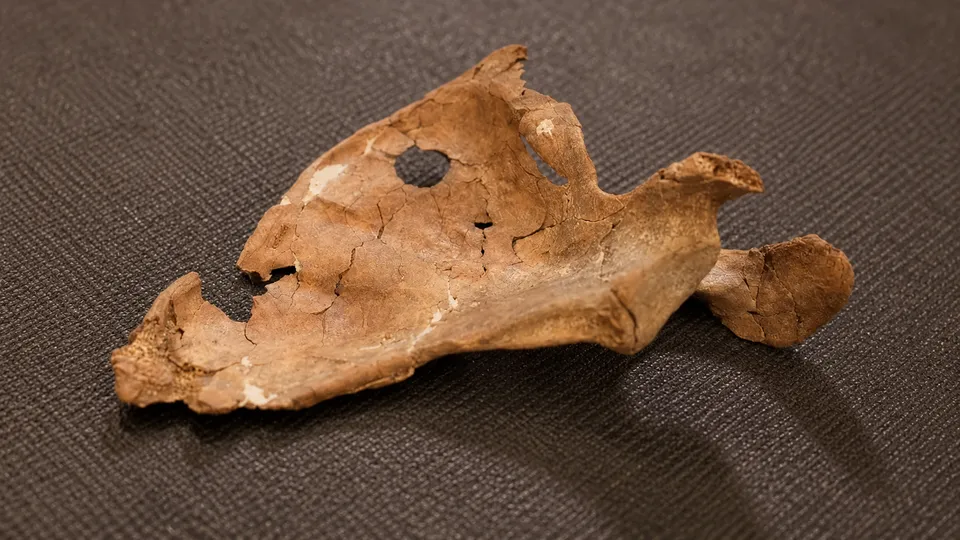
About 75,000 years ago, in a cave in what is now Iraqi Kurdistan, a Neanderthal adult of around 45 was run through with a sharpened wooden spear. The point went into the front of the chest at a downward angle, passed through a lung and probably some major arteries, and came out through the left shoulder blade. It left a round hole about 15 millimetres across. Death was probably quick. Afterwards someone laid the body on its back, head facing east, in a small space behind a large upright boulder, and four more Neanderthals were eventually placed in the same spot.
That is the account in a paper published on Oct. 15 in Scientific Reports by a team led by Emma Pomeroy of the University of Cambridge. Becky Ferreira covered it for 404 Media under a headline asking whether this might be the earliest known spear murder on Earth. The individual is called Shanidar A, and its sex is unknown. It was excavated in 2020 from beneath about 7.5 metres of rock and sediment, according to Cambridge’s press release. What survives is a nearly intact left scapula, most of a right hand, two left ribs, part of a right rib and seven teeth.
“Murder” carries a lot of weight in that headline, and the researchers are careful with it. The question they face will be familiar to any prosecutor. There is a body and a cause of death, and what’s missing is intent. There is also no weapon, which is the other interesting part.
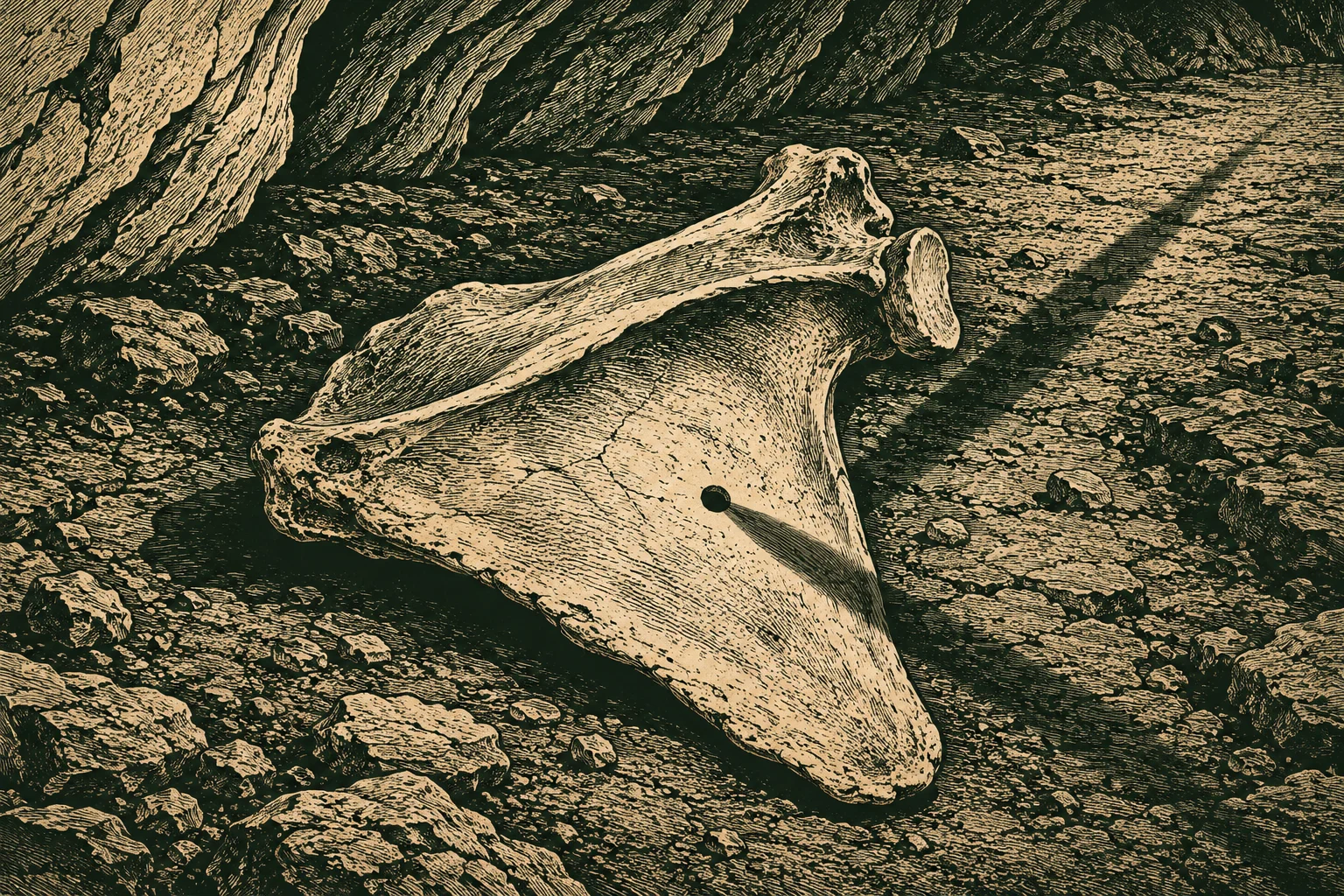
The missing spear
Wood rots. That is the basic difficulty of Stone Age archaeology: most of what survives is stone, so stone gets most of the attention, and the organic tools people probably used every day are mostly gone. Occasionally wood survives only as the shape of where it used to be. Here the case for a wooden spear rests on the shape of the hole. According to the release, flint or stone points tend to leave flat or angular holes. A circular hole fits a sharpened wooden shaft with a rounded cross-section. Bevelling around the edge marks it as an exit wound, so the spear went all the way through. “That early technology absolutely works for this wound,” Pomeroy said.
The team also ruled out the other things that make holes in old bones: roots, burrowing animals, and damage from old or recent digging. The hole was already there when the bone came out of the ground. The paper calls the result indirect evidence for wooden tools in the Middle Palaeolithic. That is about the strongest kind of evidence available when the tool itself has decomposed.
Wooden spears themselves are not new. The release notes a spear tip from Clacton-on-Sea in England, recovered in 1911, that is more than 400,000 years old, and spears from Schöningen in Germany, found in the 1990s, that date to about 200,000 years ago. Do the subtraction and hominins had pointed sticks for at least 325,000 years before this one was used. What’s new is the target. The researchers say this may be the earliest known case of a hominin killed with a wooden spear, and the first evidence of such spears in the prehistoric Middle East.
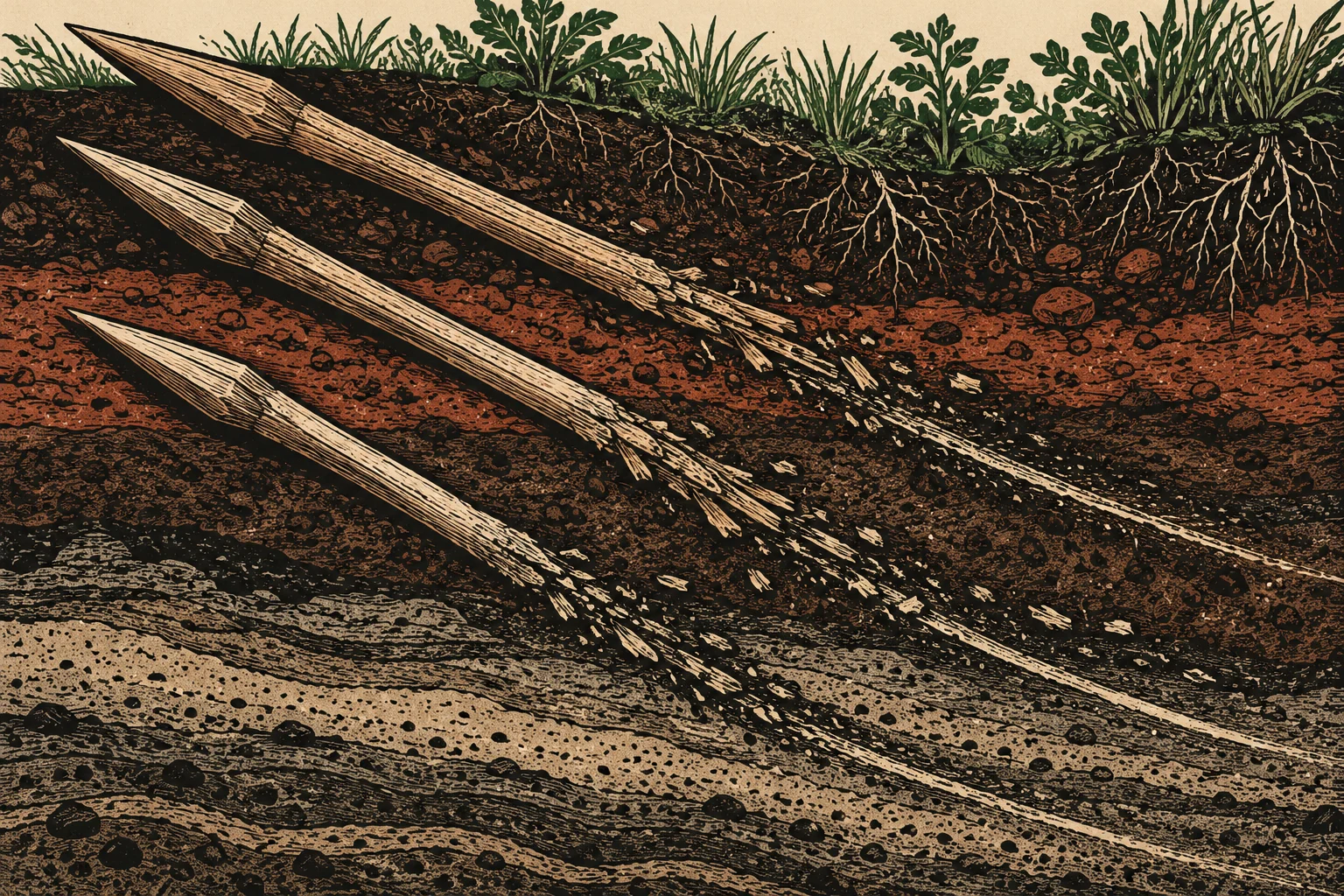
Accident or intent
The paper itself says it cannot be known whether the wound came from a hunting accident or from one person attacking another. If it was an attack, the attacker could have been another Neanderthal or a member of our own species. The press release is more confident. In it, Pomeroy says the position of the wound and the force needed to drive the spear right through the body “bear the hallmarks of an intended kill shot directed towards the heart.” Graeme Barker, who leads the excavations, says the death “was violent, and came at the end of a wooden spear,” and that “evidence of systematic violence is extremely rare in deep prehistory.”
I don’t think this is a contradiction. It is the normal gap between a paper written for referees and a release written for everyone else. The paper establishes what the bone can show, and the release says what the scientists believe. Shanidar A also has some company. The paper notes that a lesion on the ninth rib of Shanidar 3, a Neanderthal found in the same cave decades ago, is thought to have been made by a stone-tipped projectile. Not everyone is persuaded yet: an independent expert who spoke to ABC News found the work interesting but said more research is needed to support its conclusions.
The year before, and after
Shanidar A had been hurt badly once before. A heavy blow to the face split a lower front tooth lengthwise and pushed the neighbouring teeth inward. Tartar later built up on the exposed root, which shows this person lived for at least a year after the injury. Pomeroy said surviving it “would have required care and support from other Neanderthals.” So the sequence is a serious facial injury, a year or more of being looked after, a spear through the chest, and then a careful burial.
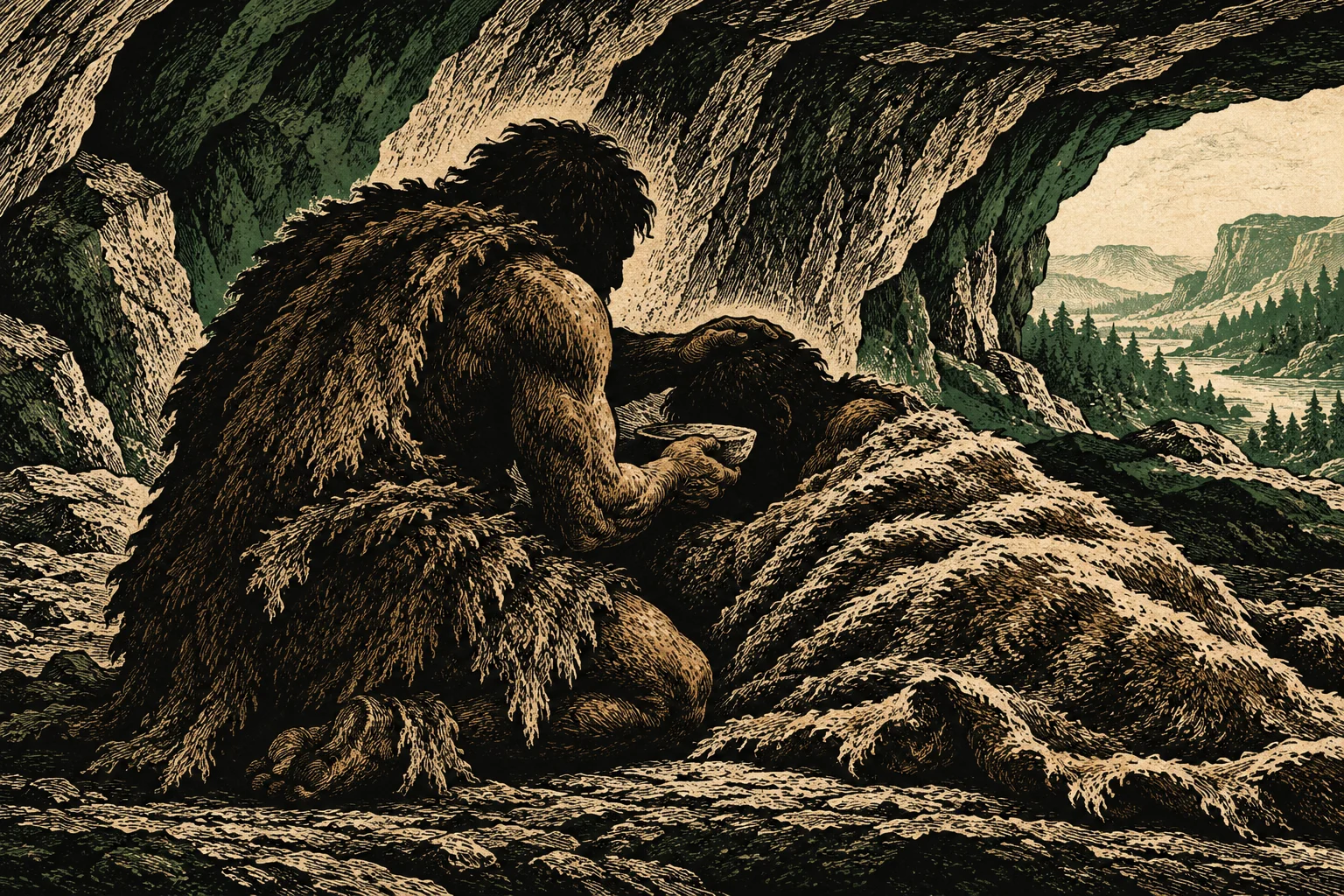
The burial is the other half of the paper. Five individuals, four adults and an infant, lay in a space roughly 1.5 metres by 1 metre by 1 metre, which comes to about a cubic metre and a half. Shanidar A was the deepest and possibly the first one placed there. The researchers wrote that the placement of the body in what became “a tight cluster of Neanderthal individuals, who were likely intentionally deposited within living memory of each other, strongly suggests a level of care during and immediately after death.” Pomeroy put it more simply: “The best explanation is intentional and symbolic funerary behaviour.”
None of this happened in isolation. Ralph Solecki’s excavations at Shanidar in the 1950s found ten individuals, and the current Cambridge-led dig began in 2015. Neanderthals used the cave for at least 50,000 years before they disappeared. The old idea of them as brutish strangers has been worn down for decades, and the evidence for care keeps building up. “It is fascinating to have evidence for both compassion and violence amongst Neanderthals,” Barker said. That combination also describes most human communities that have ever existed.
The spear has rotted away, and the motive was never going to survive. The most lasting record of the year this person spent being looked after is plaque on a broken tooth.